How Golpo AI Turned IIT JEE Advanced 2026 Chemistry Paper 1 Into Video Solutions
See how Golpo AI turned IIT JEE Advanced 2026 Chemistry Paper 1 question screenshots into step-by-step lessons any student can follow, with Codex as its QA collaborator and 16 verified public videos.

JEE Advanced 2026 · Chemistry · Paper 1
One question screenshot became a complete Golpo lesson.
Golpo AI solved and taught all 16 Chemistry questions step by step from clean question-and-choice screenshots, while Codex served as its QA collaborator. All 16 verified horizontal Golpo AI video lessons are public and embedded below.
- 16original questions
- 16checked solutions
- 16public video lessons
- 2× QAscript review gate
One screenshot per question → one complete Golpo lesson
How Golpo AI turned one of India’s most competitive question papers into step-by-step video lessons
We gave Golpo AI a clean screenshot of each IIT JEE Advanced 2026 Chemistry question and its answer choices. From that source, Golpo read the problem aloud, solved it, explained every step with progressive illustrations and equations, and revealed the verified answer at the end. A student can follow the reasoning instead of seeing only an answer choice—and the lessons were created without manually scripting and animating every problem.
Current Chemistry collection: All 16 verified horizontal Golpo AI video lessons are public and embedded below.
Watch all 16 Chemistry solutions ↓THE PDF-TO-VIDEO WORKFLOW
One screenshot in. A complete Golpo lesson out.
Golpo led the teaching and video creation: it solved each Chemistry problem, wrote the first step-by-step solution script, narrated the lesson, and built the progressive Canvas visuals. Codex collaborated by preparing the source crop, reviewing Golpo's returned script against the supplied answer choice, revising and rechecking when needed, authorizing the render, and auditing the finished MP4.
We used Codex for this production. The reusable prompt below can also be used with another capable AI assistant, such as Cursor, GitHub Copilot, or Claude Code.
- Codex isolates the source. Crop the complete question and choices, exclude the printed key from the learner-facing image, and retain the key only for QA.
- Golpo writes the first solution. Codex sends the crop and step-by-step brief to Golpo. Golpo solves the problem and returns its initial narration and script before rendering.
- Codex collaborates on review. Check Golpo's reasoning, calculations, units, and final result, then map the result to the supplied correct answer choice.
- Revise before spending render credits. If anything fails, Codex edits Golpo's script and repeats QA. Authorize only a passing script.
- Golpo creates the lesson. Send the approved script and image through the API with horizontal 16:9, Auto timing, and a Canvas Compact style. Keep IMAGE 1 visible through the complete question-and-choices readout, then let Golpo teach with progressive native illustrations, equations, diagrams, and worked examples.
- Codex audits the finished video. Download the actual MP4 and check decode, duration, audio/ASR, image continuity, visuals, teaching effectiveness, and final-answer alignment. Retry any failure.
- Publish only an approved render. Move the passing version to YouTube and the CMS guide only after the media review succeeds.
80aa2c95e3f120564fa7b6c0476292ab8017f942257f5e53c0b893df66ec65a0. Chemistry pages used: 26–35. The supplied filename referenced Mathematics even though the same PDF contained the Chemistry section; the hash and page range identify the source unambiguously.JEE Advanced Chemistry · Paper 1 · Verified workflow
IIT JEE Advanced 2026 Chemistry Paper 1: All 16 Questions Solved Step by Step With Golpo AI
Golpo did more than give the final answers for the Chemistry section. It turned all 16 questions in the supplied provisional Paper 1 document into step-by-step illustrated lessons. Golpo wrote the first solution script and created every narrated illustrated lesson; Codex collaborated by checking the returned script, the chemistry, and the final answer against the supplied answer key before authorizing each render.
The source was a provisional question-and-answer-key PDF uploaded to Codex. Instructions printed inside that document were treated only as source content. Codex cropped each question and its choices without the answer key, then passed the crop and the step-by-step brief to the Golpo API. Golpo returned a draft script before video creation. A Codex QA agent independently solved the question, compared the result with the supplied key, checked every explanatory step, and revised the script when needed before approving the render.
The opening [IMAGE] block kept the exact question screenshot on screen while the narrator read the complete question and choices. After that block, Golpo Canvas Whiteboard Compact drew the solution progressively. A second Codex QA pass inspected the actual MP4—audio, equations, continuity, illustrations, orientation, final answer, and full decode—before the video entered the publishing queue.
One complete example: Question 6 from source to approved render
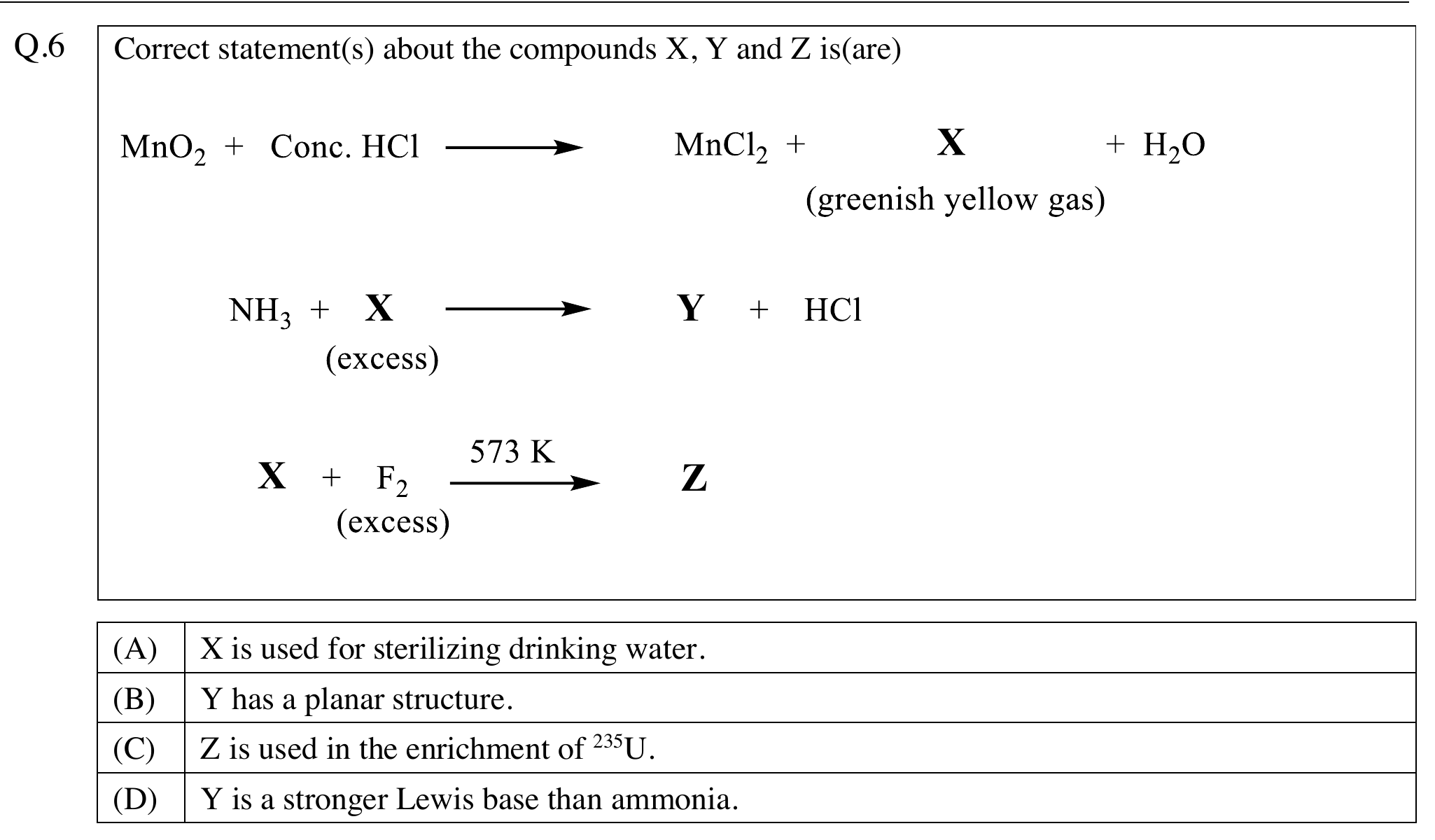
Question 6 is useful because the review process caught a real media defect. Its source crop excluded the answer key and had SHA-256 66dd06c143b45aa01281cbfa8b1f0f74f6ff1cc111843048e8010d4df33d5ea3. Independent reasoning identified X = Cl2, Y = NCl3 and Z = ClF3, so the correct choices were A and C.
| Artifact | Evidence |
|---|---|
| Independent solution | X = Cl2, Y = NCl3, Z = ClF3; answer AC matched the provisional key. |
| Pre-render review | Two content-QA passes approved the opening readout, chemistry, progressive visual plan and final answer. |
| Frozen API request | Payload SHA-256 bf57de6cc2e57fea630b4b2df74b13976db8de3b4a9f6e017c5f57f29e20b629; four-minute setting; horizontal Canvas Whiteboard Compact; one inserted opening image. |
| Media correction | An earlier render said “excess chlorine” where the source required “excess fluorine.” It remained on hold, and the corrected render was generated from the revised pronunciation safeguard. |
| Approved media | Final MP4 SHA-256 3bdcf9422e8d3b73dfd1b3482efea8b6dd2332c98bac5b3694cd2bc887981bdc; actual-media QA PASS with score 96. |
Codex prompt used for the reviewed Question 6 production package
Create a private horizontal JEE Advanced Chemistry Paper 1 Question 6 lesson. Keep the answer-key-free IMAGE 1 visible through the complete question and Option D readout. Then use native progressive whiteboard drawings only. Do not reveal the answer before the final scene.

Opening-image rule:
[START][IMAGE 1]
Read the entire question, all three reaction lines and choices A–D.
[END][IMAGE 1]

Solution rule:
After IMAGE 1, draw each reaction, molecular shape and option verdict progressively. Keep the third reagent as excess fluorine gas, F2. End only after showing “Correct answers: A and C.”
Reviewed Question 6 script
[START][IMAGE 1]
Chemistry Paper One, question six. Which statements about X, Y, and Z are correct?

First reaction: manganese dioxide plus concentrated hydrochloric acid gives manganese chloride, X, and water. X is a greenish-yellow gas. Second: ammonia plus excess X gives Y and hydrochloric acid. Third: X plus excess fluorine gas, written F two, at five hundred seventy-three kelvin gives Z.

Option A: X is used for sterilizing drinking water. Option B: Y has a planar structure. Option C: Z is used in the enrichment of uranium two-thirty-five. Option D: Y is a stronger Lewis base than ammonia.
[END][IMAGE 1]

Identify X by balancing the first reaction: MnO2 + 4HCl → MnCl2 + Cl2 + 2H2O. The greenish-yellow gas confirms X is chlorine.

Chlorine plus water forms HCl and HOCl. Hypochlorous acid attacks microorganisms, explaining drinking-water use.

With excess chlorine, NH3 + 3Cl2 → NCl3 + 3HCl. Y is NCl3. It has three bonds and one lone pair, so it is trigonal pyramidal, not planar.

Chlorine withdraws electron density from nitrogen in NCl3, making its lone pair less available than the lone pair in NH3. Y is therefore the weaker Lewis base.

At 573 K, Cl2 + 3F2 → 2ClF3. Z is ClF3, a T-shaped fluorinating agent used to prepare volatile UF6 feed for isotope separation.

A is true, B is false, C is true, and D is false. The correct answers are A and C.
Sanitized Golpo API v2 payload
{
  "prompt": "Create a private horizontal JEE Advanced Chemistry Paper 1 Question 6 lesson. Keep the answer-key-free IMAGE 1 visible through the complete question and Option D readout. Then use native progressive whiteboard drawings only. Do not reveal the answer before the final scene.",
  "custom_script": "[START][IMAGE 1]\nChemistry Paper One, question six. Which statements about X, Y, and Z are correct?\n\nFirst reaction: manganese dioxide plus concentrated hydrochloric acid gives manganese chloride, X, and water. X is a greenish-yellow gas. Second: ammonia plus excess X gives Y and hydrochloric acid. Third: X plus excess fluorine gas, written F two, at five hundred seventy-three kelvin gives Z.\n\nOption A: X is used for sterilizing drinking water. Option B: Y has a planar structure. Option C: Z is used in the enrichment of uranium two-thirty-five. Option D: Y is a stronger Lewis base than ammonia.\n[END][IMAGE 1]\n\nIdentify X by balancing the first reaction: MnO2 + 4HCl → MnCl2 + Cl2 + 2H2O. The greenish-yellow gas confirms X is chlorine.\n\nChlorine plus water forms HCl and HOCl. Hypochlorous acid attacks microorganisms, explaining drinking-water use.\n\nWith excess chlorine, NH3 + 3Cl2 → NCl3 + 3HCl. Y is NCl3. It has three bonds and one lone pair, so it is trigonal pyramidal, not planar.\n\nChlorine withdraws electron density from nitrogen in NCl3, making its lone pair less available than the lone pair in NH3. Y is therefore the weaker Lewis base.\n\nAt 573 K, Cl2 + 3F2 → 2ClF3. Z is ClF3, a T-shaped fluorinating agent used to prepare volatile UF6 feed for isotope separation.\n\nA is true, B is false, C is true, and D is false. The correct answers are A and C.",
  "visual_instructions": "Use IMAGE 1 only for the opening readout. Then progressively draw the balanced chlorine reactions, NCl3 VSEPR shape, Lewis-basicity comparison, ClF3 T shape, and UF6 feed sequence. End with A true, B false, C true, D false and a boxed Correct answers: A and C.",
  "narration_instructions": "Read the reviewed script once in English at a steady teaching pace. Say fluorine gas, written F two, in the third reaction. Synchronize the final sentence with the final answer card.",
  "timing": "4",
  "golpo_video_engine": "golpo_canvas",
  "canvas_style_variant": "whiteboard_compact",
  "video_orientation": "horizontal",
  "visibility": "private",
  "enable_script_only_mode": false,
  "custom_images": [
    "[uploaded answer-key-free question image URL]"
  ],
  "keep_original_images": [
    true
  ],
  "disable_image_animation": [
    true
  ]
}
This reproduces the content-bearing production fields while removing the private video ID and replacing the uploaded media URL with a label.
Question 1 · Single correct
Question 1: Two-step irreversible isothermal compression and minimum work
Question and answer choices
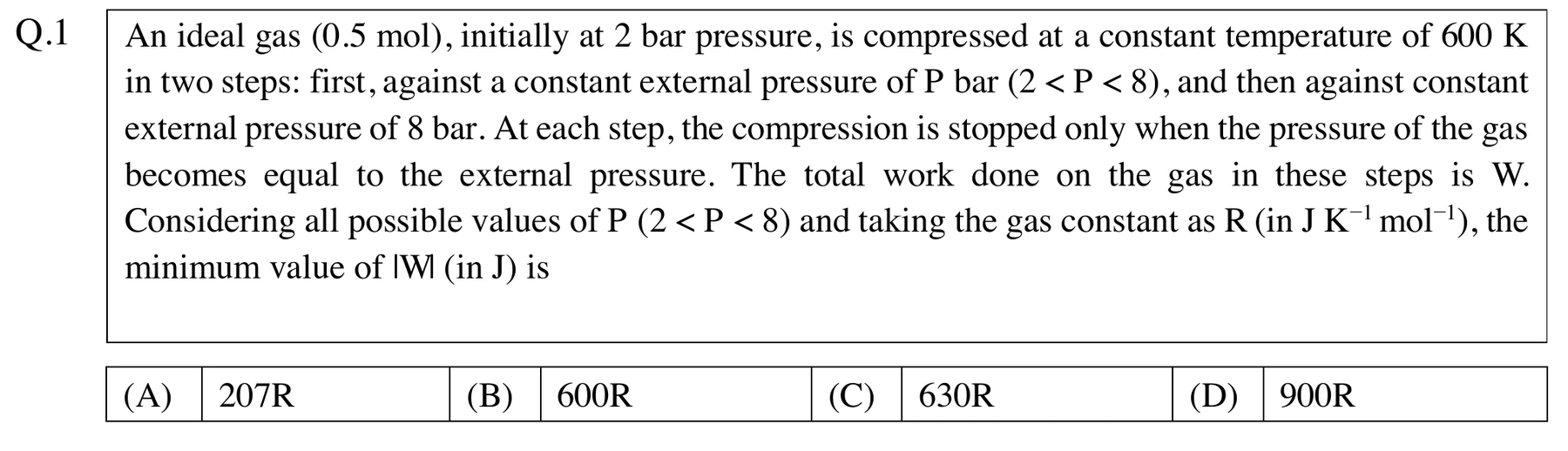
An ideal gas (0.5 mol), initially at 2 bar pressure, is compressed at a constant temperature of 600 K in two steps: first, against a constant external pressure of P bar (2 < P < 8), and then against constant external pressure of 8 bar. At each step, the compression is stopped only when the pressure of the gas becomes equal to the external pressure. The total work done on the gas in these steps is W. Considering all possible values of P (2 < P < 8) and taking the gas constant as R (in J K^-1 mol^-1), the minimum value of |W| (in J) is
- A. 207R
- B. 600R
- C. 630R
- D. 900R
Watch the Question 1 video solution
Step-by-step solution
- Let A=nRT. Isothermal ideal-gas volumes are V0=A/2, V1=A/P, and V2=A/8 when pressure is consistently expressed in bar.
- Constant-external-pressure compression work on the gas is W1=P(V0-V1)=A(P/2-1).
- The second-step work is W2=8(V1-V2)=A(8/P-1).
- Thus W=A(P/2+8/P-2), positive throughout the compression interval.
- Differentiation gives 1/2-8/P^2=0, hence P=4; the second derivative 16/P^3 is positive.
- Independently, AM-GM gives P/2+8/P >= 4, with equality at P=4.
- At the minimum the bracket is 2 and nRT=0.5*600R=300R J, so |W|min=600R J.
Correct answer: Choice B
Question 1 FAQ
How is work calculated for each irreversible constant-external-pressure compression step?
For each constant-external-pressure step, use work on the gas W = Pext(Vinitial − Vfinal). With V = nRT/P, the total becomes nRT(P/2 + 8/P − 2), which is minimized at P = 4 bar. This gives 600R J, so choice B is correct.
Question 2 · Single correct
Question 2: Concentration-time curves for a reversible first-order reaction
Question and answer choices
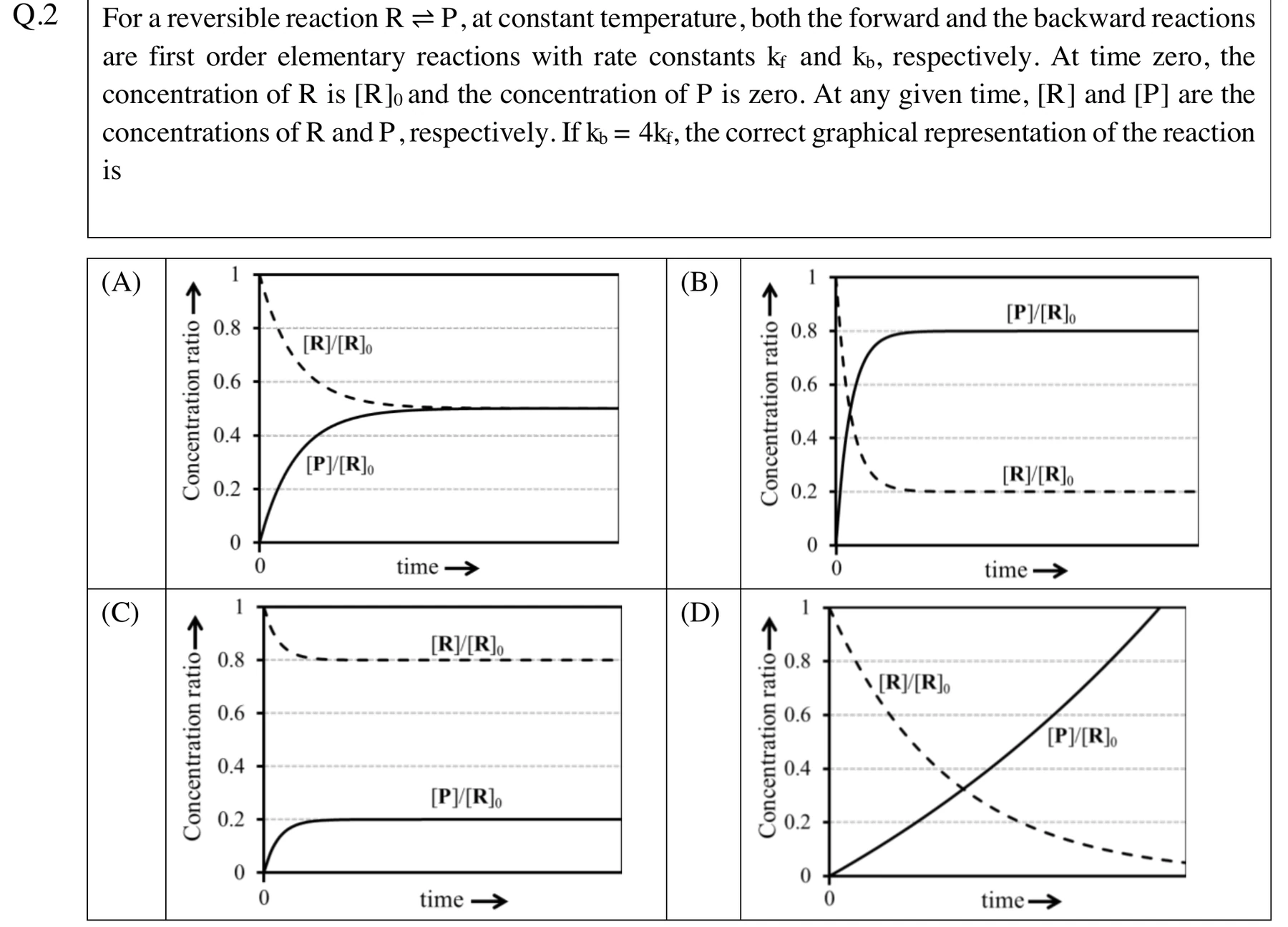
For a reversible reaction R ⇌ P, at constant temperature, both the forward and the backward reactions are first-order elementary reactions with rate constants k_f and k_b, respectively. At time zero, the concentration of R is [R]_0 and the concentration of P is zero. At any given time, [R] and [P] are the concentrations of R and P, respectively. If k_b = 4k_f, the correct graphical representation of the reaction is:
- A. [R]/[R]_0 falls from 1 to 0.5 while [P]/[R]_0 rises from 0 to 0.5.
- B. [R]/[R]_0 falls from 1 to 0.2 while [P]/[R]_0 rises from 0 to 0.8.
- C. [R]/[R]_0 falls from 1 to 0.8 while [P]/[R]_0 rises from 0 to 0.2.
- D. [R]/[R]_0 continues toward 0 while [P]/[R]_0 keeps rising without a finite equilibrium plateau in the displayed range.
Watch the Question 2 video solution
Step-by-step solution
- Conservation for the one-to-one closed system gives [R]+[P]=[R]0.
- At equilibrium, kf[R]eq=kb[P]eq=4kf[P]eq, hence [R]eq=4[P]eq.
- Therefore [P]eq=[R]0/5=0.2[R]0 and [R]eq=4[R]0/5=0.8[R]0.
- Using [R]=[R]0-[P], d[P]/dt=kf[R]0-(kf+kb)[P]=kf[R]0-5kf[P].
- The solution is [P]/[R]0=(1/5)(1-exp(-5kf t)) and [R]/[R]0=4/5+(1/5)exp(-5kf t).
- Thus P rises monotonically from 0 to 0.2 and R falls monotonically from 1 to 0.8; both flatten at equilibrium.
Correct answer: Choice C
Question 2 FAQ
How do k_f and k_b determine the equilibrium fractions of R and P?
At equilibrium, kf[R] = kb[P] and kb = 4kf, so [R]eq = 4[P]eq. Conservation then gives [R]eq/[R]0 = 0.8 and [P]eq/[R]0 = 0.2. The correct graph is choice C.
Question 3 · Single correct
Question 3: Molecular geometry, vector cancellation, and dipole moments
Question and answer choices
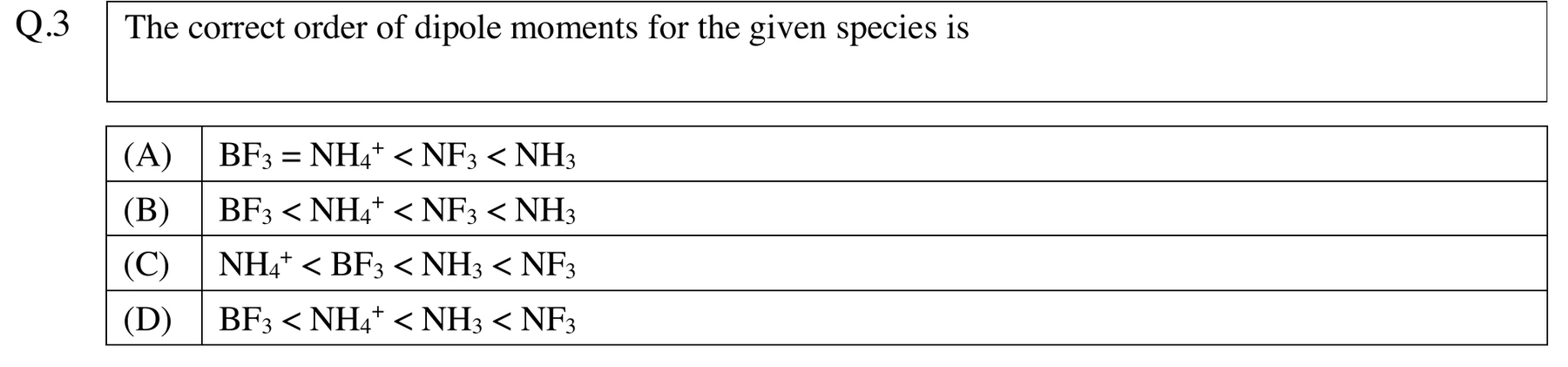
The correct order of dipole moments for the given species is
- A. BF3 = NH4+ < NF3 < NH3
- B. BF3 < NH4+ < NF3 < NH3
- C. NH4+ < BF3 < NH3 < NF3
- D. BF3 < NH4+ < NH3 < NF3
Watch the Question 3 video solution
Step-by-step solution
- BF3 is trigonal planar; three equal B-F bond-dipole vectors at 120 degrees sum to zero.
- NH4+ is tetrahedral with four equivalent N-H bonds; tetrahedral symmetry makes the vector sum zero.
- NH3 and NF3 are trigonal pyramidal, so both can have a nonzero axial molecular dipole.
- In NH3, N-H bond moments point toward nitrogen and reinforce the lone-pair-side contribution.
- In NF3, N-F bond moments point toward fluorine and oppose the lone-pair-side contribution, producing a smaller nonzero resultant.
- Therefore BF3=NH4+<NF3<NH3.
Correct answer: Choice A
Question 3 FAQ
Why do BF3 and NH4+ have zero dipole moment despite polar bonds?
BF3 and NH4+ have symmetric bond-dipole cancellation. NH3 and NF3 are pyramidal, but the N–F bond moments oppose the lone-pair direction more strongly, so NF3 has a smaller dipole than NH3. The order is choice A.
Question 4 · Single correct
Question 4: Chemoselective reduction, lactonization, and relative stereochemistry
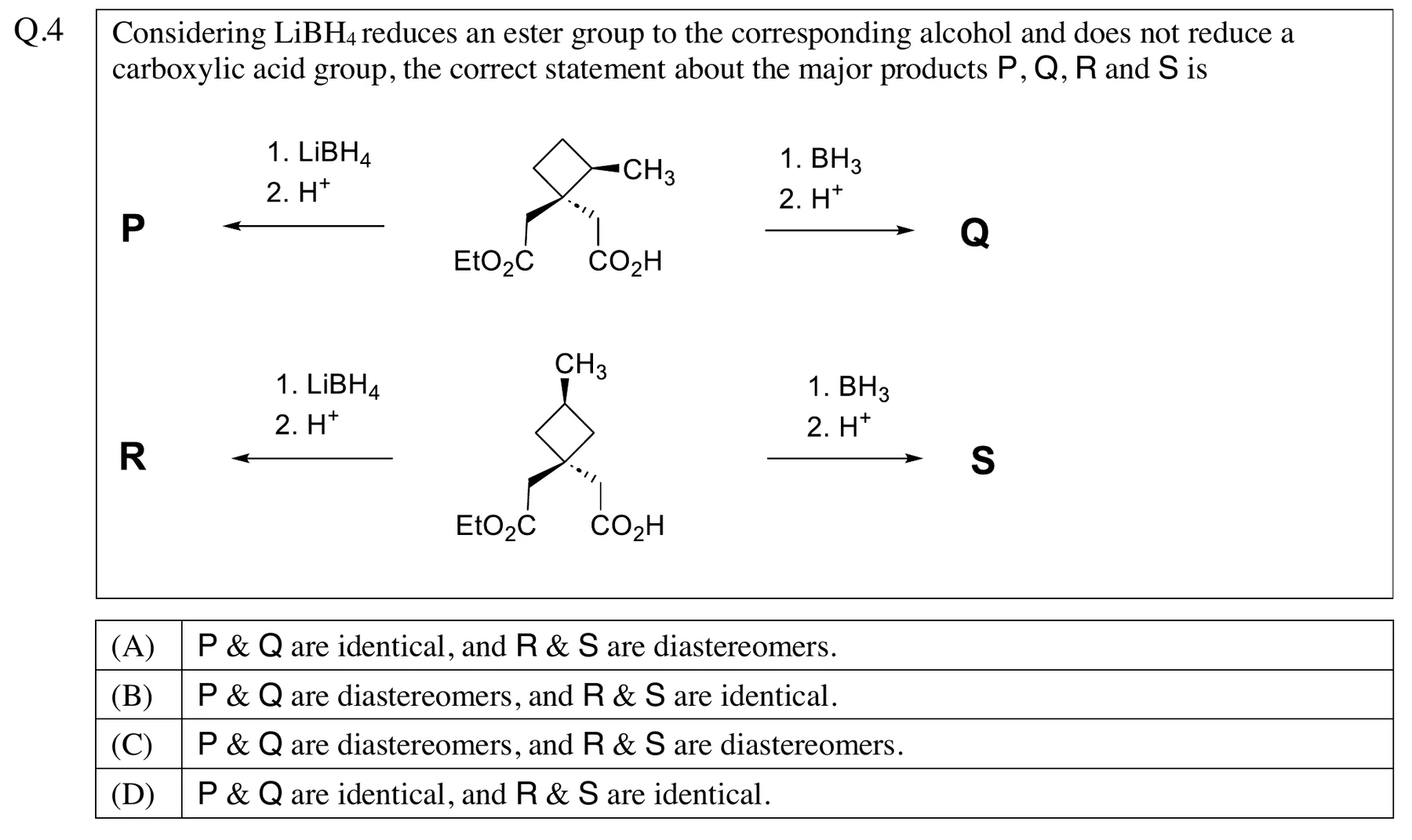
Question and answer choices
Considering LiBH4 reduces an ester group to the corresponding alcohol and does not reduce a carboxylic acid group, determine the relationship among major products P, Q, R and S. In the upper scheme, a cyclobutane has solid-wedge CH2CO2Et and hashed-wedge CH2CO2H arms at one carbon and a solid-wedge CH3 on the adjacent carbon; LiBH4/H+ gives P and BH3/H+ gives Q. In the lower scheme, the same two arms are present and the solid-wedge CH3 is on the opposite cyclobutane carbon; LiBH4/H+ gives R and BH3/H+ gives S.
- A. P and Q are identical, and R and S are diastereomers.
- B. P and Q are diastereomers, and R and S are identical.
- C. P and Q are diastereomers, and R and S are diastereomers.
- D. P and Q are identical, and R and S are identical.
Watch the Question 4 video solution
Step-by-step solution
- At the shared cyclobutane carbon, label the solid-wedge CH2CO2Et branch the ester arm and the hashed-wedge CH2CO2H branch the acid arm.
- LiBH4 reduces the ester terminus to CH2OH while leaving the acid; acidic workup closes a six-membered spiro delta-lactone whose carbonyl side comes from the hashed arm.
- BH3 reduces the acid terminus to CH2OH while leaving the ester; acidic intramolecular alcoholysis closes the same spiro delta-lactone connectivity, but its carbonyl side comes from the solid-wedge arm.
- The terminal reduction and cyclization do not invert the two bonds at the shared carbon, so the face exchange must be retained.
- With the adjacent methyl fixed, P and Q have different relative configurations and are diastereomers.
- With the opposite methyl fixed, R and S have different cis/trans relationships between the methyl face and carbonyl-side branch and are also diastereomers.
Correct answer: Choice C
Question 4 FAQ
How do LiBH4 and BH3 differ in chemoselectivity toward ester and carboxylic-acid groups?
LiBH4 reduces the ester arm while BH3 reduces the acid arm. Tracking which face supplies the lactone carbonyl while retaining the cyclobutane stereochemistry shows that both P/Q and R/S are diastereomeric pairs. Choice C is correct.
Question 5 · Multiple correct
Question 5: Hydrogenic degeneracy, shielding, and orbital penetration
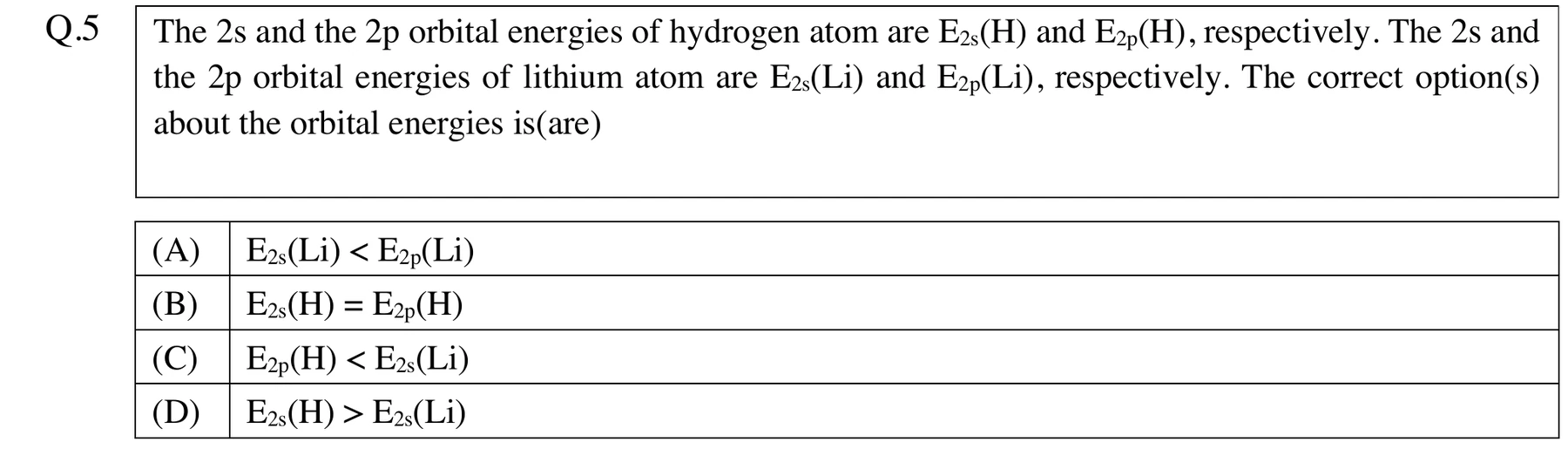
Question and answer choices
The 2s and the 2p orbital energies of hydrogen atom are E2s(H) and E2p(H), respectively. The 2s and the 2p orbital energies of lithium atom are E2s(Li) and E2p(Li), respectively. The correct option(s) about the orbital energies is(are)
- A. E2s(Li) < E2p(Li)
- B. E2s(H) = E2p(H)
- C. E2p(H) < E2s(Li)
- D. E2s(H) > E2s(Li)
Watch the Question 5 video solution
Step-by-step solution
- For a hydrogen atom in the nonrelativistic Coulomb model E_n=-13.6 eV/n^2. E_2s(H)=E_2p(H)=-3.4 eV; option B true.
- Lithium 2s penetrates its 1s core more than lithium 2p, experiences less shielding and stronger effective nuclear attraction. E_2s(Li)<E_2p(Li); option A true.
- The lithium 2s electron penetrates within the screened core; its orbital energy is lower than hydrogen n=2. Therefore E_2s(Li)<E_2s(H)=E_2p(H); option D true and C false.
Correct answer: ABD
Question 5 FAQ
Why are hydrogen 2s and 2p orbitals degenerate?
Hydrogen 2s and 2p are degenerate in the Coulomb model. In lithium, 2s penetrates the core more than 2p and is stabilized. This makes A, B and D true.
Question 6 · Multiple correct
Question 6: Redox identification, chlorine chemistry, VSEPR, Lewis basicity, and interhalogen compounds
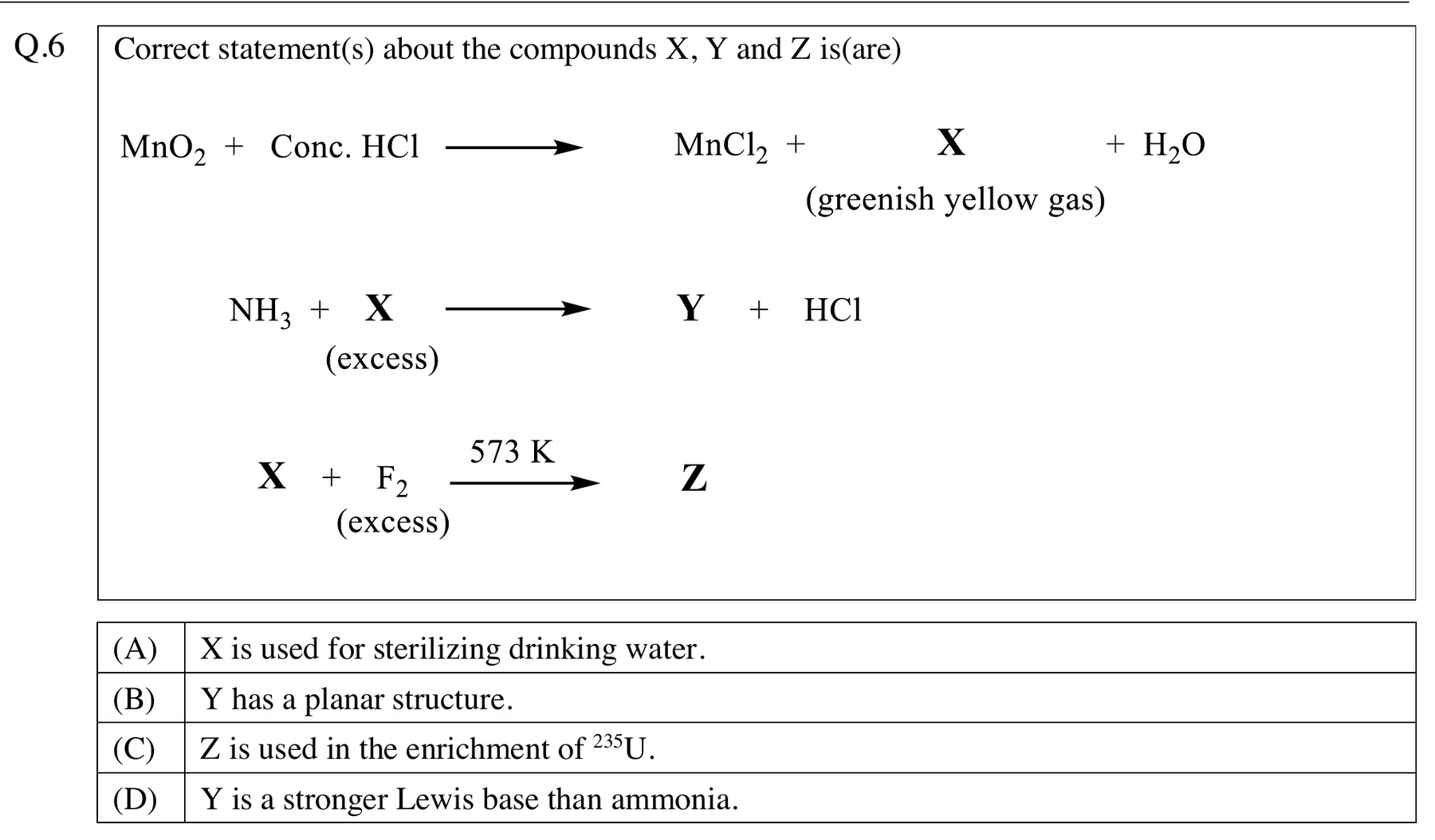
Question and answer choices
Correct statement(s) about the compounds X, Y and Z is(are). Reaction 1: MnO2 + concentrated HCl → MnCl2 + X + H2O, where X is a greenish-yellow gas. Reaction 2: NH3 + X (excess) → Y + HCl. Reaction 3: X + F2 (excess), at 573 K → Z.
- A. X is used for sterilizing drinking water.
- B. Y has a planar structure.
- C. Z is used in the enrichment of 235U.
- D. Y is a stronger Lewis base than ammonia.
Watch the Question 6 video solution
Step-by-step solution
- MnO2 + 4HCl -> MnCl2 + Cl2 + 2H2O. Mn changes +4 to +2 and chloride changes -1 to 0; the greenish-yellow X is Cl2.
- Cl2 + H2O <-> HCl + HOCl. HOCl is a disinfecting oxidant, so chlorine is used in drinking-water treatment and A is true.
- With excess chlorine, NH3 + 3Cl2 -> NCl3 + 3HCl. Y is NCl3.
- NCl3 has three N-Cl bonds and one central N lone pair; AX3E gives trigonal-pyramidal molecular shape, not planar, so B is false.
- The electronegative chlorine substituents withdraw electron density relative to the hydrogen substituents in NH3; the NCl3 nitrogen lone pair is less available for Lewis-base donation, so D is false.
- At 573 K with excess F2, Cl2 + 3F2 -> 2ClF3. Z is ClF3. It is a fluorinating agent used to prepare volatile UF6; isotope separation acts on UF6 feed, so C is true.
Correct answer: AC
Question 6 FAQ
How do the three reactions identify X as Cl2, Y as NCl3 and Z as ClF3?
The reactions identify X as Cl2, Y as NCl3 and Z as ClF3. Chlorine disinfects water, NCl3 is trigonal pyramidal and a weaker Lewis base than NH3, and ClF3 helps prepare UF6 feed. Therefore A and C are correct.
Question 7 · Multiple correct
Question 7: Dioxygenyl hexafluoroplatinate, molecular orbitals, oxidation state, and reagent role
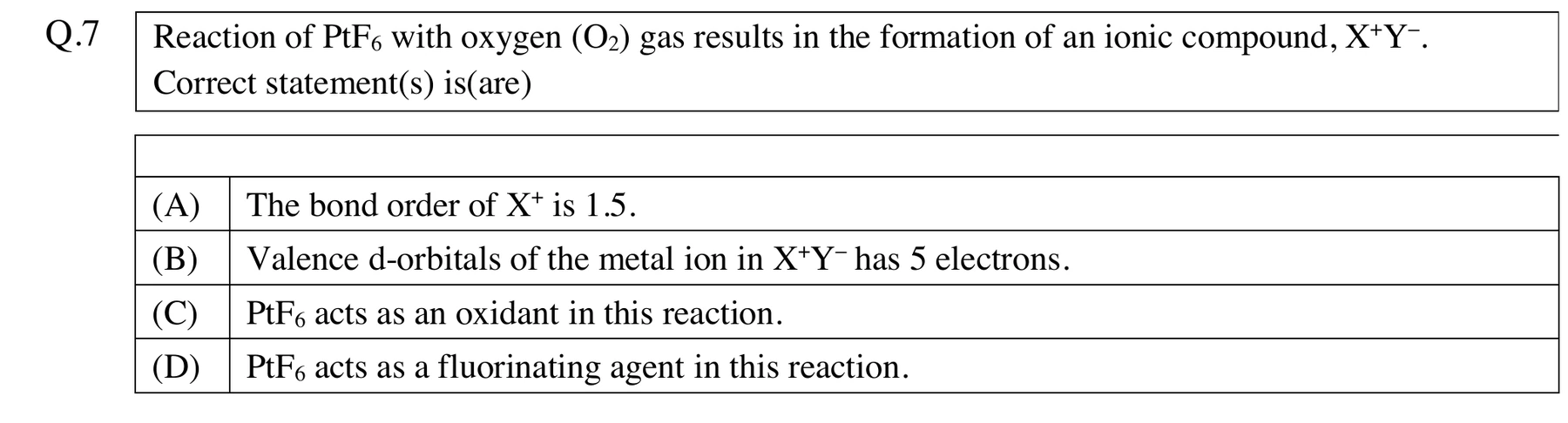
Question and answer choices
Reaction of PtF6 with oxygen (O2) gas results in the formation of an ionic compound, X+Y-. Correct statement(s) is(are)
- A. The bond order of X+ is 1.5.
- B. Valence d-orbitals of the metal ion in X+Y- has 5 electrons.
- C. PtF6 acts as an oxidant in this reaction.
- D. PtF6 acts as a fluorinating agent in this reaction.
Watch the Question 7 video solution
Step-by-step solution
- O2 loses one electron to form O2+, while PtF6 accepts that electron to form PtF6-. X+=O2+ and Y-=PtF6-.
- Neutral O2 has bond order 2. Removing one electron from a pi-star antibonding orbital raises the bond order by one-half, so BO(O2+)=2.5. A is false.
- For [PtF6]-, x+6(-1)=-1 gives Pt in +5 oxidation state. Platinum is group 10, so Pt(V) is d5. B is true.
- PtF6 accepts an electron and is reduced to PtF6-, so it oxidizes O2 and acts as the oxidant. No fluorine atom is transferred. C is true and D is false.
Correct answer: Choices B, C
Question 7 FAQ
Why does removing one antibonding electron give O2+ a bond order of 2.5?
PtF6 removes an antibonding electron from O2, forming O2+ with bond order 2.5. In [PtF6]−, platinum is +5 and therefore d5, while PtF6 acts as the oxidant. The correct choices are B and C.
Question 8 · Multiple correct
Question 8: Kolbe electrolysis, aromatization, Friedel-Crafts acylation, Rosenmund reduction, hydrazine cyclization, and anthraquinone chemistry
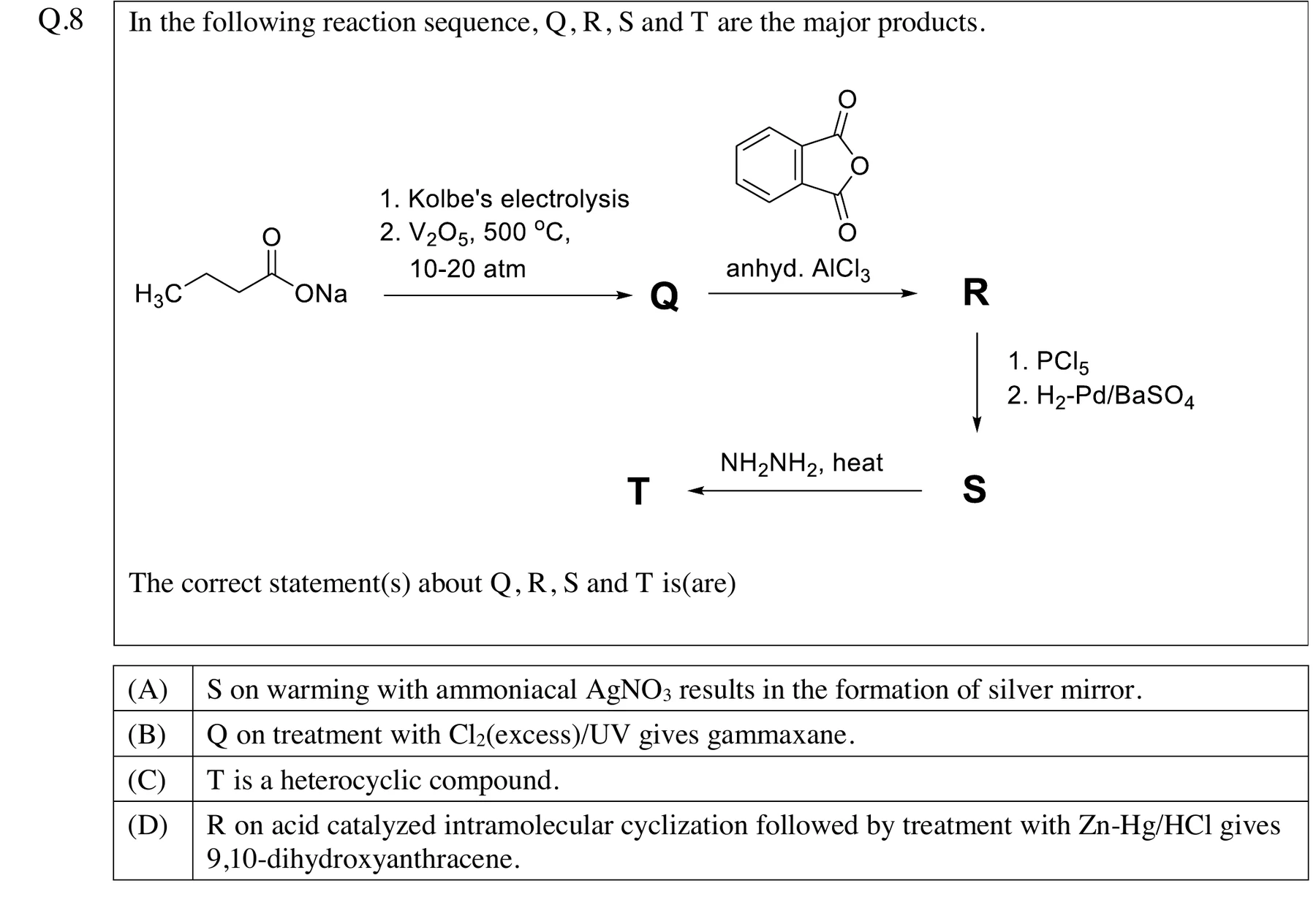
Question and answer choices
In the reaction sequence, sodium butanoate undergoes Kolbe electrolysis and then V2O5 at 500 °C and 10–20 atm to give Q; Q reacts with phthalic anhydride/anhydrous AlCl3 to give R; R undergoes PCl5 followed by H2–Pd/BaSO4 to give S; and S reacts with NH2NH2 on heating to give T. The correct statement(s) about Q, R, S and T is(are)
- A. S on warming with ammoniacal AgNO3 results in the formation of silver mirror.
- B. Q on treatment with Cl2(excess)/UV gives gammaxane.
- C. T is a heterocyclic compound.
- D. R on acid-catalyzed intramolecular cyclization followed by treatment with Zn-Hg/HCl gives 9,10-dihydroxyanthracene.
Watch the Question 8 video solution
Step-by-step solution
- Kolbe electrolysis of sodium butanoate forms n-propyl radicals; coupling gives n-hexane. V2O5 at 500 degrees C and 10-20 atm dehydrocyclizes/aromatizes n-hexane to benzene. Q is benzene.
- Benzene undergoes Friedel-Crafts acylation with phthalic anhydride/anhydrous AlCl3 to give 2-benzoylbenzoic acid after workup. R is o-benzoylbenzoic acid.
- PCl5 converts the carboxylic acid group of R to an acid chloride. Rosenmund reduction with H2/Pd-BaSO4 gives the aldehyde S, 2-benzoylbenzaldehyde, while retaining the ketone. Its aldehyde group gives Tollens silver mirror. A is true.
- Benzene adds three Cl2 molecules under ultraviolet light to form benzene hexachloride; its gamma isomer is gammaxane. B is true.
- Hydrazine condenses with the adjacent aldehyde and ketone groups of S to close a six-membered ring containing two adjacent nitrogen atoms, giving a phthalazine derivative. T is heterocyclic and C is true.
- Acid-catalyzed ring closure of R gives anthraquinone. Classical Clemmensen replacement of both carbonyl oxygens by methylene groups gives 9,10-dihydroanthracene, not 9,10-dihydroxyanthracene. D is false.
Correct answer: Choices A, B, C
Question 8 FAQ
How are Q, R, S and T identified across the four-step organic sequence?
Kolbe electrolysis and aromatization give benzene; subsequent acylation, Rosenmund reduction and hydrazine cyclization identify R, S and T. The aldehyde, gammaxane and heterocycle statements pass, while the anthraquinone reduction claim does not. A, B and C are correct.
Question 9 · Numerical answer
Question 9: Ideal gas mixtures and mole counting
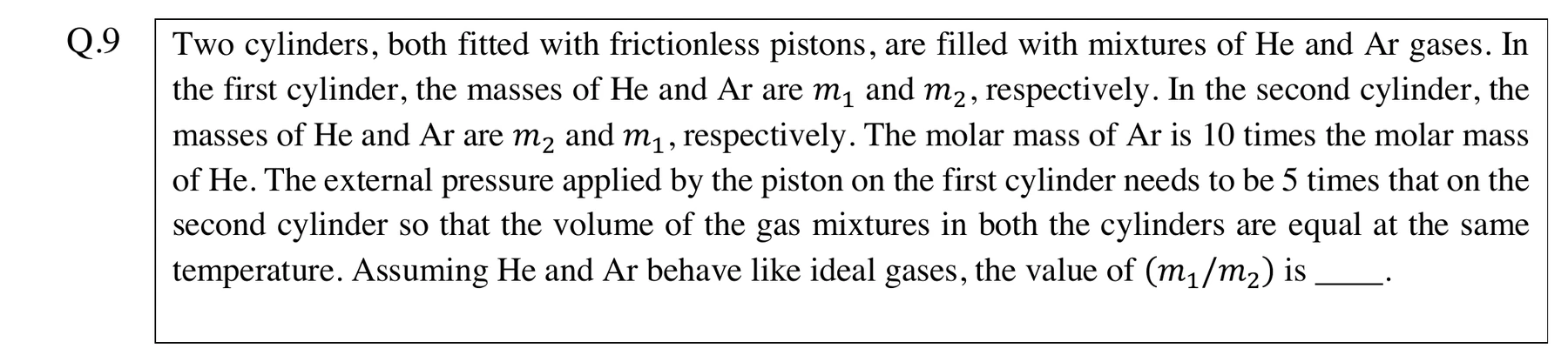
Question
Two cylinders, both fitted with frictionless pistons, are filled with mixtures of He and Ar gases. In the first cylinder, the masses of He and Ar are m1 and m2, respectively. In the second cylinder, the masses of He and Ar are m2 and m1, respectively. The molar mass of Ar is 10 times the molar mass of He. The external pressure on the first cylinder must be 5 times that on the second cylinder so that both gas mixtures have equal volume at the same temperature. Assuming ideal behavior, find m1/m2.
This is a numerical-answer question; the source does not provide answer choices.
Watch the Question 9 video solution
Step-by-step solution
- Cylinder 1 contains n1=m1/M+m2/(10M) total moles.
- Cylinder 2 contains n2=m2/M+m1/(10M) total moles.
- At the same temperature and equal volume, the ideal-gas law gives P1/P2=n1/n2.
- Because P1=5P2, m1+m2/10=5(m2+m1/10).
- Dividing by m2 gives x+0.1=5(1+0.1x)=5+0.5x.
- Thus 0.5x=4.9 and x=9.8.
Correct answer: 9.80
Question 9 FAQ
How does equal volume at equal temperature turn the pressure ratio into a mole ratio?
Equal volume and temperature make pressure proportional to total moles. Substituting the He and Ar mole counts, using MAr = 10MHe, gives (10m1 + m2)/(10m2 + m1) = 5 and m1/m2 = 49/5 = 9.80.
Question 10 · Numerical answer
Question 10: Square-planar geometrical and linkage isomerism

Question
The total number of all possible isomers for the square-planar complex K[M(NCS)(NO2)(gly)] is ____. Here M is the metal ion and gly is NH2CH2COO-.
This is a numerical-answer question; the source does not provide answer choices.
Watch the Question 10 video solution
Step-by-step solution
- Glycinate, NH2CH2COO-, is an unsymmetrical bidentate N,O donor and occupies two adjacent square-planar sites.
- NCS- is ambidentate: it can bind through N or S, giving two linkage choices.
- NO2- is ambidentate: it can bind through N (nitro) or O (nitrito), giving two linkage choices.
- For a fixed pair of linkage modes, the two distinct monodentate ligands fill the remaining adjacent sites in two non-equivalent orientations: which one is trans to gly-N versus trans to gly-O.
- 2 orientation choices × 2 thiocyanate linkage choices × 2 nitrite linkage choices = 8
- All counted structures are square planar; no extra optical pair is added.
Correct answer: 8
Question 10 FAQ
How do linkage isomerism of NCS- and NO2- multiply the isomer count?
NCS− and NO2− each have two linkage modes, giving four linkage combinations. For every combination, the unsymmetrical glycinate chelate has two square-planar orientations, so the total is 4 × 2 = 8.
Question 11 · Numerical answer
Question 11: Thermal reactions of beta-keto acids and vicinal dicarboxylic acids
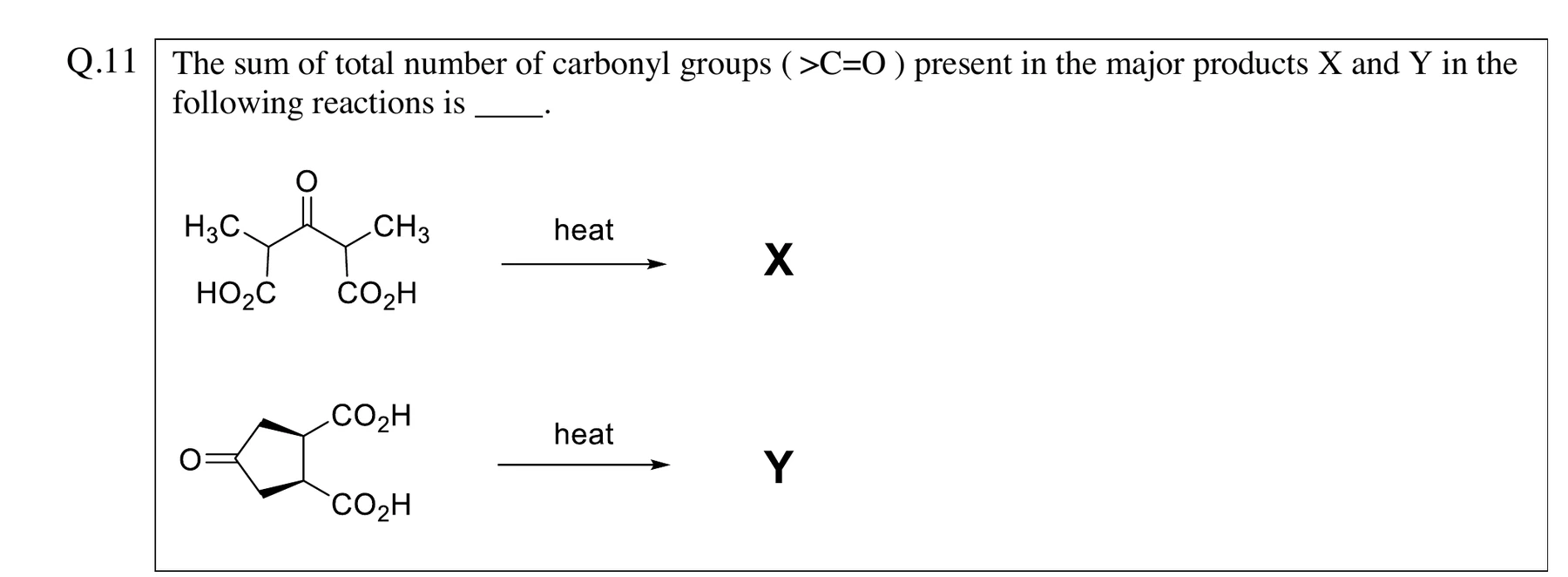
Question
The sum of the total number of carbonyl groups (>C=O) present in the major products X and Y is ____. Reaction 1 heats HOOC-CH(CH3)-CO-CH(CH3)-COOH to give X. Reaction 2 heats the depicted cyclopentanone bearing two adjacent carboxylic-acid groups to give Y.
This is a numerical-answer question; the source does not provide answer choices.
Watch the Question 11 video solution
Step-by-step solution
- For X, the open-chain compound is HOOC-CH(CH3)-CO-CH(CH3)-COOH. Each terminal carboxyl group forms a beta-keto-acid unit with the central ketone.
- On heating, both beta-keto-acid ends decarboxylate. Proton transfer gives CH3CH2-CO-CH2CH3 (pentan-3-one). X therefore contains one carbonyl group.
- For Y, the two adjacent carboxylic acid groups are positioned for intramolecular dehydration on heating, forming a cyclic anhydride.
- The anhydride contributes two carbonyl groups, and the original cyclopentanone carbonyl remains. Y therefore contains three carbonyl groups.
- The requested sum is 1+3=4.
Correct answer: 4
Question 11 FAQ
Why does the open-chain beta-keto diacid decarboxylate to a product with one carbonyl?
The open-chain beta-keto diacid decarboxylates to a product with one carbonyl. The cyclic vicinal dicarboxylic acid forms an anhydride while retaining the ketone, giving three carbonyls. The requested sum is 4.
Question 12 · Numerical answer
Question 12: Terminal diyne alkylation and sp-hybridized linear geometry

Question
Treatment of buta-1,3-diyne with NaNH2 (2 equivalents), followed by reaction with excess trans-CH3-CH=CH-CH2-Br, gives X as the major product. The maximum number of carbon atoms that are collinear in X is ____.
This is a numerical-answer question; the source does not provide answer choices.
Watch the Question 12 video solution
Step-by-step solution
- Buta-1,3-diyne is HC≡C-C≡CH and has two terminal acetylenic protons.
- Two equivalents of NaNH2 remove both terminal protons, giving the dianion ⁻C≡C-C≡C⁻.
- Each acetylide end performs SN2 attack at the CH2-Br carbon of trans-CH3-CH=CH-CH2-Br; excess reagent gives dialkylation.
- X is trans-crotyl-CH2-C≡C-C≡C-CH2-trans-crotyl, equivalently CH3-CH=CH-CH2-C≡C-C≡C-CH2-CH=CH-CH3.
- The four consecutive sp carbons of the diyne core lie on one straight axis. At each terminal sp carbon, the sigma bond to the adjacent CH2 carbon lies on that same 180-degree axis, adding one carbon at each end.
- The next bond at each CH2 is tetrahedral, so no further carbon can join the same straight line. Maximum collinear count = 4+2=6.
Correct answer: 6
Question 12 FAQ
How does double deprotonation and SN2 alkylation build the final diyne product?
Two equivalents of NaNH2 form the dianion of buta-1,3-diyne, and two SN2 alkylations attach the allylic chains. The four sp carbons are collinear, and one adjacent carbon at each end lies on the same axis, giving a maximum of 6.
Question 13 · Match the lists
Question 13: Signs of enthalpy and entropy changes
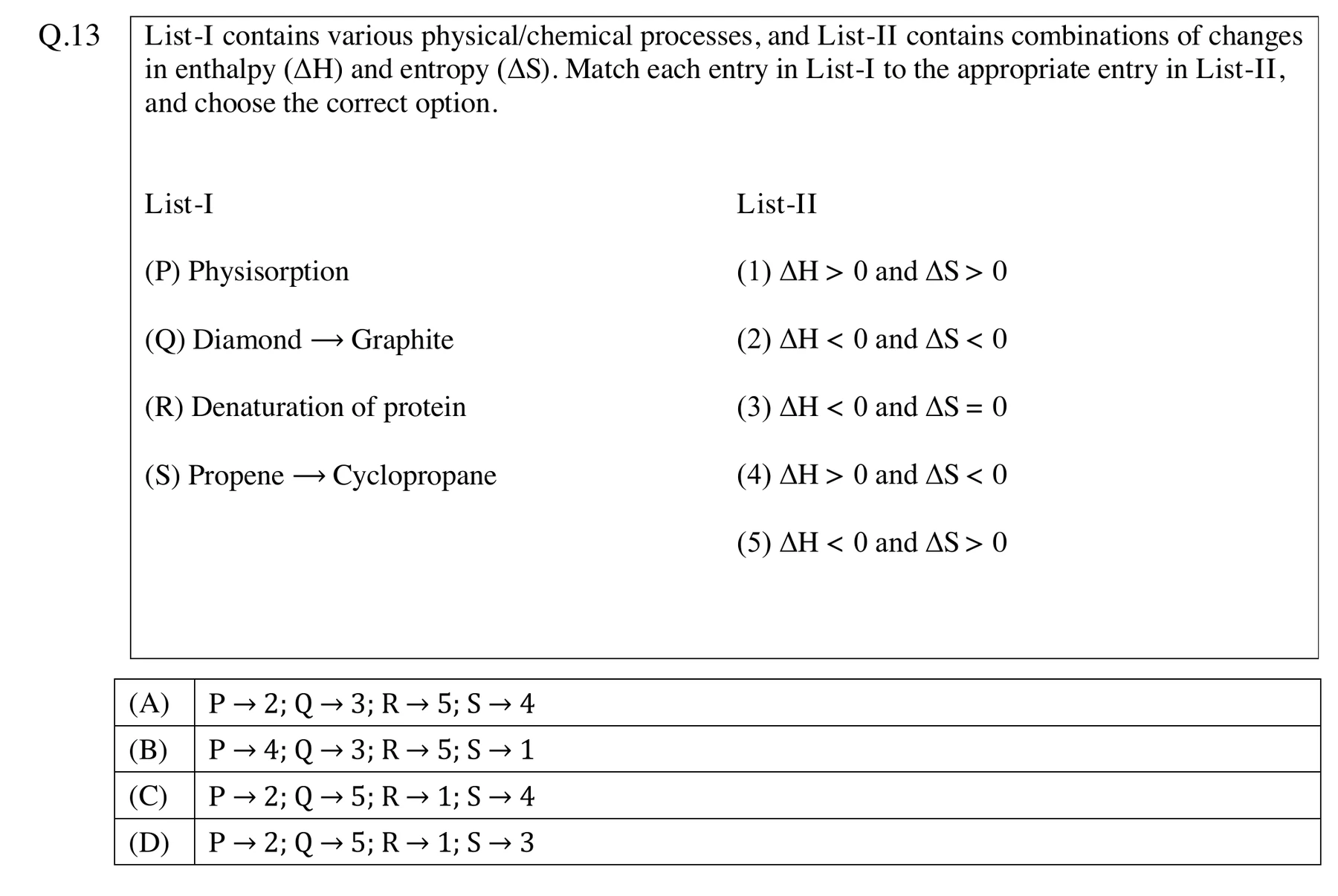
Question and answer choices
Match List I with List II. List I: P, physisorption; Q, diamond → graphite; R, denaturation of protein; S, propene → cyclopropane. List II: 1, ΔH>0 and ΔS>0; 2, ΔH<0 and ΔS<0; 3, ΔH<0 and ΔS=0; 4, ΔH>0 and ΔS<0; 5, ΔH<0 and ΔS>0.
- A. P→2; Q→3; R→5; S→4
- B. P→4; Q→3; R→5; S→1
- C. P→2; Q→5; R→1; S→4
- D. P→2; Q→5; R→1; S→3
Watch the Question 13 video solution
Step-by-step solution
- P physisorption forms weak surface attractions and localizes gas particles: ΔH<0, ΔS<0, List-II entry 2.
- Q diamond→graphite: graphite has lower enthalpy and greater entropy under ordinary conditions: ΔH<0, ΔS>0, entry 5.
- R protein denaturation disrupts stabilizing interactions and increases chain conformations: ΔH>0, ΔS>0, entry 1.
- S propene→cyclopropane creates a strained ring and reduces freedom: ΔH>0, ΔS<0, entry 4.
- The four matches form option C.
Correct answer: Choice C
Question 13 FAQ
How do adsorption, allotrope stability, unfolding and ring strain determine the signs of ΔH and ΔS?
Physisorption is exothermic with decreased entropy; diamond to graphite is exothermic with increased entropy; protein denaturation is endothermic with increased entropy; and propene cyclization is endothermic with decreased entropy. This is mapping P→2, Q→5, R→1, S→4, or choice C.
Question 14 · Match the lists
Question 14: VSEPR molecular-shape counting
Question and answer choices
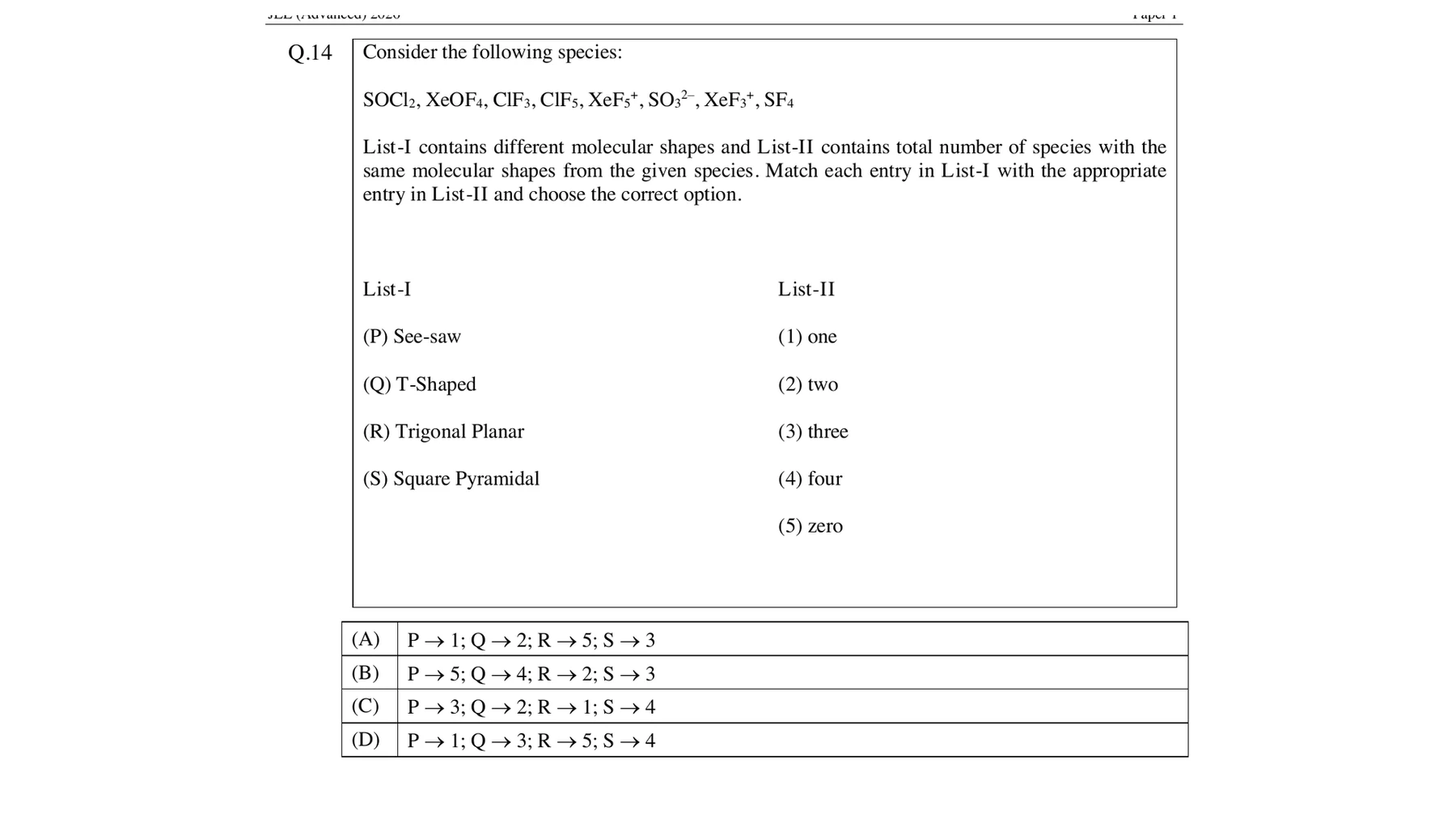
For SOCl2, XeOF4, ClF3, ClF5, XeF5+, SO3^2−, XeF3+ and SF4, match List I shapes—P see-saw, Q T-shaped, R trigonal planar, S square pyramidal—to List II counts—1 one, 2 two, 3 three, 4 four, 5 zero.
- A. P→1; Q→2; R→5; S→3
- B. P→5; Q→4; R→2; S→3
- C. P→3; Q→2; R→1; S→4
- D. P→1; Q→3; R→5; S→4
Watch the Question 14 video solution
Step-by-step solution
- SF4 is AX4E and is the only see-saw species, so P→1.
- ClF3 and XeF3+ are AX3E2 and T-shaped, so Q→2.
- SOCl2 and SO3^2− are trigonal pyramidal; no species is trigonal planar, so R→5, meaning zero.
- XeOF4, ClF5, and XeF5+ are AX5E and square pyramidal, so S→3.
- P→1,Q→2,R→5,S→3 is option A.
Correct answer: Choice A
Question 14 FAQ
How do electron-domain counts assign each species to see-saw, T-shaped or square-pyramidal geometry?
VSEPR electron-domain counting gives one see-saw species, two T-shaped species, no trigonal-planar species and three square-pyramidal species. The mapping is P→1, Q→2, R→5, S→3, so choice A is correct.
Question 15 · Match the lists
Question 15: Reductive ozonolysis followed by intramolecular aldol cyclization
Question and answer choices
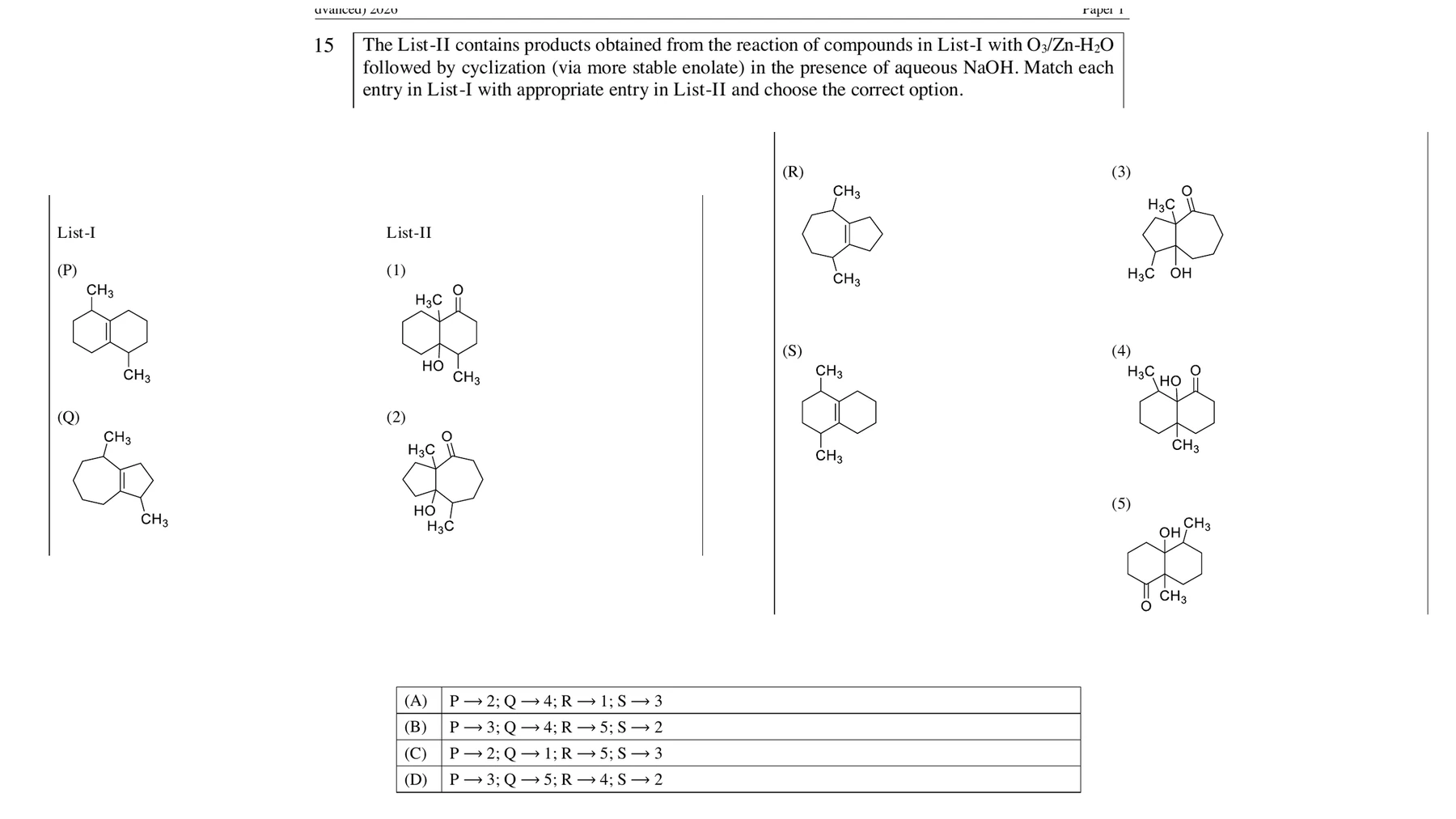
List II shows products obtained when the four fused bicyclic alkenes P, Q, R and S in List I undergo O3/Zn-H2O, followed by cyclization through the more stable enolate in aqueous NaOH. Match each substrate to product 1–5. The source image is canonical for the four substrate and five product structures.
- A. P→2; Q→4; R→1; S→3
- B. P→3; Q→4; R→5; S→2
- C. P→2; Q→1; R→5; S→3
- D. P→3; Q→5; R→4; S→2
Watch the Question 15 video solution
Step-by-step solution
- Each shared alkene carbon has two carbon substituents and no H, so reductive ozonolysis gives exactly two ketones, no aldehyde.
- The donor carbonyl remains ketone and the attacked carbonyl becomes C-OH in the aldol addition.
- P: 6|6 and opposite-path methyl markers -> product 2.
- Q: 7|5 and opposite-path methyl markers -> product 1.
- R: 7|5 and same-long-path methyl markers -> product 5.
- S: 6|6 and same-path methyl markers -> product 3.
- P2 Q1 R5 S3 is option C.
Correct answer: Choice C
Question 15 FAQ
How does reductive ozonolysis convert each fused alkene into a tethered dicarbonyl?
Reductive ozonolysis opens each alkene into a tethered dicarbonyl. Selecting the more stable enolate and following the allowed ring-closing path and methyl markers gives P→2, Q→1, R→5, S→3. Choice C is correct.
Question 16 · Match the lists
Question 16: Oxime reactions, nitrile formation, substitution, cyclization, and deacetylation
Question and answer choices
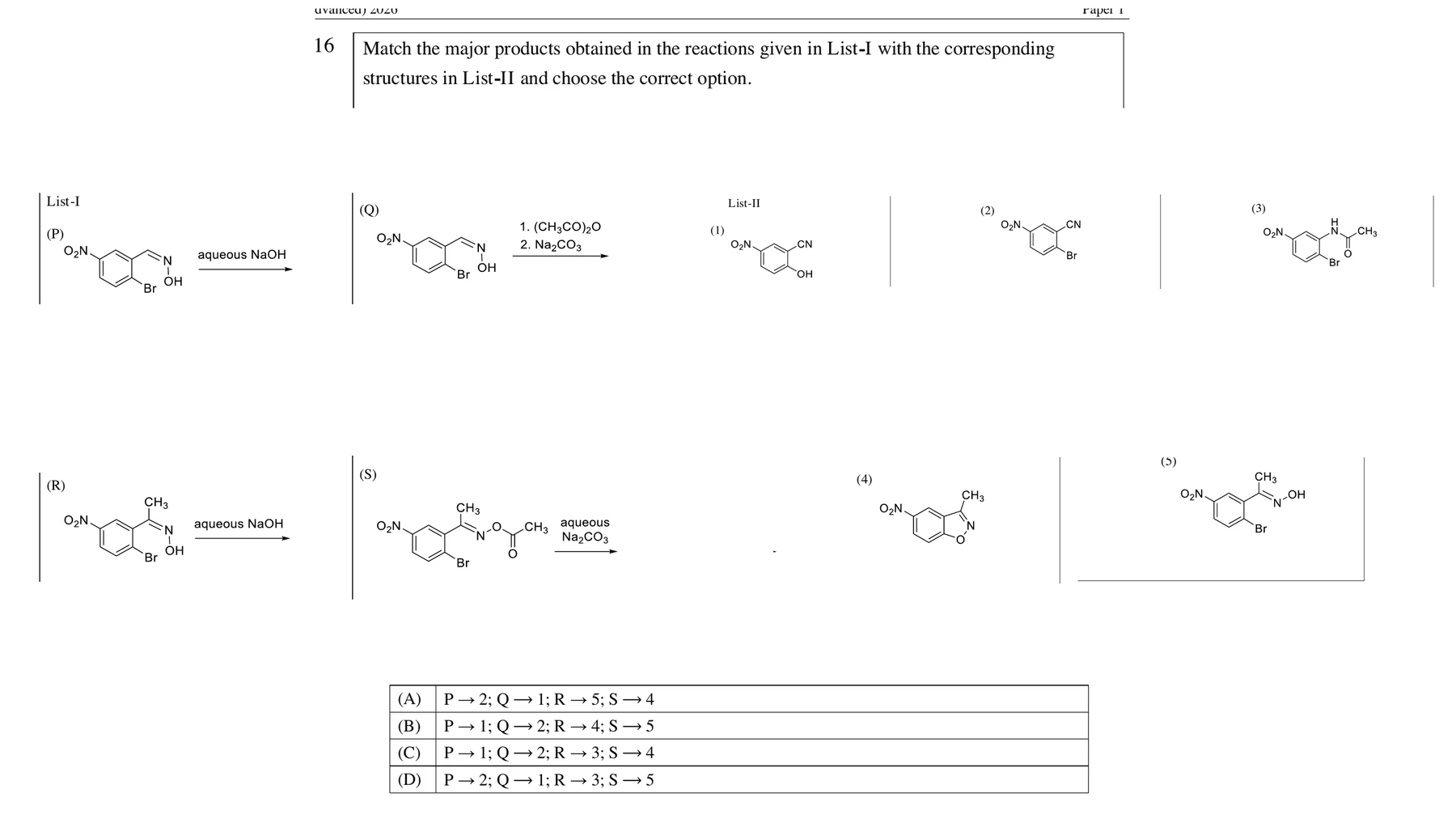
Match the major products from reactions P–S with structures 1–5. P is the depicted nitro-bromo aromatic aldoxime with aqueous NaOH. Q is the same aldoxime with acetic anhydride followed by Na2CO3. R is the depicted nitro-bromo aromatic methyl ketoxime with aqueous NaOH. S is its O-acetyl oxime with aqueous Na2CO3. The source image is canonical for the structures.
- A. P→2; Q→1; R→5; S→4
- B. P→1; Q→2; R→4; S→5
- C. P→1; Q→2; R→3; S→4
- D. P→2; Q→1; R→3; S→5
Watch the Question 16 video solution
Step-by-step solution
- P: oximate intramolecular SNAr gives 3-H benzisoxazole; C3 deprotonation and Kemp N-O opening gives ortho-hydroxybenzonitrile, structure 1.
- Q: Ac2O-assisted aldoxime dehydration gives the nitrile while mild carbonate retains aryl Br, structure 2.
- R: ketoximate cyclizes to 3-methylbenzisoxazole; C3 has no hydrogen, so P-type Kemp opening cannot occur, structure 4.
- S: aqueous carbonate deacetylates the O-acetyl ketoxime while retaining aryl Br, structure 5.
- Mapping P->1,Q->2,R->4,S->5 is option B.
Correct answer: Choice B
Question 16 FAQ
Which conditions cause aldoxime dehydration, aryl substitution, cyclization or O-deacetylation?
The aldoxime and ketoxime substrates respond differently to dehydration, aromatic substitution, cyclization and O-deacetylation under the stated conditions. Tracking each transformation gives P→1, Q→2, R→4, S→5, which is choice B.
Workflow FAQ
Did the answer key appear in the opening question screenshot?
No. Each crop contained the question and answer choices only. The provisional key was stored separately for verification.
Why check the script before generating the video?
Golpo returns its first solution script before rendering. Codex then checks the chemistry, derivation, and final option so errors can be corrected before they consume production time and credits.
Why run QA again after Golpo creates the video?
A correct script does not guarantee correct rendered audio or timing. Question 6 proved this when an early render substituted “chlorine” for “fluorine.” Actual-media QA caught the defect before publication.
Are all 16 Chemistry video lessons available?
All 16 horizontal Chemistry lessons passed actual-media QA and now have playback-verified public YouTube players below.
How did Golpo AI turn each IIT JEE Advanced question into a video lesson?
Each lesson began with one clean screenshot containing the full question and answer choices. Golpo read it aloud, solved the problem, explained the reasoning step by step with progressive illustrations and equations, and revealed the verified answer at the end.
What was Codex’s role?
Codex served as Golpo’s QA collaborator. It prepared the answer-key-free question image, checked Golpo’s draft reasoning and final choice against the supplied provisional key, requested corrections when needed, and audited the finished video before publication.
Where can I watch the Chemistry video solutions?
All 16 approved public YouTube videos are embedded beside their questions in this guide.
Tags


