How Golpo AI Turned IIT JEE Advanced 2026 Mathematics Paper 1 Into Video Solutions
See how Golpo AI turned IIT JEE Advanced 2026 Mathematics Paper 1 question screenshots into step-by-step lessons any student can follow, with Codex as its QA collaborator and 14 verified public videos.

JEE Advanced 2026 · Mathematics · Paper 1
One question screenshot became a complete Golpo lesson.
Golpo AI solved and taught all 16 Mathematics questions step by step from clean question-and-choice screenshots, while Codex served as its QA collaborator. Fourteen verified horizontal video lessons are public. Questions 10 and 14 retain their complete written solutions while the final horizontal videos are pending.
- 16original questions
- 16checked solutions
- 14public video lessons
- 2× QAscript review gate
One screenshot per question → one complete Golpo lesson
How Golpo AI turned one of India’s most competitive question papers into step-by-step video lessons
We gave Golpo AI a clean screenshot of each IIT JEE Advanced 2026 Mathematics question and its answer choices. From that source, Golpo read the problem aloud, solved it, explained every step with progressive illustrations and equations, and revealed the verified answer at the end. A student can follow the reasoning instead of seeing only an answer choice—and the lessons were created without manually scripting and animating every problem.
Current Mathematics collection: Fourteen verified horizontal video lessons are public. Questions 10 and 14 retain their complete written solutions while the final horizontal videos are pending.
Watch the IIT JEE Advanced 2026 Mathematics playlist ↗THE PDF-TO-VIDEO WORKFLOW
One screenshot in. A complete Golpo lesson out.
Golpo was the primary teaching and video-creation system: it solved each problem, wrote the first step-by-step solution script, narrated the lesson, and drew the progressive Canvas visuals. Codex collaborated around that work by isolating the source question, checking Golpo's returned script against the supplied answer choice, revising and rechecking when needed, authorizing the render, and auditing the finished MP4.
We used Codex for this production. The reusable prompt below can also be used with another capable AI assistant, such as Cursor, GitHub Copilot, or Claude Code.
Codex isolates the source
Codex crops the complete question and choices, excludes the printed answer key from the learner-facing image, and keeps the key only for QA.
Golpo writes the first solution
Codex sends the crop and lesson brief to Golpo. Golpo solves the problem and returns its initial step-by-step narration and script before rendering.
Codex reviews with the key
Codex checks Golpo's reasoning, calculations, units, and final result, then confirms that the result maps to the supplied correct answer choice.
Revise before rendering
If a check fails, Codex edits Golpo's script and runs QA again. Only a passing script is authorized for video creation.
Golpo creates the lesson
Golpo receives the approved script and image with horizontal 16:9, Auto timing, and a Canvas Compact style. The opening image stays visible through the full readout; Golpo then draws the solution progressively.
Codex audits the MP4
Codex checks the actual render's decode, duration, audio and ASR, image timing, continuity, illustrations, teaching quality, and final-answer alignment.
Publish an approved render
Any failed render returns for correction. Only the QA-approved video is embedded in the guide or prepared for YouTube.
SOURCE ARTIFACT
Uploaded provisional Paper 1 question paper and answer key
The source file is preserved with SHA-256 80aa2c95e3f120564fa7b6c0476292ab8017f942257f5e53c0b893df66ec65a0. The answer key was used for QA and excluded from every opening screenshot.
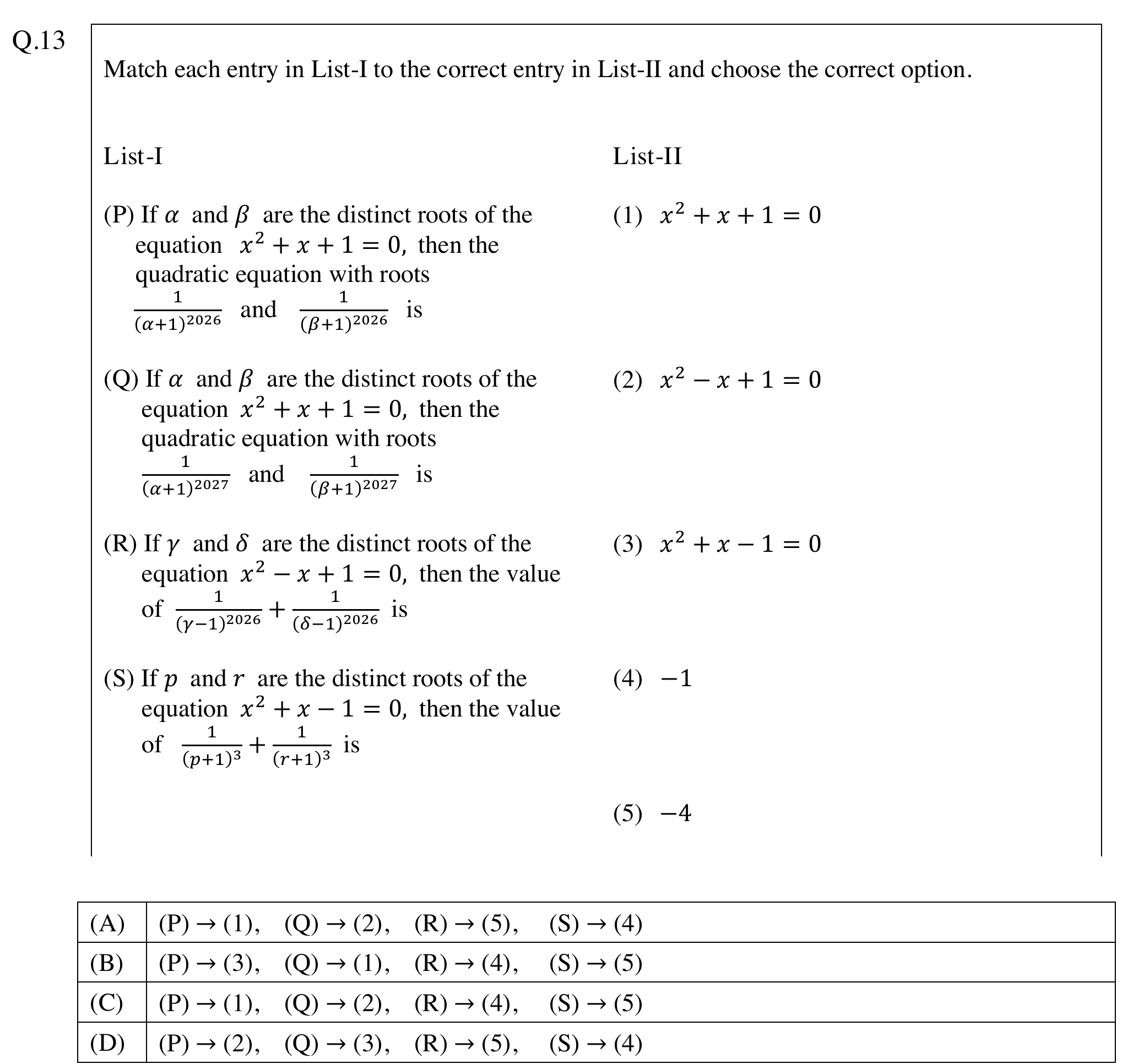
FULL EXAMPLE · MATHEMATICS QUESTION 13
Codex instruction and sanitized Golpo API v2 payload
This example preserves the production settings, complete script, image timing instructions, and Canvas controls. Signed media URLs and generated identifiers are sanitized.
This is the exact answer-key-free question image supplied as the opening visual. It remains on screen while the complete question and choices are read aloud.
Show the Codex orchestration prompt
Use the uploaded JEE Advanced 2026 Paper 1 provisional question paper and its supplied answer key.

For each selected question:
1. Codex isolates a clean image containing the complete question and all answer choices. Exclude the printed answer key from that learner-facing image, but retain the key for QA.
2. Codex sends the question image and a step-by-step lesson request to Golpo.
3. Golpo solves the problem and returns its initial narration and solution script before any video is rendered.
4. Codex collaborates as reviewer: check every reasoning step, calculation, unit, and final result, then map the result to the supplied correct answer choice.
5. If any check fails, Codex edits Golpo's script and runs the script QA again. Authorize rendering only after the revised script passes.
6. Send the approved script and question image to Golpo through the API. Use horizontal 16:9, Auto timing, and a Golpo Canvas Compact style.
7. Keep [IMAGE 1] on screen from the first frame while Golpo reads the complete question and every choice aloud. Do not show the answer key.
8. After [IMAGE 1], Golpo must teach the solution with progressive native illustrations, equations, diagrams, and worked examples. Do not use static solution screenshots.
9. Golpo ends with the complete final result and the correct answer choice, held visibly through the final frame.
10. Codex reviews the actual MP4 for decode, duration, audio/ASR, question-image continuity, visual accuracy, teaching effectiveness, and final-answer alignment. Retry any failure and publish only an approved render.
Show the complete sanitized Golpo payload
{
  "prompt": "Create a four-minute JEE Advanced 2026 Mathematics Paper 1 Question 13 lesson in Golpo Canvas Whiteboard Compact. Use a native 16:9 horizontal frame and automatic scene timing. Insert only question.png as Image 1 from frame one through the complete question, both lists, every answer choice, both short bridge sentences, and one extra silent second. Read P with exponent 2026 on both roots and Q with exponent 2027 on both roots. After the image block, use only progressive native illustrations and worked equations. Build only the exact final mapping P to 1, Q to 2, R to 4, S to 5 with noncrossing connectors, show Correct answer: C, and hold that complete board through the last word and final frame. Directions are not narration. Use this exact script with its single image block:\n\n[START][IMAGE 1]\nQuestion thirteen. Match List One to List Two. P: alpha and beta are distinct roots of x squared plus x plus one equals zero. Find the quadratic whose roots are one over the quantity alpha plus one raised to power two thousand twenty-six, and one over the quantity beta plus one raised to power two thousand twenty-six. Both exponents in P are two thousand twenty-six. Q: alpha and beta are again distinct roots of x squared plus x plus one equals zero. Find the quadratic whose roots are one over the quantity alpha plus one raised to power two thousand twenty-seven, and one over the quantity beta plus one raised to power two thousand twenty-seven. Both exponents in Q are two thousand twenty-seven. R: gamma and delta are distinct roots of x squared minus x plus one equals zero. Find one over the quantity gamma minus one raised to power two thousand twenty-six, plus one over the quantity delta minus one raised to power two thousand twenty-six. S: p and r are distinct roots of x squared plus x minus one equals zero. Find one over the cube of p plus one, plus one over the cube of r plus one. Each power applies to the entire parenthesized denominator. List Two: one, x squared plus x plus one equals zero; two, x squared minus x plus one equals zero; three, x squared plus x minus one equals zero; four, minus one; five, minus four. Choices in P, Q, R, S order are: A, one, two, five, four; B, three, one, four, five; C, one, two, four, five; D, two, three, five, four.\n\nKeep the complete question and every choice visible. We will now solve it.\n[END][IMAGE 1]\n\nLet u equal alpha plus one and v equal beta plus one. Vieta gives u plus v equal u v equal one. Hence each satisfies z squared minus z plus one equals zero, with cube minus one and sixth power one.\n\nFor P, two thousand twenty-six is four modulo six. The reciprocal powers are u squared and v squared, with sum minus one and product one. Their quadratic is x squared plus x plus one. P matches one.\n\nFor Q, two thousand twenty-seven is five modulo six. The reciprocal powers reduce to u and v, with sum and product one. Their quadratic is x squared minus x plus one. Q matches two.\n\nFor R, let a equal gamma minus one and b equal delta minus one. Their sum is minus one, product one, and cubes one. Since two thousand twenty-six is one modulo three, the reciprocal sum is a plus b over a b, or minus one. R matches four.\n\nFor S, p times p plus one equals one, so its reciprocal is p, and similarly for r. The value is p cubed plus r cubed. With p plus r and p r both minus one, the cube-sum formula gives minus four. S matches five.\n\nThe complete mapping is P to one, Q to two, R to four, S to five. This is choice C. The correct answer is C.\n",
  "custom_script": "[START][IMAGE 1]\nQuestion thirteen. Match List One to List Two. P: alpha and beta are distinct roots of x squared plus x plus one equals zero. Find the quadratic whose roots are one over the quantity alpha plus one raised to power two thousand twenty-six, and one over the quantity beta plus one raised to power two thousand twenty-six. Both exponents in P are two thousand twenty-six. Q: alpha and beta are again distinct roots of x squared plus x plus one equals zero. Find the quadratic whose roots are one over the quantity alpha plus one raised to power two thousand twenty-seven, and one over the quantity beta plus one raised to power two thousand twenty-seven. Both exponents in Q are two thousand twenty-seven. R: gamma and delta are distinct roots of x squared minus x plus one equals zero. Find one over the quantity gamma minus one raised to power two thousand twenty-six, plus one over the quantity delta minus one raised to power two thousand twenty-six. S: p and r are distinct roots of x squared plus x minus one equals zero. Find one over the cube of p plus one, plus one over the cube of r plus one. Each power applies to the entire parenthesized denominator. List Two: one, x squared plus x plus one equals zero; two, x squared minus x plus one equals zero; three, x squared plus x minus one equals zero; four, minus one; five, minus four. Choices in P, Q, R, S order are: A, one, two, five, four; B, three, one, four, five; C, one, two, four, five; D, two, three, five, four.\n\nKeep the complete question and every choice visible. We will now solve it.\n[END][IMAGE 1]\n\nLet u equal alpha plus one and v equal beta plus one. Vieta gives u plus v equal u v equal one. Hence each satisfies z squared minus z plus one equals zero, with cube minus one and sixth power one.\n\nFor P, two thousand twenty-six is four modulo six. The reciprocal powers are u squared and v squared, with sum minus one and product one. Their quadratic is x squared plus x plus one. P matches one.\n\nFor Q, two thousand twenty-seven is five modulo six. The reciprocal powers reduce to u and v, with sum and product one. Their quadratic is x squared minus x plus one. Q matches two.\n\nFor R, let a equal gamma minus one and b equal delta minus one. Their sum is minus one, product one, and cubes one. Since two thousand twenty-six is one modulo three, the reciprocal sum is a plus b over a b, or minus one. R matches four.\n\nFor S, p times p plus one equals one, so its reciprocal is p, and similarly for r. The value is p cubed plus r cubed. With p plus r and p r both minus one, the cube-sum formula gives minus four. S matches five.\n\nThe complete mapping is P to one, Q to two, R to four, S to five. This is choice C. The correct answer is C.\n",
  "narration_instructions": "Use a clear, calm English mathematics-teacher voice at natural pacing. Read script.txt exactly, including every list entry, every choice, and every exponent. In P, say twenty twenty-six for BOTH reciprocal-root exponents; never say twenty twenty-seven within P. In Q, say twenty twenty-seven for BOTH reciprocal-root exponents. Preserve parentheses, signs, labels P Q R S, and list numbers. Do not narrate image markers or production directions. Use brief pauses while equations and drawings appear. State the final mapping and choice C exactly. Target approximately four minutes using automatic scene timing and no custom timestamp schedule.\n",
  "visual_instructions": "Use duration selected as 4 minutes with automatic scene timing, Golpo Canvas Whiteboard Compact, and a native 16:9 horizontal frame. Use balanced left-and-right panels and readable margins.\n\nInsert ONLY question.png as Image 1, as an image inside the video. From frame one, keep the complete original question, both lists, and all choices fully visible, unchanged, uncropped, unobscured, and unanimated through the complete Image 1 narration block and its final word. Do not retire it when choice D ends. Keep it visible for both closing bridge sentences inside the image block, then hold it for one additional silent second. Never reuse the screenshot.\n\nAfter the opening, use only native progressive illustrations, diagrams, and worked equations. Do not insert solution screenshots, static full-page solution boards, documents, or prerecorded slides. Keep all production directions out of narration.\n\nP and Q: Draw one accurate complex unit circle with u=alpha+1 and v=beta+1 at angles plus and minus pi over three. Build u+v=uv=1, u squared minus u plus one equals zero, u cubed=v cubed=minus one, and u to the sixth=v to the sixth=one. For P, write BOTH original reciprocal exponents as negative 2026, reduce negative 2026 modulo six to exponent two, and derive x squared plus x plus one, P to 1. Never show 2027 anywhere in the P panel. For Q, write BOTH exponents as negative 2027, reduce to exponent one, and derive x squared minus x plus one, Q to 2.\n\nR: Draw a separate unit circle for a=gamma-1 and b=delta-1 at plus and minus two pi over three. Build a+b=minus one, ab=one, a cubed=b cubed=one, and the reciprocal sum equal to minus one. Mark R to 4.\n\nS: Draw the two real roots on a number line. Progressively show p(p+1)=1 and r(r+1)=1, then one over p+1 equals p and one over r+1 equals r. Build p cubed plus r cubed=minus four. Mark S to 5.\n\nFINAL BOARD — mandatory exact construction: Complete this board BEFORE the closing paragraph begins. Use four separate horizontal connectors with NO crossing lines: P arrow 1, Q arrow 2, R arrow 4, S arrow 5. These are the only connector endpoints; leave entry 3 unused. Beside the mapping, display \"Correct answer: C\" in large readable text. Once complete, lock this exact board: do not clear it, replace it, redraw it, or switch to an equations-only recap. Keep the correct labeled mapping and Correct answer: C visible through every final spoken word, a two-second silent ending pause, and the final video frame. Use no music or competing sound effects.\n",
  "timing": "4",
  "golpo_video_engine": "golpo_canvas",
  "canvas_style_variant": "whiteboard_compact",
  "narration_voice": "female-1",
  "narration_language": "en",
  "onscreen_text_language": "en",
  "video_orientation": "horizontal",
  "visibility": "private",
  "enable_color": true,
  "enable_script_only_mode": false,
  "enable_podcast_engine": false,
  "onscreen_text_from_script_only": false,
  "watermark": false,
  "scene_pacing": "normal",
  "visual_animation_style": "sketch",
  "custom_images": [
    "[SANITIZED_SIGNED_MEDIA_URL]"
  ],
  "custom_images_description": [
    "Original JEE Advanced 2026 Mathematics Paper 1 question 13, containing the complete List-I, List-II, and choices A-D with no answer key. Insert this exact image unchanged from frame one. Keep it continuously visible through every spoken choice, both short bridge sentences inside Image 1, and one additional silent second. Do not crop, zoom, pan, cover, animate, or reuse it. After it retires, use only native progressive illustrations and worked equations."
  ],
  "keep_original_images": [
    true
  ],
  "disable_image_animation": [
    true
  ],
  "video_id": "[GENERATED_BY_GOLPO]"
}This guide covers every question in JEE Advanced 2026 Mathematics Paper 1: derivatives, coordinate geometry, matrices, probability, three-dimensional geometry, limits, equivalence relations, combinatorics, trigonometry, orthogonal matrices, and conic sections. Each of the 16 sections preserves the question and choices, gives the checked working, and states the provisional-key answer.
Fourteen verified horizontal Golpo AI lessons are embedded for Questions 1–9, 11–13, 15, and 16. Question 10 remains in production, and Question 14 is withheld because its current public upload is portrait; both written solutions remain available.
Jump to a question: Q1 Q2 Q3 Q4 Q5 Q6 Q7 Q8 Q9 Q10 Q11 Q12 Q13 Q14 Q15 Q16
IIT JEE Advanced 2026 Mathematics Paper 1 answer key
Use this table to check an answer, then open the linked question for the derivation. The numerical-value entries show the computed value; the matching-list entries show the full mapping.
| Question | Format | Verified answer |
|---|---|---|
| Question 1 | Single-correct | Choice D — No local maximum or local minimum |
| Question 2 | Single-correct | Choice C — √(5/2) |
| Question 3 | Single-correct | Choice B — Only matrix B is invertible |
| Question 4 | Single-correct | Choice C — 4π+7 |
| Question 5 | Multiple-correct | Choices A, C — P(F1|E1)=P(F1|E2)=2/5; correct choices A and C |
| Question 6 | Multiple-correct | Choices A, D — P: 7x-5y+z=-10; correct choices A and D |
| Question 7 | Multiple-correct | Choices B, D — g′(0)=lim(h→0) f(h), whenever the limit exists; correct choices B and D |
| Question 8 | Multiple-correct | Choices A, C, D — A, C and D |
| Question 9 | Numerical-value | 2520 |
| Question 10 | Numerical-value | α + β = 2 + 3 = 5 |
| Question 11 | Numerical-value | 206 |
| Question 12 | Numerical-value | 4 |
| Question 13 | Matching-list | Choice C — P→1, Q→2, R→4, S→5 |
| Question 14 | Matching-list | Choice B — P→5, Q→3, R→2, S→4 |
| Question 15 | Matching-list | Choice A — P→5, Q→4, R→2, S→1; values (5/6,1/√3,1,0) |
| Question 16 | Matching-list | Choice B — P→3, Q→2, R→1, S→5 |
Question 1: Calculus · derivatives and extrema
Format: Single-correct
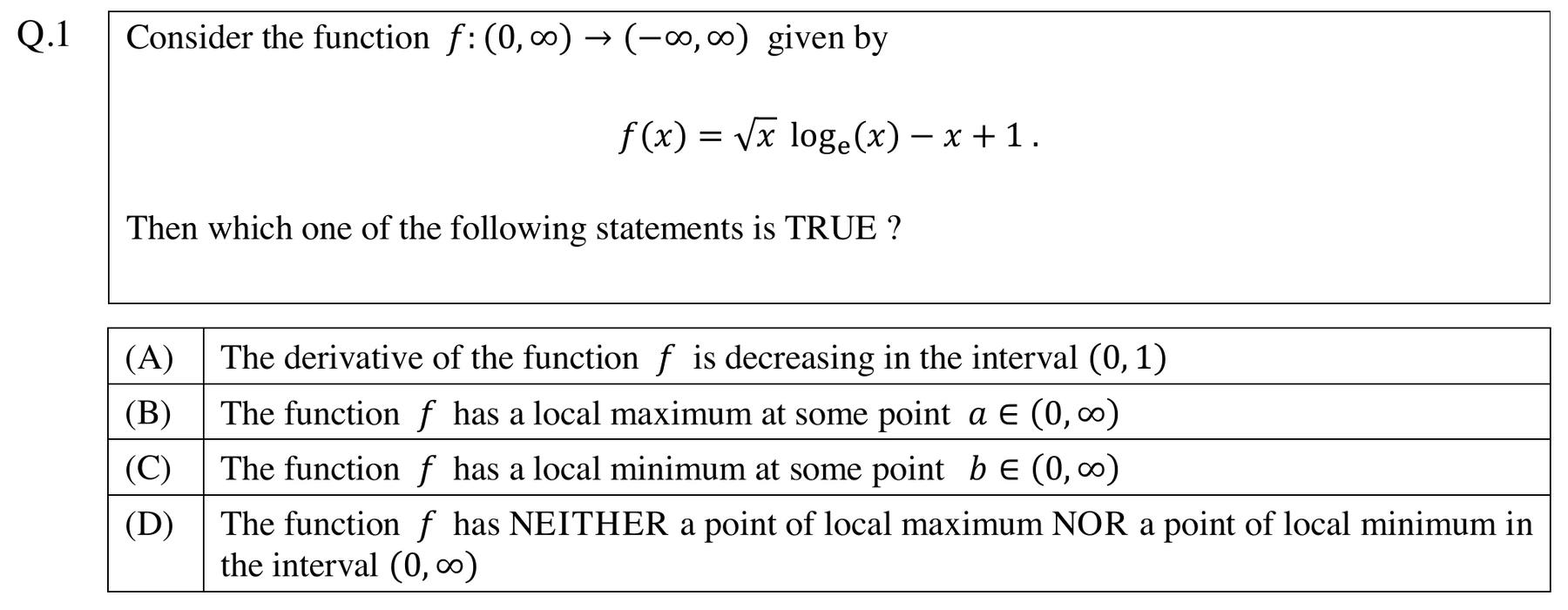
Consider f:(0,∞)→ℝ given by f(x)=√x ln x−x+1. Which statement is true?
Answer choices
- A. The derivative is decreasing on (0,1).
- B. f has a local maximum at some positive point.
- C. f has a local minimum at some positive point.
- D. f has neither a local maximum nor a local minimum on (0,∞).
The opening shows the question and choices. The illustrated reasoning follows, then the verified answer.
Watch the Question 1 video solution
Step-by-step solution
Differentiate twice
The second derivative is positive for 0<x<1 and negative for x>1.
Locate the maximum of the derivative
The derivative increases up to x=1 and decreases after it, so its unique maximum is zero. Option A is false.
Classify the stationary point
f(1)=0The derivative has the same negative sign on both sides of 1. Thus f continues decreasing through its stationary point and has no local extremum. B and C are false; D is true.
Answer: Choice D — No local maximum or local minimum
Details that commonly cause mistakes
- A stationary point need not be a local extremum.
- The sign of f′ determines monotonicity of f; the sign of f″ determines monotonicity of f′.
Question 2: Coordinate geometry · tangents and circumcircles
Format: Single-correct
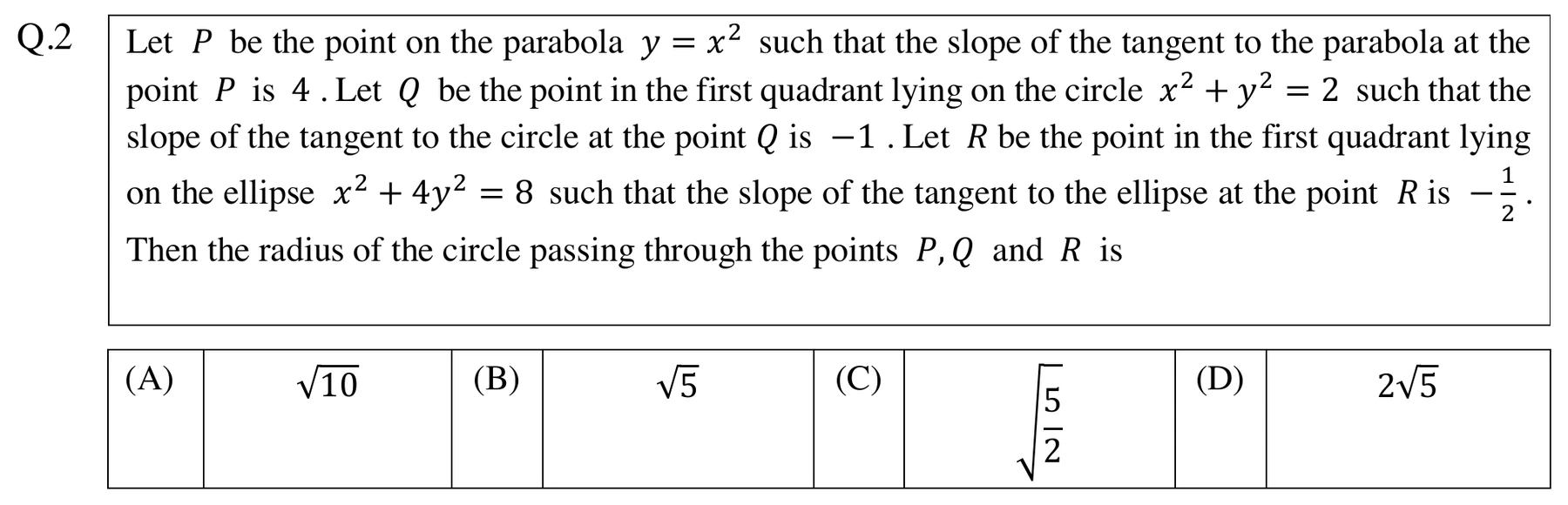
Let P on y=x² have tangent slope 4. Let Q in the first quadrant on x²+y²=2 have tangent slope −1. Let R in the first quadrant on x²+4y²=8 have tangent slope −1/2. Find the radius of the circle through P,Q,R.
Answer choices
- A. √10
- B. √5
- C. √(5/2)
- D. 2√5
The opening shows the question and choices. The illustrated reasoning follows, then the verified answer.
Watch the Question 2 video solution
Step-by-step solution
Find P
Substitute x=2 into y=x².
Find Q
The first-quadrant condition selects the positive coordinates.
Find R
Substitute x=2y into the ellipse to get y=1.
Use the right angle
RP is vertical and RQ is horizontal, so PQ is the diameter of the circumcircle.
Read the radius
The midpoint (3/2,5/2) is equidistant from all three points, providing an independent check. Choice C.
Answer: Choice C — √(5/2)
Details that commonly cause mistakes
- For x²+4y²=8 the derivative is −x/(4y), not −x/y.
- The circumradius is half the hypotenuse.
Question 3: Linear algebra · elementary row operations
Format: Single-correct
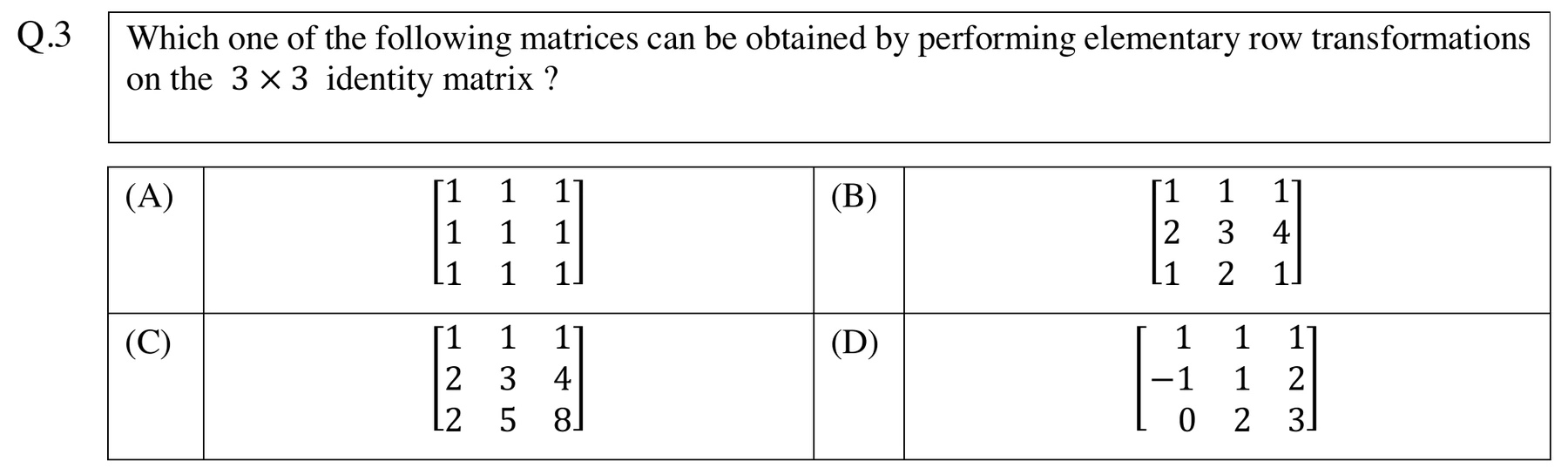
Which matrix can be obtained from the 3×3 identity matrix by elementary row transformations?
Answer choices
- A. [[1,1,1],[1,1,1],[1,1,1]]
- B. [[1,1,1],[2,3,4],[1,2,1]]
- C. [[1,1,1],[2,3,4],[2,5,8]]
- D. [[1,1,1],[-1,1,2],[0,2,3]]
The opening shows the question and choices. The illustrated reasoning follows, then the verified answer.
Watch the Question 3 video solution
Step-by-step solution
Use the invariant
Elementary row operations preserve rank and are reversible. Exactly the invertible 3×3 matrices can be obtained from I₃.
Reject the singular choices
A has repeated rows. In C, row 3 equals 3 row 2 minus 4 row 1. In D, row 3 equals row 1 plus row 2.
Check B
Subtract 2R₁ from R₂, subtract R₁ from R₃, then subtract the new R₂ from R₃. The triangular matrix has three nonzero pivots.
Reverse the reduction
Scale the last row and eliminate above its pivot, then eliminate the entry above the middle pivot. Reversing these operations constructs B from I₃. Choice B.
Answer: Choice B — Only matrix B is invertible
Details that commonly cause mistakes
- Row operations need not preserve the numerical determinant, but they preserve whether it is zero.
Question 4: Trigonometry · principal inverse values
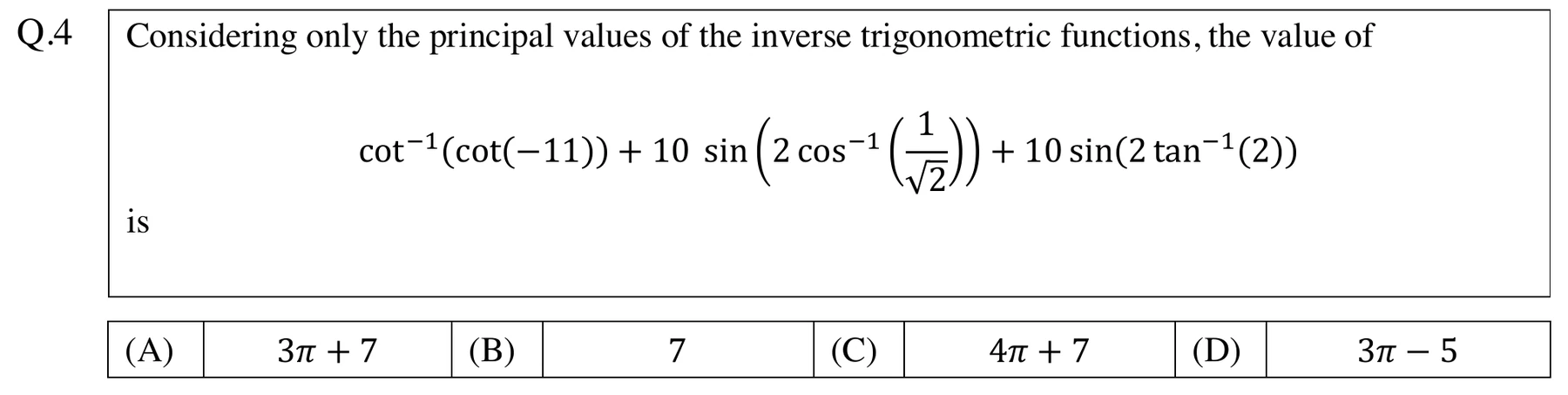
Format: Single-correct
Considering principal inverse trigonometric values, evaluate cot⁻¹(cot(−11))+10 sin(2 cos⁻¹(1/√2))+10 sin(2 tan⁻¹2).
Answer choices
- A. 3π+7
- B. 7
- C. 4π+7
- D. 3π−5
The opening shows the question and choices. The illustrated reasoning follows, then the verified answer.
Watch the Question 4 video solution
Step-by-step solution
Choose the principal range
All angles are in radians. An inverse function returns a principal angle; it is not a reciprocal.
Reduce the cotangent angle
Cotangent has period π, so cot⁻¹(cot(−11))=4π−11.
Evaluate the cosine term
The principal arccosine is π/4.
Evaluate the tangent term
The third term is 10×4/5=8. An acute right triangle with adjacent side 1, opposite side 2, and hypotenuse √5 verifies the identity.
Combine
The exact result matches choice C in the source key.
Answer: Choice C — 4π+7
Details that commonly cause mistakes
- Do not cancel cot⁻¹ and cot without checking the principal range.
- The factor 10 multiplies each sine term.
Question 5: Probability: independence and conditional probability
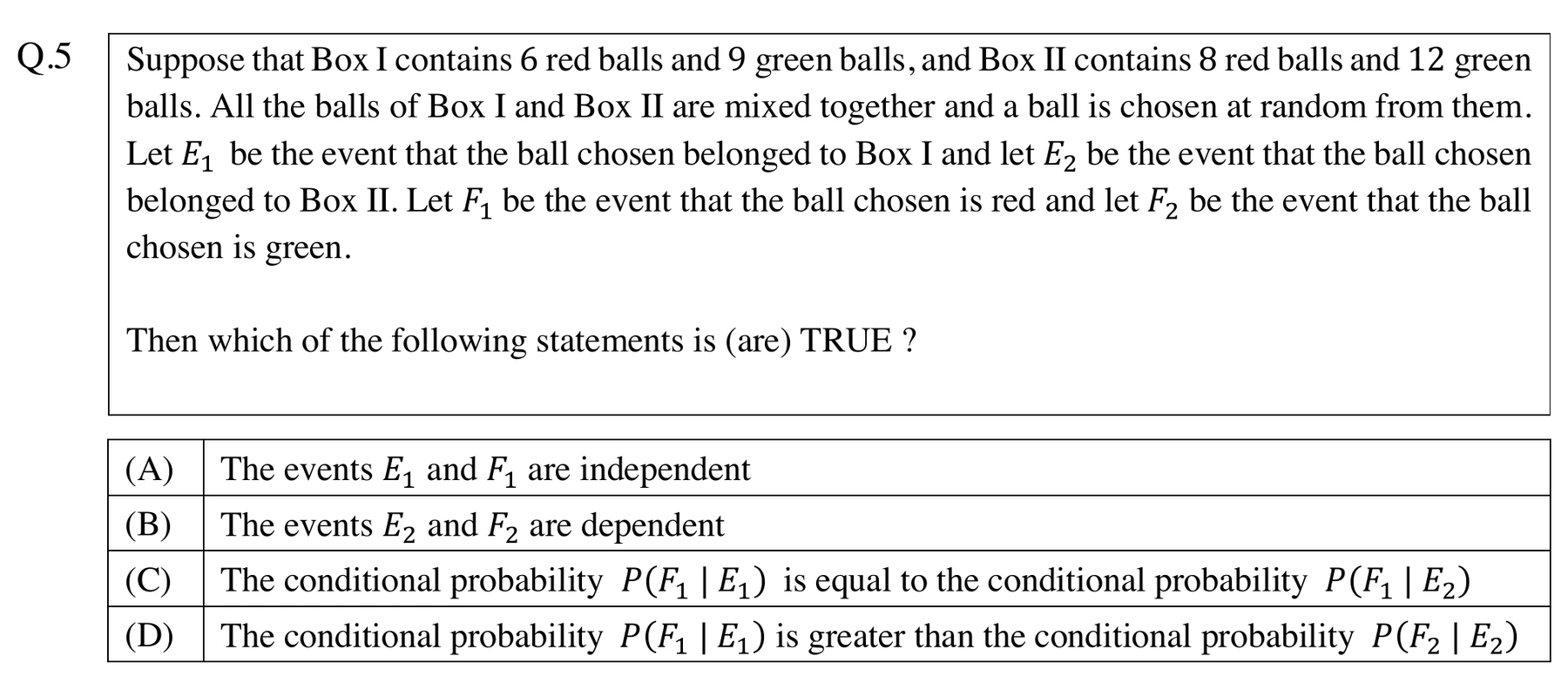
Format: Multiple-correct
Suppose that Box I contains 6 red balls and 9 green balls, and Box II contains 8 red balls and 12 green balls. All the balls of Box I and Box II are mixed together and a ball is chosen at random from them. Let E1 be the event that the ball chosen belonged to Box I and let E2 be the event that the ball chosen belonged to Box II. Let F1 be the event that the ball chosen is red and let F2 be the event that the ball chosen is green. Then which of the following statements is (are) TRUE?
Answer choices
- A. The events E1 and F1 are independent
- B. The events E2 and F2 are dependent
- C. The conditional probability P(F1 | E1) is equal to the conditional probability P(F1 | E2)
- D. The conditional probability P(F1 | E1) is greater than the conditional probability P(F2 | E2)
The opening shows the question and choices. The illustrated reasoning follows, then the verified answer.
Watch the Question 5 video solution
Step-by-step solution
Count each category
N=6+9+8+12=35; P(E1)=15/35=3/7; P(E2)=20/35=4/7; P(F1)=14/35=2/5; P(F2)=21/35=3/5Uniform selection from the mixed balls weights each box by its number of balls.
Option A
P(E1 ∩ F1)=6/35=(3/7)(2/5)=P(E1)P(F1)E1 and F1 are independent, so A is true.
Option B
P(E2 ∩ F2)=12/35=(4/7)(3/5)=P(E2)P(F2)E2 and F2 are independent, so the assertion that they are dependent is false.
Options C and D
P(F1|E1)=6/15=2/5; P(F1|E2)=8/20=2/5; P(F2|E2)=12/20=3/5The two red conditional probabilities are equal, making C true. Two fifths is less than three fifths, making D false.
Answer: Choices A, C — P(F1|E1)=P(F1|E2)=2/5; correct choices A and C
Details that commonly cause mistakes
- Do not assign each box probability 1/2: the selection is from all 35 balls.
- The word dependent in option B reverses the truth.
- D compares red from Box I with green from Box II, not red from both boxes.
Question 6: Three-dimensional geometry: planes, distances, and angles
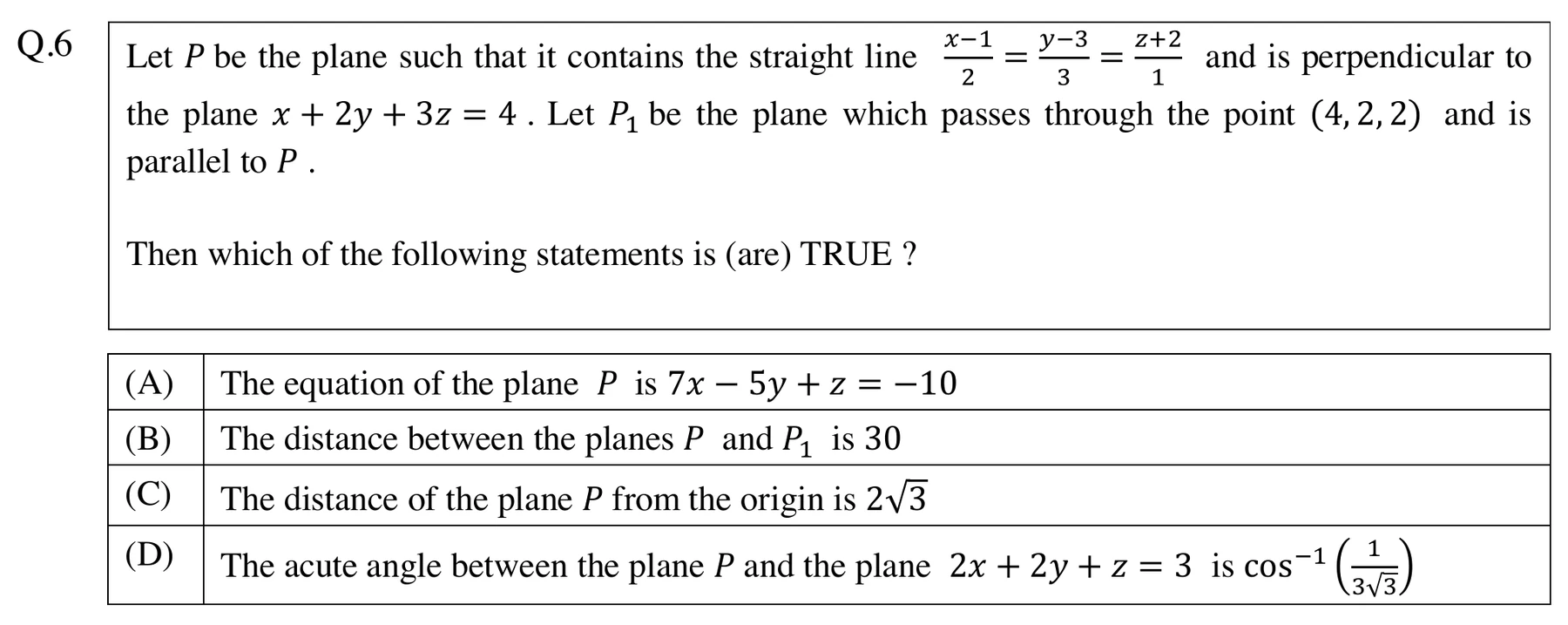
Format: Multiple-correct
Let P be the plane such that it contains the straight line (x-1)/2=(y-3)/3=(z+2)/1 and is perpendicular to the plane x+2y+3z=4. Let P1 be the plane which passes through the point (4,2,2) and is parallel to P. Then which of the following statements is (are) TRUE?
Answer choices
- A. The equation of the plane P is 7x-5y+z=-10
- B. The distance between the planes P and P1 is 30
- C. The distance of the plane P from the origin is 2√3
- D. The acute angle between the plane P and the plane 2x+2y+z=3 is cos^-1(1/(3√3))
The opening shows the question and choices. The illustrated reasoning follows, then the verified answer.
Watch the Question 6 video solution
Step-by-step solution
Find a normal
d=(2,3,1); m=(1,2,3); n=d×m=(7,-5,1); |n|=√75=5√3Containing the line requires n perpendicular to d; the perpendicular plane condition requires n perpendicular to m.
Plane equation and option A
Q=(1,3,-2); n·Q=7-15-2=-10; P:7x-5y+z=-10A is true. Substituting Q+t d yields -10 for every real t.
Parallel plane and option B
P1:7x-5y+z=20; distance=|20-(-10)|/√75=30/(5√3)=2√3The separation is 2√3, not 30, so B is false.
Origin distance and option C
distance(O,P)=10/√75=2/√3=2√3/3This is not 2√3; C is false.
Acute angle and option D
k=(2,2,1); |k|=3; |n·k|=|14-10+1|=5; cos θ=5/((5√3)3)=1/(3√3)The acute plane angle equals the acute angle between the normals, making D true.
Answer: Choices A, D — P: 7x-5y+z=-10; correct choices A and D
Details that commonly cause mistakes
- Perpendicular planes have perpendicular normal vectors.
- The gap in right-hand constants is not a distance until divided by the common normal length.
- Use the absolute dot product for the acute plane angle.
- The numerator in D is 1 and the full denominator is 3√3, as confirmed visually from the source page.
Question 7: Limits, continuity, differentiability, and counterexamples
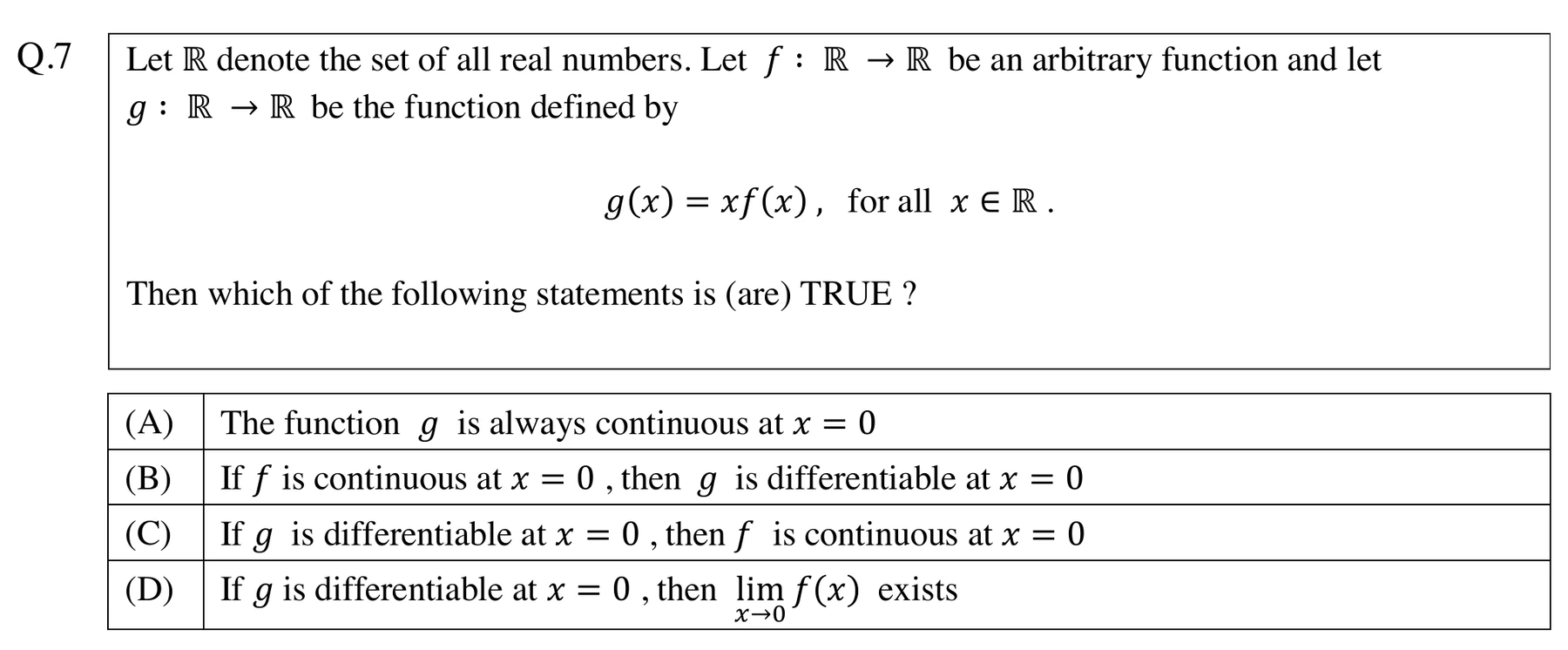
Format: Multiple-correct
Let R denote the set of all real numbers. Let f:R→R be an arbitrary function and let g:R→R be the function defined by g(x)=x f(x), for all x∈R. Then which of the following statements is (are) TRUE?
Answer choices
- A. The function g is always continuous at x=0
- B. If f is continuous at x=0, then g is differentiable at x=0
- C. If g is differentiable at x=0, then f is continuous at x=0
- D. If g is differentiable at x=0, then lim(x→0) f(x) exists
The opening shows the question and choices. The illustrated reasoning follows, then the verified answer.
Watch the Question 7 video solution
Step-by-step solution
Core derivative identity
g(0)=0 · f(0)=0; [g(h)-g(0)]/h=f(h) for h≠0Consequently g is differentiable at zero if and only if the finite two-sided limit of f at zero exists. Its value need not equal f(0).
A is false
f(0)=0; f(x)=1/x for x≠0. Then g(0)=0 and g(x)=1 for x≠0.The punctured limit of g is 1 but g(0)=0, so g need not be continuous at zero.
B is true
f continuous at 0 ⇒ lim(h→0) f(h)=f(0) ⇒ g′(0)=f(0)Continuity of f supplies exactly the finite difference-quotient limit needed for g.
C is false
f(0)=0; f(x)=1 for x≠0. Then g(x)=x for every real x, so g′(0)=1 while f is discontinuous at 0.g cannot detect the chosen value f(0), because multiplication by x erases it at zero.
D is true
g differentiable at 0 ⇒ lim(h→0)[g(h)-g(0)]/h exists finitely ⇒ lim(h→0)f(h)=g′(0)The derivative implies existence of the punctured limit, but does not force equality with f(0).
Answer: Choices B, D — g′(0)=lim(h→0) f(h), whenever the limit exists; correct choices B and D
Details that commonly cause mistakes
- Do not assume an arbitrary real-valued function is bounded near zero.
- Multiplication by x does not always repair a singularity.
- The value f(0) does not affect g at any point; at zero it is multiplied by zero.
- Existence of a finite two-sided limit is weaker than continuity, which also requires agreement with f(0).
Question 8: Matrices: nilpotent decomposition, integer inverses, linear systems
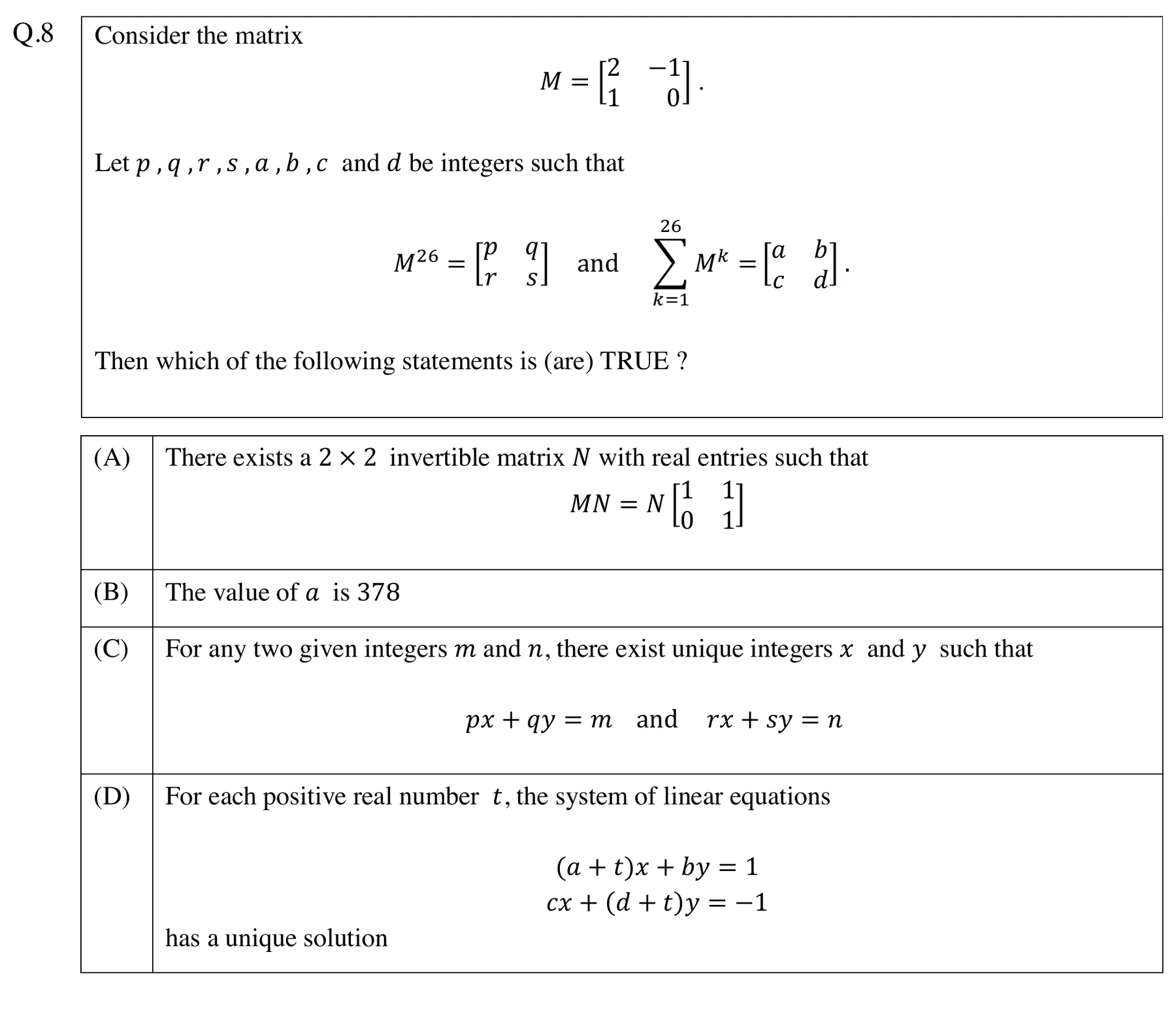
Format: Multiple-correct
Consider M = [[2, -1], [1, 0]]. Let p,q,r,s,a,b,c,d be integers such that M^26 = [[p,q],[r,s]] and sum from k=1 to 26 of M^k = [[a,b],[c,d]]. Which statements are true?
Answer choices
- A. There exists a 2 by 2 invertible matrix N with real entries such that MN = N[[1,1],[0,1]].
- B. The value of a is 378.
- C. For any two given integers m and n, there exist unique integers x and y such that px+qy=m and rx+sy=n.
- D. For each positive real number t, the system (a+t)x+by=1, cx+(d+t)y=-1 has a unique solution.
Watch the Question 8 video solution
Step-by-step solution
Step 1
Set K=M-I=[[1,-1],[1,-1]]. Direct multiplication gives K^2=0, hence M^k=I+kK.
Step 2
A: N=[[1,1],[1,0]] has determinant -1 and MN=NJ for J=[[1,1],[0,1]]. Both sides equal [[1,2],[1,1]].
Step 3
Sum k=1..26 is 351, so S=26I+351K=[[377,-351],[351,-325]]. Thus a=377, and B is false.
Step 4
M^26=[[27,-26],[26,-25]], determinant 1, inverse [[-25,26],[-26,27]]. Hence x=-25m+26n and y=-26m+27n are unique integers for any integer m,n. C is true.
Step 5
det(S+tI)=(t+377)(t-325)+351^2=t^2+52t+676=(t+26)^2>0 for t>0. D is true, for the specified right-hand side and indeed any real right-hand side.
Step 6
All true statements are A, C and D.
Answer: Choices A, C, D — A, C and D
Details that commonly cause mistakes
- This is multiple-correct: all of A,C,D must be selected.
- A repeated eigenvalue does not make M diagonalizable; A specifies its Jordan form.
- The sum is 26+351=377 in the top-left, not 378.
- A real inverse alone does not prove integer solutions; determinant 1 and the explicit integer inverse do.
Question 9: Equivalence relations and set partitions
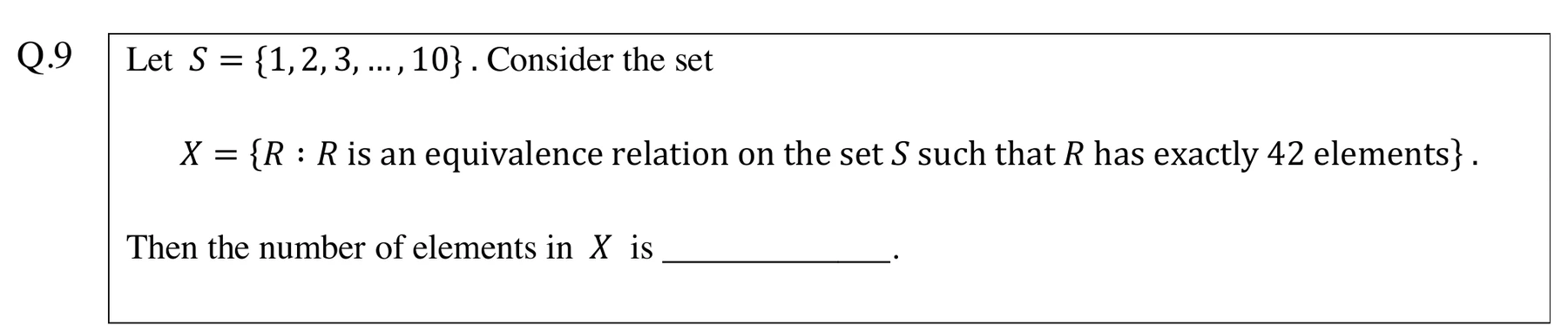
Format: Numerical-value
Let S={1,2,3,...,10}. Let X={R: R is an equivalence relation on S such that R has exactly 42 elements}. Find the number of elements in X.
The opening shows the question and choices. The illustrated reasoning follows, then the verified answer.
Watch the Question 9 video solution
Step-by-step solution
Step 1
Equivalence relations correspond one-to-one to partitions of S. For class sizes n_i, sum(n_i)=10 and |R|=sum(n_i^2)=42, because every ordered pair inside a class belongs to R.
Step 2
If largest size L<=4, sum n_i^2<=L sum n_i<=40, impossible. If L>=7, L^2>=49>42. Thus L=5 or 6.
Step 3
(6,2,1,1)L=6 leaves total size 4 and square sum 6. All remaining sizes are <=2. If u classes have size 2 and v have size 1, 2u+v=4 and 4u+v=6, giving u=1,v=2. Pattern (6,2,1,1).
Step 4
(5,4,1)L=5 leaves total size 5 and square sum 17. A remaining largest size <=3 would give square sum <=3*5=15. Therefore there is a size 4 and the remaining size 1. Pattern (5,4,1).
Step 5
C(10,6)C(4,2)=1260For (6,2,1,1), choose the 6-class and then the 2-class: C(10,6)C(4,2)=210*6=1260. Equivalently 10!/(6!2!2!); the last 2! removes the order of equal singleton classes.
Step 6
For (5,4,1), choose the 5-class and then the 4-class: C(10,5)C(5,4)=252*5=1260. Total 1260+1260=2520.
Answer: 2520
Details that commonly cause mistakes
- The 42 elements of R are ordered pairs, not equivalence classes.
- Partitions of S are not just integer partitions; elements are labeled.
- Do not order the two singleton classes in (6,2,1,1).
- The answer is numerical; no answer letter should be invented.
Question 10: Continuity, differentiability, absolute values and greatest-integer function
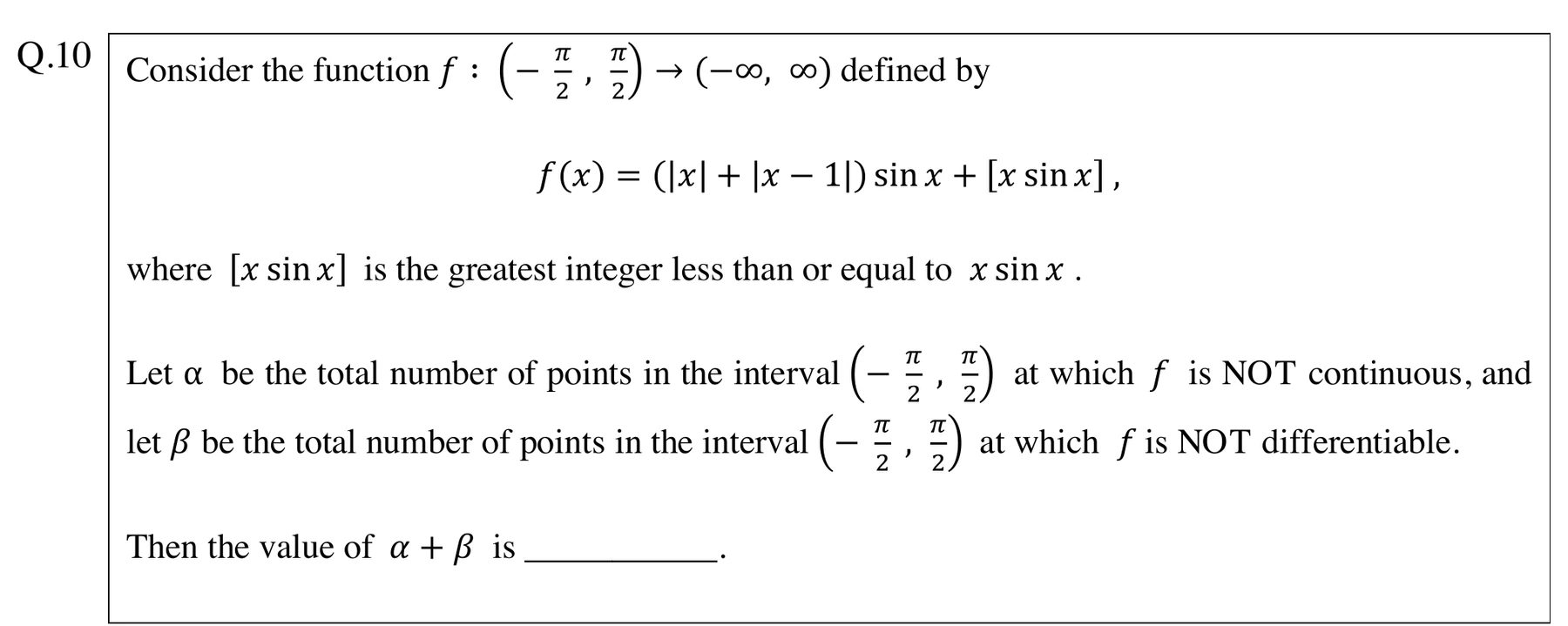
Format: Numerical-value
On (-π/2,π/2), f(x)=(|x|+|x-1|)sin x+floor(x sin x). Let α be the number of discontinuities and β the number of nondifferentiability points in this open interval. Find α+β.
Question 10 video update
Video lesson awaiting completion. The complete written solution is available now.
Step-by-step solution
Step 1
Write f=g+floor(h), with g=(|x|+|x-1|)sin x continuous, h=x sin x. The absolute-value coefficient is 1-2x for x<0, 1 for 0<=x<=1, and 2x-1 for x>1.
Step 2
h is even, h(0)=0, and h'(x)=sin x+x cos x>0 for 0<x<π/2. Its range is [0,π/2), with 1<π/2<2, so h=1 has exactly two roots ±a. Also h(1)=sin1<1, hence 1<a<π/2.
Step 3
floor(h)=0 for |x|<a and 1 for a<=|x|<π/2. Thus it has jumps at -a and a only. At zero it remains zero on a full neighborhood, despite h(0)=0. Since g is continuous, f has exactly these two discontinuities. α=2.
Step 4
f'_-(0)=f'_+(0)=1At x=0, g'_-(0)=g'_+(0)=1; floor(h) is locally zero. Hence f is differentiable at zero.
Step 5
At x=1, g'_-(1)=cos1 and g'_+(1)=cos1+2sin1, which differ because sin1>0. The floor is locally zero since a>1, so f is not differentiable at 1. Away from -a,a,0,1 both summands are smooth or locally constant. β=3, at -a,1,a.
Step 6
α+β=2+3=5. The domain endpoints are excluded.
Answer: α + β = 2 + 3 = 5
Details that commonly cause mistakes
- An absolute-value corner at zero does not necessarily survive multiplication by sin x; here it cancels in the first derivative.
- A floor argument equaling an integer need not create a jump: h=0 at its minimum x=0 gives no jump.
- Count discontinuities again within β because differentiability implies continuity.
- The two interval endpoints are excluded.
- The answer is numerical; no answer letter should be invented.
Question 11: Combinatorics: bounded compositions, stars and bars, inclusion-exclusion

Format: Numerical-value
The number of ways to distribute 10 identical red pens and 14 identical blue pens among four persons such that each person gets 6 pens, is _____________.
The opening shows the question and choices. The illustrated reasoning follows, then the verified answer.
Watch the Question 11 video solution
Step-by-step solution
Reduce to red counts
r1+r2+r3+r4=10, 0<=ri<=6; bi=6-ri; sum bi=14A valid four-tuple of red counts determines exactly one complete distribution; the four persons are distinct.
Unrestricted nonnegative solutions
C(10+4-1,4-1)=C(13,3)=286Stars and bars temporarily ignores the upper bound.
Remove invalid allocations
ri>=7 => yi=ri-7; y1+y2+y3+y4=3; C(6,3)=20For each specified person, exactly 20 unrestricted allocations give that person at least 7 red pens.
No intersections and final count
7+7>10; N=C(13,3)-4 C(6,3)=286-80=206Two simultaneous violations are impossible, so no overlap correction is needed.
Answer: 206
Details that commonly cause mistakes
- Pens of each color are identical; persons are distinct.
- The upper bound is six, so invalid counts start at seven.
- Do not multiply by an additional blue count: each red count fixes that person's blue count.
Question 12: Trigonometry: triple-angle identity and telescoping products

Format: Numerical-value
Let α=(1−2cos(π/11))(1−2cos(3π/11))(1−2cos(9π/11))(1−2cos(27π/11))(1−2cos(81π/11)). Then the value of 5−α² is _____________.
The opening shows the question and choices. The illustrated reasoning follows, then the verified answer.
Watch the Question 12 video solution
Step-by-step solution
Ratio identity
cos3t/cos t=4cos²t−3=2cos2t−1; 1−2cos x=−cos(3x/2)/cos(x/2)Apply the cosine triple-angle formula with t=x/2.
Denominators do not vanish
ck=cos(3^k π/22), k=0,...,5; ck=0 =>3^k=11(2m+1), impossibleA power of three is not divisible by eleven, so all relevant cosine ratios are defined.
Telescope five factors
α=∏[k=0..4](−c(k+1)/ck)=−c5/c0=−cos(243π/22)/cos(π/22)Four intermediate factors cancel; five negative signs give one negative sign.
Evaluate the final ratio
243π/22=11π+π/22; cos(243π/22)=−cos(π/22); α=1Cosine changes sign after adding an odd multiple of pi.
Compute the requested expression
5−α²=5−1²=4 ∈[3.9,4.1]The exact value 4 agrees with the provisional key's accepted interval.
Answer: 4
Details that commonly cause mistakes
- The requested value is 5−α², not α.
- Use the cosine ratio with a minus sign: the plus-cosine sine ratio would be the wrong identity.
- There are five factors, so their five minus signs give an overall minus sign.
- Angles are in radians; 81π/11 is the final original factor and 243π/22 the last telescoped numerator.
Question 13: Complex roots, cyclic powers and Vieta formulas
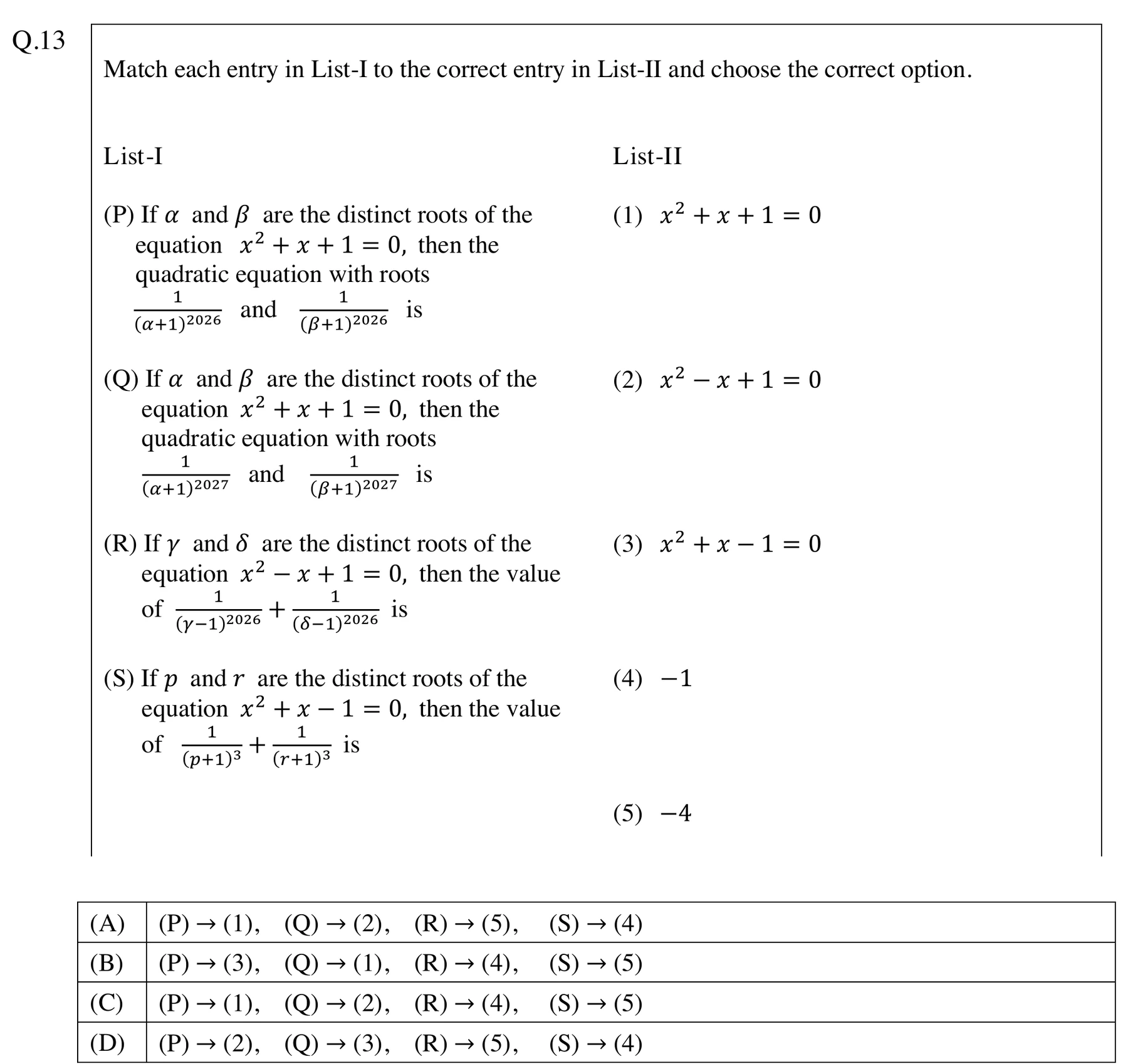
Format: Matching-list
Match List-I with List-II. P: for distinct roots α,β of x²+x+1=0, find the quadratic with roots (α+1)^(-2026),(β+1)^(-2026). Q: the same with exponent -2027. R: for distinct roots γ,δ of x²−x+1=0, evaluate (γ−1)^(-2026)+(δ−1)^(-2026). S: for distinct roots p,r of x²+x−1=0, evaluate (p+1)^(-3)+(r+1)^(-3). List-II: (1) x²+x+1=0; (2) x²−x+1=0; (3) x²+x−1=0; (4) −1; (5) −4.
Answer choices
- A. P→1, Q→2, R→5, S→4
- B. P→3, Q→1, R→4, S→5
- C. P→1, Q→2, R→4, S→5
- D. P→2, Q→3, R→5, S→4
Watch the Question 13 video solution
Step-by-step solution
P: transform to sixth roots
u=α+1,v=β+1; u+v=uv=1; u²−u+1=v²−v+1=0; u³=v³=−1; u⁶=v⁶=1. 2026≡4 (mod 6), so u^(−2026)=u², v^(−2026)=v². Sum=−1, product=1.P gives x²+x+1=0, List-II entry 1.
Q: reciprocal power is the original shifted root
2027≡5 (mod 6); u^(−2027)=u, v^(−2027)=v; sum=1, product=1.Q gives x²−x+1=0, entry 2.
R: shifted roots are cube roots of unity
a=γ−1,b=δ−1; a+b=−1,ab=1; a³=b³=1. 2026≡1 (mod 3), so a^(−2026)+b^(−2026)=1/a+1/b=(a+b)/(ab)=−1.R matches entry 4.
S: reciprocal substitution removes denominators
p(p+1)=r(r+1)=1; (p+1)^(-3)+(r+1)^(-3)=p³+r³=(p+r)³−3pr(p+r)=−1−3=−4.S matches entry 5. The entire mapping uniquely gives C.
Answer: Choice C — P→1, Q→2, R→4, S→5
Details that commonly cause mistakes
- P and Q ask for quadratics, whereas R and S ask for scalar values.
- The minus one in R is inside each denominator before the power.
- Do not interchange entries 4 (−1) and 5 (−4).
- In S, p+r=−1 and pr=−1; the cubic correction is −3, not +3.
Question 14: Trigonometric equations and counting on closed intervals
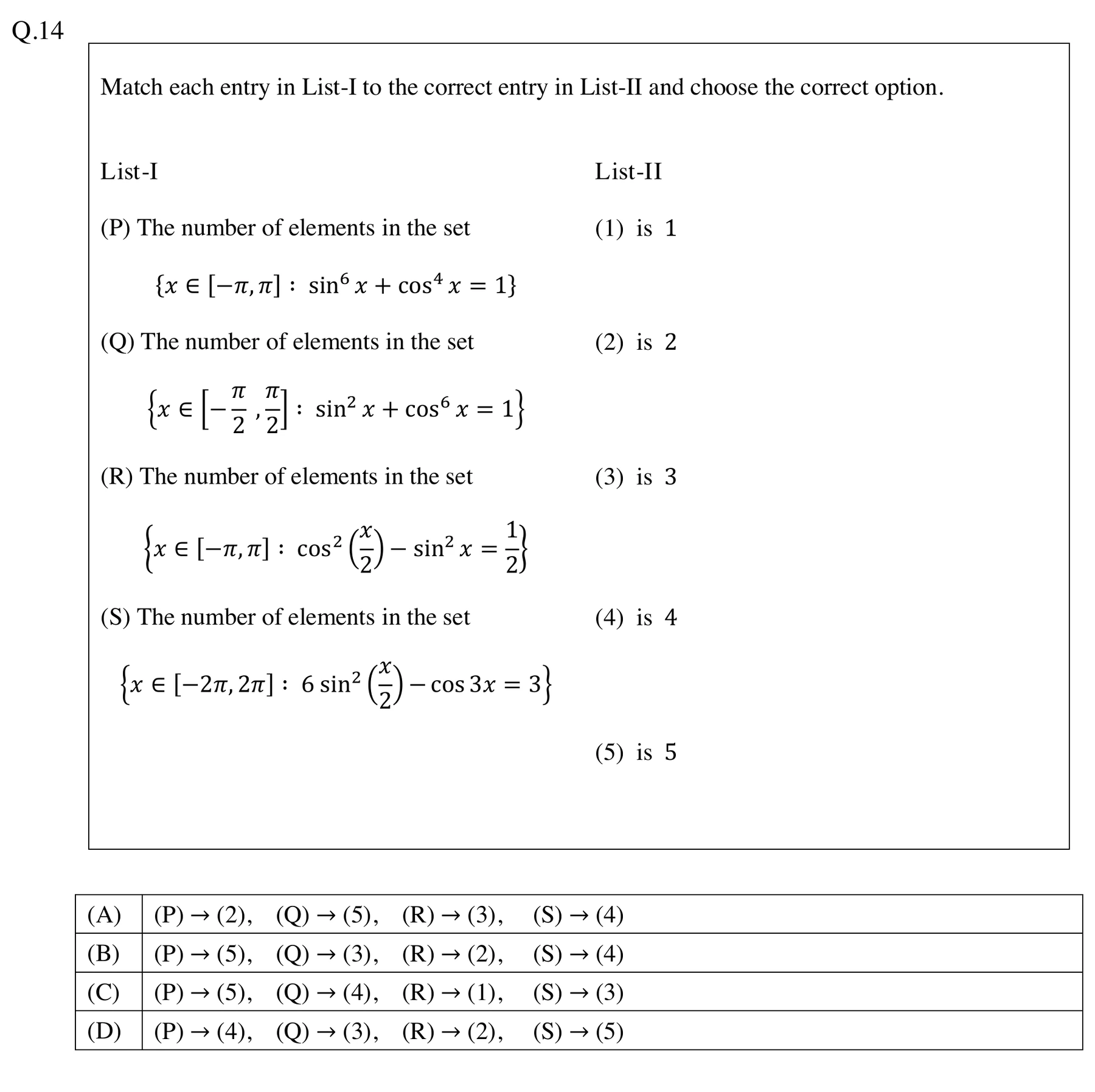
Format: Matching-list
Match the cardinalities in List-I to List-II. P: {x∈[−π,π]: sin⁶x+cos⁴x=1}; Q: {x∈[−π/2,π/2]: sin²x+cos⁶x=1}; R: {x∈[−π,π]: cos²(x/2)−sin²x=1/2}; S: {x∈[−2π,2π]: 6sin²(x/2)−cos(3x)=3}. List-II entries (1),(2),(3),(4),(5) mean counts 1,2,3,4,5 respectively.
Answer choices
- A. P→2, Q→5, R→3, S→4
- B. P→5, Q→3, R→2, S→4
- C. P→5, Q→4, R→1, S→3
- D. P→4, Q→3, R→2, S→5
Question 14 video update
The current public upload is portrait and is withheld from this horizontal lesson collection. The complete written solution is available now.
Step-by-step solution
P: polynomial in sin²x
t=sin²x∈[0,1]; t³+(1−t)²=1 ⇒ t(t+2)(t−1)=0 ⇒ t=0 or 1. x∈{−π,−π/2,0,π/2,π}.Five distinct real x values, including both closed endpoints: P→5.
Q: polynomial in cos²x
u=cos²x∈[0,1]; 1−u+u³=1 ⇒ u(u−1)(u+1)=0 ⇒ u=0 or 1. x∈{−π/2,0,π/2}.Three values, including both closed endpoints: Q→3.
R: reject the cosine root outside [−1,1]
c=cos x; (1+c)/2−(1−c²)=1/2 ⇒ 2c²+c−2=0 ⇒ c=(−1±√17)/4. c₋<−1, while 0<c₊<1. x=±arccos((√17−1)/4).Exactly two solutions within [−π,π]: R→2.
S: triple-angle cancellation
3(1−cos x)−cos 3x=3 ⇒ 3cos x+cos 3x=0 ⇒ 4cos³x=0. x∈{−3π/2,−π/2,π/2,3π/2}.Exactly four solutions within [−2π,2π]: S→4. The complete map uniquely selects B.
Answer: Choice B — P→5, Q→3, R→2, S→4
Details that commonly cause mistakes
- Every interval is closed: P includes both −π and π, while Q includes both ±π/2.
- P has sin⁶x+cos⁴x; Q has sin²x+cos⁶x.
- cos²(x/2) is the square of cosine of the half angle; cos(3x) is a triple-angle cosine.
- R has two quadratic roots for cos x, but one is below −1 and must be rejected.
- Count distinct real x values, not only possible sine or cosine values.
Question 15: Orthogonal matrices and vector products
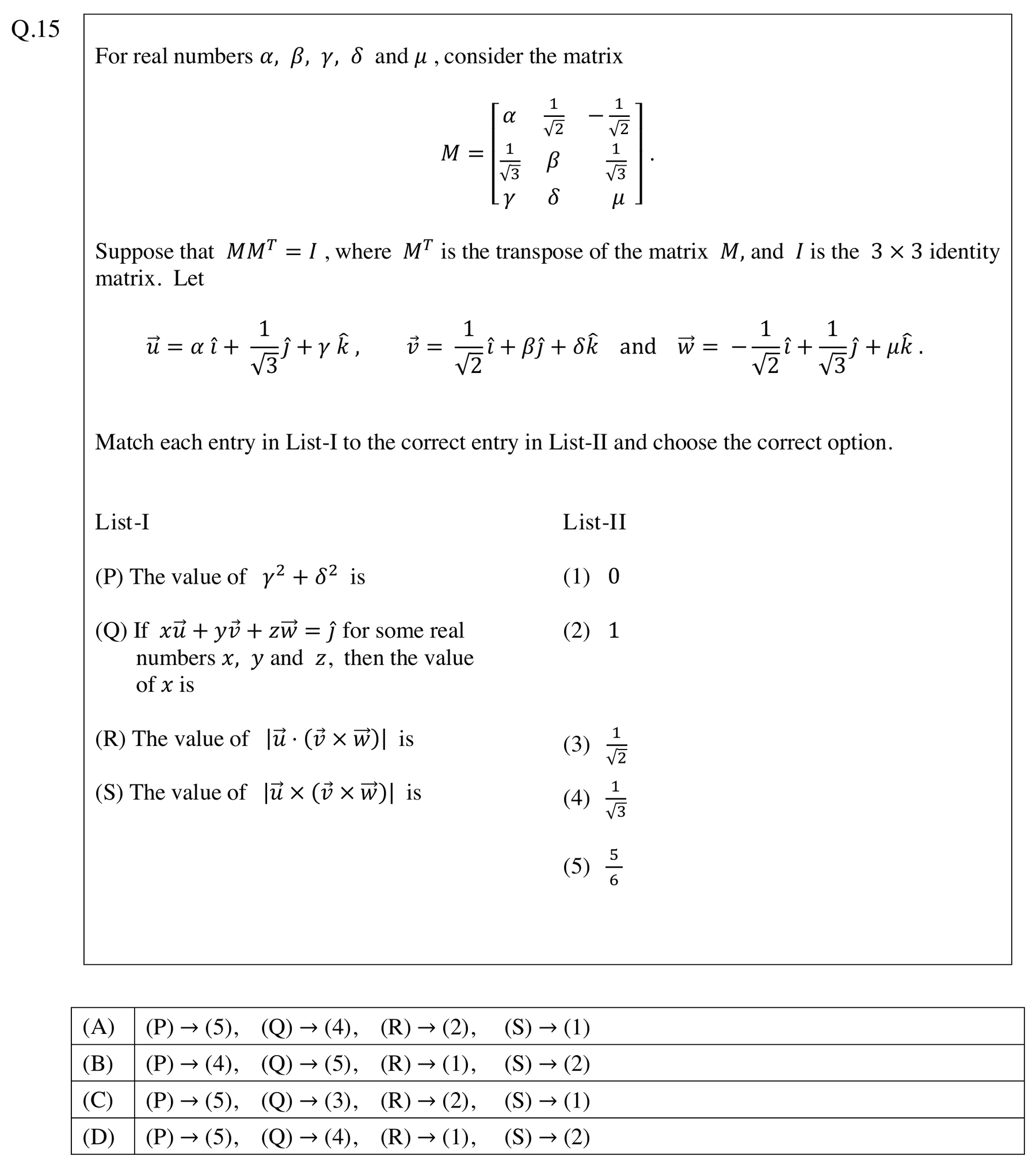
Format: Matching-list
For real numbers α, β, γ, δ and μ, let M=[[α,1/√2,−1/√2],[1/√3,β,1/√3],[γ,δ,μ]] and suppose MMᵀ=I₃. Let u=(α,1/√3,γ), v=(1/√2,β,δ), w=(−1/√2,1/√3,μ). Match List I to List II and choose the correct option.
List I
- P. γ²+δ²
- Q. x, where xu+yv+zw=ĵ for real x,y,z
- R. |u·(v×w)|
- S. |u×(v×w)|
List II
- 1. 0
- 2. 1
- 3. 1/√2
- 4. 1/√3
- 5. 5/6
Answer choices
- A. P→5, Q→4, R→2, S→1
- B. P→4, Q→5, R→1, S→2
- C. P→5, Q→3, R→2, S→1
- D. P→5, Q→4, R→1, S→2
Watch the Question 15 video solution
Step-by-step solution
Rows and columns are orthonormal
MMᵀ=I ⇒ M⁻¹=Mᵀ ⇒ MᵀM=IBecause M is square, the hypothesis implies invertibility and makes both its rows and its columns orthonormal.
P: use the third column and third row
1/2+1/3+μ²=1 ⇒ μ²=1/6; γ²+δ²+μ²=1 ⇒ γ²+δ²=5/6P matches List II entry 5.
Q: project onto u
u·(xu+yv+zw)=u·ĵ ⇒ x=1/√3u has unit length and is perpendicular to v and w. Q matches entry 4.
R: determinant magnitude
|u·(v×w)|=|det M|; (det M)²=det(MMᵀ)=1 ⇒ |det M|=1The determinant may have either sign, but its absolute value is always 1. R matches entry 2.
S: vector triple product
u×(v×w)=v(u·w)−w(u·v)=0 ⇒ |u×(v×w)|=0Both scalar products vanish by orthogonality. S matches entry 1.
Answer: Choice A — P→5, Q→4, R→2, S→1; values (5/6,1/√3,1,0)
Details that commonly cause mistakes
- MMᵀ=I gives column orthogonality because the matrix is square; explain that implication.
- Do not replace |det M| with an unjustified positive determinant: either orientation is allowed.
- The cross product is not associative: S means u×(v×w).
- Q asks for x, whose value comes from the j component of u, not from v.
Question 16: Coordinate geometry: circle, parabola, ellipse and hyperbola
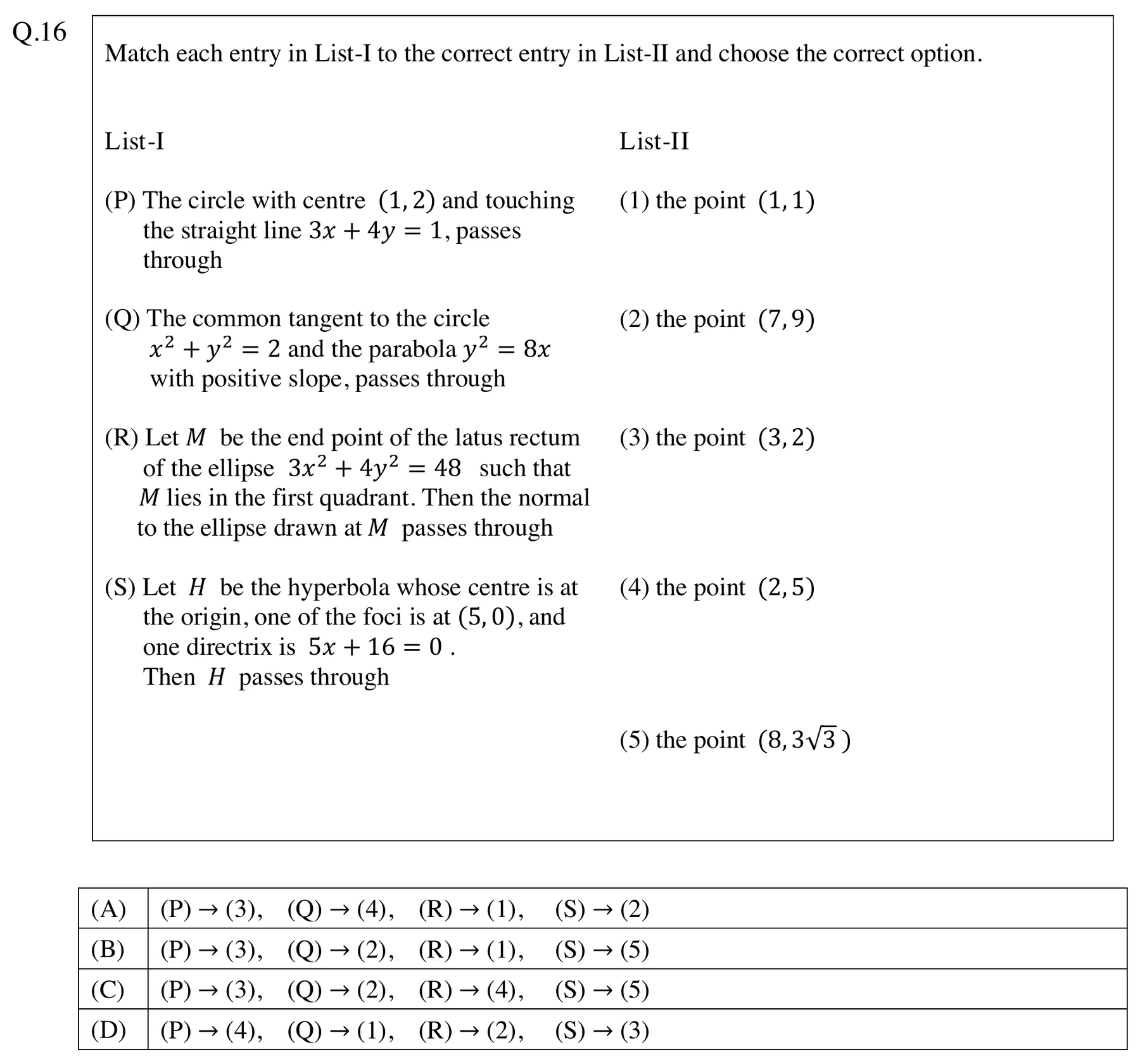
Format: Matching-list
Match each entry in List I to the correct point in List II and choose the correct option.
List I
- P. The circle with centre (1,2), touching 3x+4y=1, passes through which point?
- Q. The common tangent to x²+y²=2 and y²=8x with positive slope passes through which point?
- R. M is the first-quadrant endpoint of the latus rectum of 3x²+4y²=48. The normal at M passes through which point?
- S. H is the hyperbola centred at the origin, with one focus (5,0) and one directrix 5x+16=0. H passes through which point?
List II
- 1. (1,1)
- 2. (7,9)
- 3. (3,2)
- 4. (2,5)
- 5. (8,3√3)
Answer choices
- A. P→3, Q→4, R→1, S→2
- B. P→3, Q→2, R→1, S→5
- C. P→3, Q→2, R→4, S→5
- D. P→4, Q→1, R→2, S→3
Watch the Question 16 video solution
Step-by-step solution
P: circle radius from a tangent line
r=|3(1)+4(2)−1|/√(3²+4²)=2; (x−1)²+(y−2)²=4The point (3,2) satisfies the circle equation, so P→3.
Q: common tangent with positive slope
y=mx+2/m; (2/m)²/(1+m²)=2 ⇒ m⁴+m²−2=0 ⇒ (m²−1)(m²+2)=0 ⇒ m=1; y=x+2The only positive real slope is m=1. The line passes through (7,9), so Q→2. Its distance from the origin is √2, and substitution into y²=8x gives (x−2)²=0, confirming tangency to both curves.
R: normal at the first-quadrant latus rectum endpoint
x²/16+y²/12=1; a=4,b²=12,c=2; M=(c,b²/a)=(2,3); dy/dx=−3x/(4y)=−1/2; normal: y−3=2(x−2)The normal is y=2x−1 and passes through (1,1), so R→1.
S: hyperbola from a focus and a directrix
c=5; a²/c=16/5 ⇒ a²=16; b²=c²−a²=9; x²/16−y²/9=1At (8,3√3), the left side is 4−3=1, so S→5.
Match to the choices and source key
P→3, Q→2, R→1, S→5 ⇒ BThis complete mapping is exactly option B, matching the supplied provisional answer key B.
Answer: Choice B — P→3, Q→2, R→1, S→5
Details that commonly cause mistakes
- Use the centre-to-line distance for P, not the distance from the origin.
- Q specifies positive slope: the negative-slope common tangent is not the requested line.
- For R, the latus rectum endpoint is (2,3), not the vertex (4,0) or focus (2,0).
- The normal slope is the negative reciprocal of the tangent slope.
- For S, the directrix distance is a/e=a²/c, not a or c.
How the question videos were made and checked
Each lesson begins with one image containing only the question and its choices. The answer key was kept out of that opening image. The narrator reads the complete prompt while it remains visible, then the lesson moves to progressive illustrated steps and ends with the checked answer.
The written derivations were checked against the supplied provisional key before video creation. A video is embedded here only after its public YouTube playback, title, channel, and horizontal dimensions were verified. This is why some questions already have complete written solutions but still show a video placeholder.
To make a similar lesson, start with the Golpo AI exam-question workflow. The related guides explain how to turn a PDF into a video, insert a question image, choose between Canvas Compact and Expanded styles, write Video Instructions, and set Voice Instructions.
Create an illustrated lesson with Golpo AI
Frequently asked questions
How did Golpo AI turn each IIT JEE Advanced question into a video lesson?
Each lesson began with one clean screenshot containing the full question and answer choices. Golpo read it aloud, solved the problem, explained the reasoning step by step with progressive illustrations and equations, and revealed the verified answer at the end.
What was Codex’s role?
Codex served as Golpo’s QA collaborator. It prepared the answer-key-free question image, checked Golpo’s draft reasoning and final choice against the supplied provisional key, requested corrections when needed, and audited the finished video before publication.
Where can I watch the IIT JEE Advanced 2026 Mathematics playlist?
Open the IIT JEE Advanced 2026 Mathematics YouTube playlist ↗. The same approved videos also appear beside their questions below.
Does this guide cover the full Mathematics Paper 1?
Yes. It includes all 16 questions: four single-correct, four multiple-correct, four numerical-value, and four matching-list questions.
Are these official JEE Advanced solutions?
No. These are independently worked solutions based on the supplied JEE Advanced 2026 Mathematics Paper 1 provisional question paper and answer key.
Which Mathematics video solutions are available?
Fourteen verified horizontal Golpo AI lessons are embedded for Questions 1–9, 11–13, 15, and 16. Question 10 remains in production, and Question 14 is withheld because its current public upload is portrait; both written solutions remain available.
How were the answers checked?
Each written derivation was checked against the supplied provisional key. A video appears here only after its public YouTube playback, title, channel, and horizontal dimensions were checked.
How were the Golpo AI lessons made?
Golpo solved each problem, returned the first step-by-step script for review, and created the narrated progressive Canvas lesson. Codex collaborated by preparing the answer-key-free source image, checking and revising Golpo's returned script against the supplied answer choice, authorizing the render, and auditing the finished MP4.
These independently prepared solutions are based on the supplied provisional question paper and key. They are not an official publication of the examination authority.
Tags


