Home Health and Hospice Caregiver Videos from Care Documents
See four document-only videos for start of care, transfer checks, comfort-kit orientation, and after-hours routing—with hands-on competency preserved.

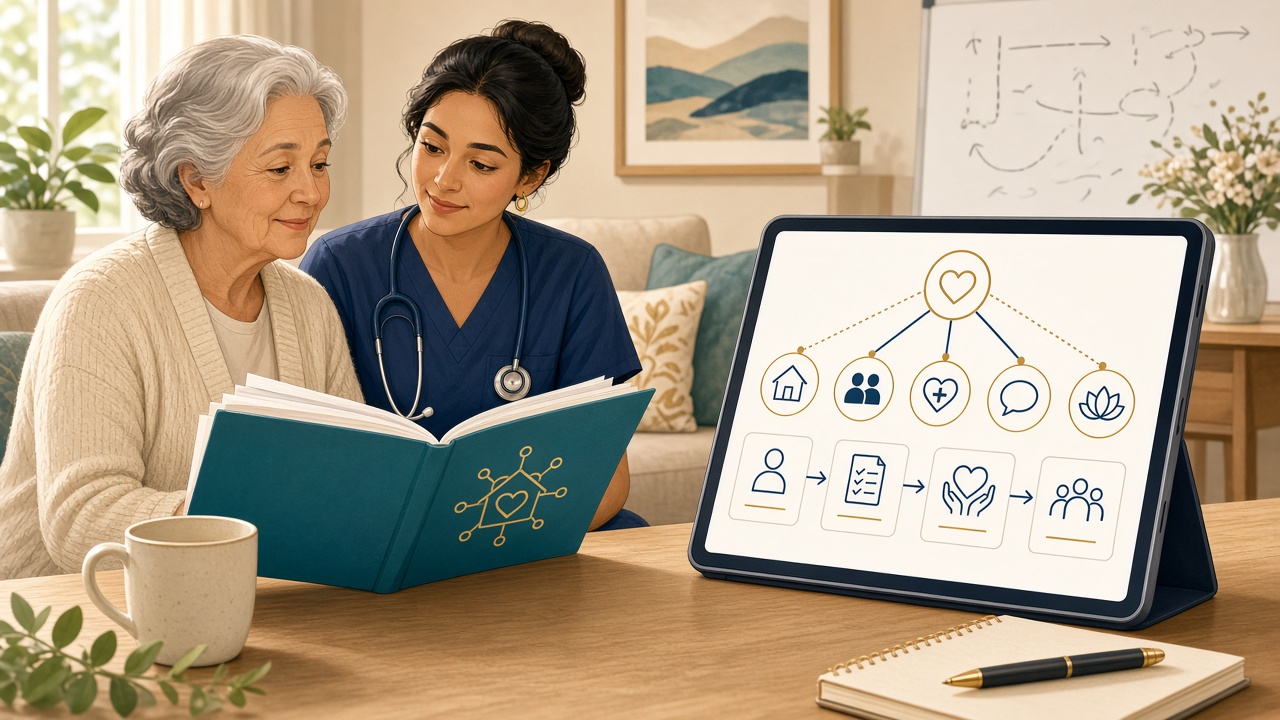
The direct answer: Turn branch-specific care folders and approved caregiver handouts into replayable orientation while keeping assessment, orders, and demonstrated competency with the care team.
This guide is for home-health agencies, hospice programs, palliative-care teams, and family caregiver education leaders. It contains four real Golpo videos. Each was generated from the source PDF or PowerPoint shown beside it. No narration script was supplied.
The business problem
- A family caregiver receives large amounts of information during a stressful transition.
- Branch phone numbers, after-hours routes, equipment contacts, and visit expectations are operational details that must remain exact.
- Some tasks require the caregiver to demonstrate safe use to staff satisfaction; watching cannot establish competency.
- Medication kits and symptom concerns are especially unsafe places for generated content to select an action.
The persuasive asset is not a generic AI video. It is a controlled pair: the exact operational document and a short visual explanation that can be checked against it. Buyers can inspect the source, the brief, the resulting narration, and the final scenes rather than trusting a claim about automation.
Four real document-to-video examples
| Example | Engine | Style | Length |
|---|---|---|---|
| Your First Home Health Visit | Golpo Canvas | Editorial (Expanded) | 1:55 |
| Caregiver Transfer Checklist | Golpo Canvas | Illustration (Expanded) | 2:19 |
| Understanding the Comfort Kit | Golpo Sketch | Professional Clean | 2:05 |
| Who to Call After Hours | Golpo Canvas | Sharpie (Compact) | 2:22 |
Example 1 · Document → video · Golpo Canvas · Editorial (Expanded) · 1:55
Your First Home Health Visit
Purpose: Explain the start-of-care folder, who comes, what is assessed, what to have ready, the visit plan, and patient rights.
Open the MP4 · 1:55
Source PDF: Home Health Start Of Care
No script was supplied. Golpo wrote the narration from the uploaded document.
Exact production brief
Build this video entirely from the attached document. Title it: Your First Home Health Visit. Explain the start-of-care folder, who comes, what is assessed, what to have ready, the visit plan, and patient rights. Write the narration yourself from the attached document. No narration script has been supplied. Do not introduce any fact, figure, date, name, instruction, recommendation, legal conclusion, clinical interpretation, benefit, or outcome that is not in the document. Do not soften or strengthen its wording. The document is a clearly labelled fictional specimen, so describe its organizations, people, identifiers, and values as illustrative rather than real.
Exact visual direction
Open the folder section by section and end on the documented contact routes. Do not imply eligibility or coverage. FIGURE LOCK: every number, date, identifier, threshold, amount, dose, score, time, temperature, visit window, phone number, and code shown or spoken must be copied from the attached document. Never invent a placeholder or rounded value.
Boundary: The plan, orders, live care team, labels, and hands-on competency process remain controlling.
Example 2 · Document → video · Golpo Canvas · Illustration (Expanded) · 2:19
Caregiver Transfer Checklist
Purpose: Explain setup, gait-belt checks, chair positioning, the assisted stand sequence, stop conditions, and documentation.
Open the MP4 · 2:19
Source PDF: Home Care Transfer Checklist
No script was supplied. Golpo wrote the narration from the uploaded document.
Exact production brief
Build this video entirely from the attached document. Title it: Caregiver Transfer Checklist. Explain setup, gait-belt checks, chair positioning, the assisted stand sequence, stop conditions, and documentation. Write the narration yourself from the attached document. No narration script has been supplied. Do not introduce any fact, figure, date, name, instruction, recommendation, legal conclusion, clinical interpretation, benefit, or outcome that is not in the document. Do not soften or strengthen its wording. The document is a clearly labelled fictional specimen, so describe its organizations, people, identifiers, and values as illustrative rather than real.
Exact visual direction
Demonstrate the checklist sequence only. Emphasize that hands-on competency must be verified by the care team. FIGURE LOCK: every number, date, identifier, threshold, amount, dose, score, time, temperature, visit window, phone number, and code shown or spoken must be copied from the attached document. Never invent a placeholder or rounded value.
Boundary: The plan, orders, live care team, labels, and hands-on competency process remain controlling.
Example 3 · Document → video · Golpo Sketch · Professional Clean · 2:05
Understanding the Comfort Kit
Purpose: Explain why the sealed kit is delivered, inventory and storage, who may direct use, documentation, and disposal.
Open the MP4 · 2:05
Source PDF: Hospice Comfort Kit Orientation
No script was supplied. Golpo wrote the narration from the uploaded document.
Exact production brief
Build this video entirely from the attached document. Title it: Understanding the Comfort Kit. Explain why the sealed kit is delivered, inventory and storage, who may direct use, documentation, and disposal. Write the narration yourself from the attached document. No narration script has been supplied. Do not introduce any fact, figure, date, name, instruction, recommendation, legal conclusion, clinical interpretation, benefit, or outcome that is not in the document. Do not soften or strengthen its wording. The document is a clearly labelled fictional specimen, so describe its organizations, people, identifiers, and values as illustrative rather than real.
Exact visual direction
Show the kit as sealed until a nurse directs otherwise. Never state or imply a dose and never select a medicine for a symptom. FIGURE LOCK: every number, date, identifier, threshold, amount, dose, score, time, temperature, visit window, phone number, and code shown or spoken must be copied from the attached document. Never invent a placeholder or rounded value.
Boundary: The plan, orders, live care team, labels, and hands-on competency process remain controlling.
Example 4 · Document → video · Golpo Canvas · Sharpie (Compact) · 2:22
Who to Call After Hours
Purpose: Explain the call tree for routine changes, same-day concerns, urgent symptoms, equipment failure, and emergencies.
Open the MP4 · 2:22
Source PDF: Home Care After Hours Guide
No script was supplied. Golpo wrote the narration from the uploaded document.
Exact production brief
Build this video entirely from the attached document. Title it: Who to Call After Hours. Explain the call tree for routine changes, same-day concerns, urgent symptoms, equipment failure, and emergencies. Write the narration yourself from the attached document. No narration script has been supplied. Do not introduce any fact, figure, date, name, instruction, recommendation, legal conclusion, clinical interpretation, benefit, or outcome that is not in the document. Do not soften or strengthen its wording. The document is a clearly labelled fictional specimen, so describe its organizations, people, identifiers, and values as illustrative rather than real.
Exact visual direction
Build the five-lane routing map with the exact phone numbers and response expectations printed in the guide. FIGURE LOCK: every number, date, identifier, threshold, amount, dose, score, time, temperature, visit window, phone number, and code shown or spoken must be copied from the attached document. Never invent a placeholder or rounded value.
Boundary: The plan, orders, live care team, labels, and hands-on competency process remain controlling.
A branch-and-language caregiver pipeline
- Place branch contacts, source version, and approved routing into the document before upload.
- Generate one narrow orientation per document rather than combining the whole care plan.
- Review every scene for additions, role confusion, and missing stop conditions.
- Keep hands-on validation, individualized orders, and symptom decisions outside the video.
- Regenerate branch or language variants from controlled documents and retain approval records.
Where API or MCP adds scale
Use API or MCP after the source templates and review gates are stable. A safe workflow identifies the approved document revision, uploads that artifact, generates a draft, compares scenes and narration with the source, routes exceptions to the named owner, publishes the approved MP4 and source together, and withdraws both when the source is superseded. Automation should accelerate a governed queue—not remove human review.
Publication boundaries
- A video never proves transfer, equipment, or medication competency.
- The patient's plan, clinician orders, current labels, and live care-team directions control.
- Comfort-kit orientation must not map symptoms to medicines or state a dose.
Review additions, meaning-changing omissions, sequence, numeric fidelity, visual implication, accessibility, source revision, and destination links. If the video and document disagree, the video does not publish.
Evidence and further reading
- CMS Home Health Conditions of Participation
- CMS Hospice Conditions of Participation
- AARP caregiving resources
Frequently asked questions
Can the video certify caregiver competency?
No. Where the plan requires demonstration, staff must observe and document it.
Can the comfort-kit video say which medicine to use?
No. It can explain storage, inventory, documentation, and who to call; a qualified professional directs use.
How do branch-specific numbers stay correct?
Put them in the versioned source document, generate from that artifact, and verify every number before publication.
Can we produce language variants?
Yes, but each language output needs qualified review for meaning, routing, accessibility, and source-version alignment.
Does this replace the plan of care?
No. The plan, orders, labels, and direct instructions remain controlling.
What is a safe first project?
Start-of-care logistics or the after-hours call tree usually provides clear operational value without attempting clinical judgment.
Build the first controlled pilot
Begin with the after-hours guide that causes the most repeated calls, and make the branch director the revision owner.
Continue through the document-to-video healthcare cluster
- How Pharmacies Can Turn Medication Documents into Patient Videos
- How Physical Therapy Practices Can Create Rehabilitation Videos from Protocols
- Behavioral Health Intake and Consent Videos from Approved Documents
- Medical Billing and RCM Explainer Videos from Patient Documents
- Clinical Trial Consent and Participant Videos from Approved Documents
- Insurance EOB, policy, claim, and renewal videos
- Doctor-clinic patient education videos
- Automate video generation with the Golpo API
- Create Golpo videos through MCP
Tags


