How Golpo AI Turned IIT JEE Advanced 2026 Physics Paper 1 Into Video Solutions
See how Golpo AI turned IIT JEE Advanced 2026 Physics Paper 1 question screenshots into step-by-step lessons any student can follow, with Codex as its QA collaborator and 15 verified public videos.

JEE Advanced 2026 · Physics · Paper 1
One question screenshot became a complete Golpo lesson.
Golpo AI solved and taught all 16 Physics questions step by step from clean question-and-choice screenshots, while Codex served as its QA collaborator. Fifteen verified horizontal video lessons are public. Question 5 retains its complete written solution while the corrected horizontal video is pending.
- 16original questions
- 16checked solutions
- 15public video lessons
- 2× QAscript review gate
One screenshot per question → one complete Golpo lesson
How Golpo AI turned one of India’s most competitive question papers into step-by-step video lessons
We gave Golpo AI a clean screenshot of each IIT JEE Advanced 2026 Physics question and its answer choices. From that source, Golpo read the problem aloud, solved it, explained every step with progressive illustrations and equations, and revealed the verified answer at the end. A student can follow the reasoning instead of seeing only an answer choice—and the lessons were created without manually scripting and animating every problem.
Current Physics collection: Fifteen verified horizontal video lessons are public. Question 5 retains its complete written solution while the corrected horizontal video is pending.
Watch the IIT JEE Advanced 2026 Physics playlist ↗THE PDF-TO-VIDEO WORKFLOW
One screenshot in. A complete Golpo lesson out.
Golpo was the primary teaching and video-creation system: it solved each problem, wrote the first step-by-step solution script, narrated the lesson, and drew the progressive Canvas visuals. Codex collaborated around that work by isolating the source question, checking Golpo's returned script against the supplied answer choice, revising and rechecking when needed, authorizing the render, and auditing the finished MP4.
We used Codex for this production. The reusable prompt below can also be used with another capable AI assistant, such as Cursor, GitHub Copilot, or Claude Code.
Codex isolates the source
Codex crops the complete question and choices, excludes the printed answer key from the learner-facing image, and keeps the key only for QA.
Golpo writes the first solution
Codex sends the crop and lesson brief to Golpo. Golpo solves the problem and returns its initial step-by-step narration and script before rendering.
Codex reviews with the key
Codex checks Golpo's reasoning, calculations, units, and final result, then confirms that the result maps to the supplied correct answer choice.
Revise before rendering
If a check fails, Codex edits Golpo's script and runs QA again. Only a passing script is authorized for video creation.
Golpo creates the lesson
Golpo receives the approved script and image with horizontal 16:9, Auto timing, and a Canvas Compact style. The opening image stays visible through the full readout; Golpo then draws the solution progressively.
Codex audits the MP4
Codex checks the actual render's decode, duration, audio and ASR, image timing, continuity, illustrations, teaching quality, and final-answer alignment.
Publish an approved render
Any failed render returns for correction. Only the QA-approved video is embedded in the guide or prepared for YouTube.
SOURCE ARTIFACT
Uploaded provisional Paper 1 question paper and answer key
The source file is preserved with SHA-256 80aa2c95e3f120564fa7b6c0476292ab8017f942257f5e53c0b893df66ec65a0. The answer key was used for QA and excluded from every opening screenshot.
FULL EXAMPLE · PHYSICS QUESTION 01
Codex instruction and sanitized Golpo API v2 payload
This example preserves the production settings, complete script, image timing instructions, and Canvas controls. Signed media URLs and generated identifiers are sanitized.
This is the exact answer-key-free question image supplied as the opening visual. It remains on screen while the complete question and choices are read aloud.
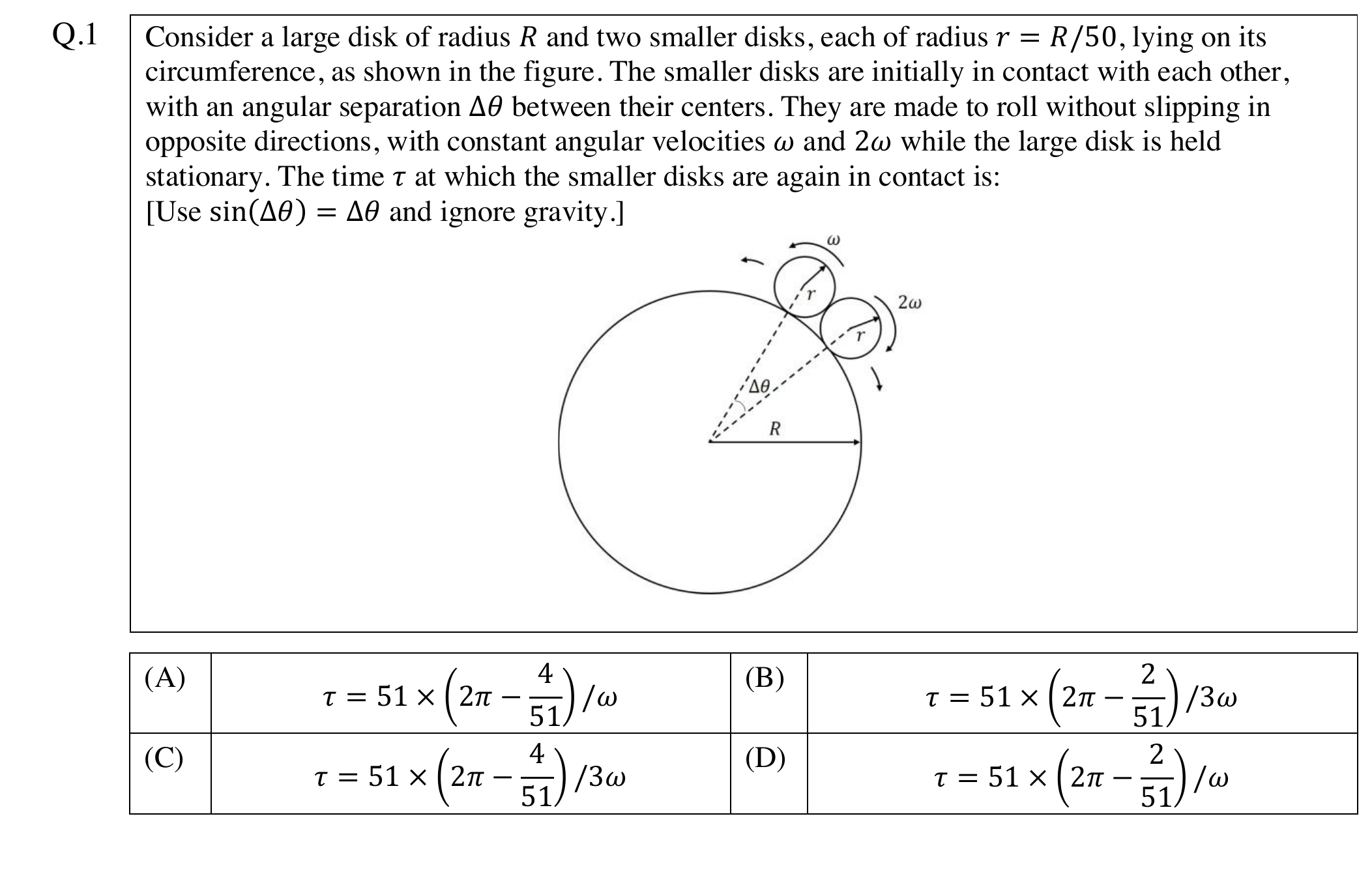
Show the Codex orchestration prompt
Use the uploaded JEE Advanced 2026 Paper 1 provisional question paper and its supplied answer key.

For each selected question:
1. Codex isolates a clean image containing the complete question and all answer choices. Exclude the printed answer key from that learner-facing image, but retain the key for QA.
2. Codex sends the question image and a step-by-step lesson request to Golpo.
3. Golpo solves the problem and returns its initial narration and solution script before any video is rendered.
4. Codex collaborates as reviewer: check every reasoning step, calculation, unit, and final result, then map the result to the supplied correct answer choice.
5. If any check fails, Codex edits Golpo's script and runs the script QA again. Authorize rendering only after the revised script passes.
6. Send the approved script and question image to Golpo through the API. Use horizontal 16:9, Auto timing, and a Golpo Canvas Compact style.
7. Keep [IMAGE 1] on screen from the first frame while Golpo reads the complete question and every choice aloud. Do not show the answer key.
8. After [IMAGE 1], Golpo must teach the solution with progressive native illustrations, equations, diagrams, and worked examples. Do not use static solution screenshots.
9. Golpo ends with the complete final result and the correct answer choice, held visibly through the final frame.
10. Codex reviews the actual MP4 for decode, duration, audio/ASR, question-image continuity, visual accuracy, teaching effectiveness, and final-answer alignment. Retry any failure and publish only an approved render.
Show the complete sanitized Golpo payload
{
  "prompt": "JEE Advanced 2026 Physics Paper 1 Question 1. Use the exact reviewed narration below, preserving the single IMAGE 1 block. Follow the separate video instructions for progressive native illustrations.\nUse no logo, no watermark, and no pen or hand overlay.\n\n[START][IMAGE 1]Question one. Consider a large disk of radius R and two smaller disks, each of radius r equal to R divided by fifty, lying on its circumference as shown. The smaller disks are initially in contact, with angular separation delta theta between their centers. They roll without slipping in opposite directions with constant angular velocities omega and two omega, while the large disk is stationary. Find the time tau when the smaller disks are again in contact. Use sine delta theta equal to delta theta and ignore gravity. Option A: tau equals fifty-one times the quantity two pi minus four over fifty-one, divided by omega. Option B: tau equals fifty-one times the quantity two pi minus two over fifty-one, divided by the product of three and omega. Option C: tau equals fifty-one times the quantity two pi minus four over fifty-one, divided by the product of three and omega. Option D: tau equals fifty-one times the quantity two pi minus two over fifty-one, divided by omega.[END][IMAGE 1]\n\nBegin with the geometry of the initial contact. Each small-disk center is a distance R plus r from the large-disk center O. Join O to the two small centers and join those centers to each other. Their center-to-center distance is two r. Bisecting this isosceles triangle gives\n\nr equals open parenthesis R plus r close parenthesis times sine of delta theta over two.\n\nBecause r equals R over fifty, R plus r equals fifty-one r. Therefore sine of delta theta over two equals one over fifty-one. The angle is small, so delta theta over two is approximately one over fifty-one, and delta theta is approximately two over fifty-one radians.\n\nNext convert each disk's spin into motion of its center. Rolling without slipping on the fixed large disk means the point of contact is instantaneously at rest. Therefore the center speed equals the small radius times the spin rate. For the first disk, v one equals r omega. For the second, v two equals two r omega.\n\nBoth centers travel on a circle of radius R plus r, which is fifty-one r. Their orbital angular speeds about O are therefore omega over fifty-one and two omega over fifty-one. The centers move in opposite directions, so their relative angular speed is the sum: three omega over fifty-one.\n\nNow track the relative angle. Initially it is delta theta. The disks first move apart. They touch again when the relative angle reaches two pi minus delta theta. Hence the relative angle swept is two pi minus two delta theta, not two pi minus delta theta. Using delta theta equal to two over fifty-one, the required sweep is two pi minus four over fifty-one.\n\nTime equals relative angle divided by relative angular speed. Thus tau equals the quantity two pi minus four over fifty-one, divided by three omega over fifty-one. This simplifies to fifty-one times the quantity two pi minus four over fifty-one, divided by the product of three and omega.\n\nThe factor three comes from adding the opposite orbital rates. The factor four over fifty-one comes from subtracting the initial contact angle at both ends of the relative sweep. Therefore the correct answer is option C.",
  "custom_script": "[START][IMAGE 1]Question one. Consider a large disk of radius R and two smaller disks, each of radius r equal to R divided by fifty, lying on its circumference as shown. The smaller disks are initially in contact, with angular separation delta theta between their centers. They roll without slipping in opposite directions with constant angular velocities omega and two omega, while the large disk is stationary. Find the time tau when the smaller disks are again in contact. Use sine delta theta equal to delta theta and ignore gravity. Option A: tau equals fifty-one times the quantity two pi minus four over fifty-one, divided by omega. Option B: tau equals fifty-one times the quantity two pi minus two over fifty-one, divided by the product of three and omega. Option C: tau equals fifty-one times the quantity two pi minus four over fifty-one, divided by the product of three and omega. Option D: tau equals fifty-one times the quantity two pi minus two over fifty-one, divided by omega.[END][IMAGE 1]\n\nBegin with the geometry of the initial contact. Each small-disk center is a distance R plus r from the large-disk center O. Join O to the two small centers and join those centers to each other. Their center-to-center distance is two r. Bisecting this isosceles triangle gives\n\nr equals open parenthesis R plus r close parenthesis times sine of delta theta over two.\n\nBecause r equals R over fifty, R plus r equals fifty-one r. Therefore sine of delta theta over two equals one over fifty-one. The angle is small, so delta theta over two is approximately one over fifty-one, and delta theta is approximately two over fifty-one radians.\n\nNext convert each disk's spin into motion of its center. Rolling without slipping on the fixed large disk means the point of contact is instantaneously at rest. Therefore the center speed equals the small radius times the spin rate. For the first disk, v one equals r omega. For the second, v two equals two r omega.\n\nBoth centers travel on a circle of radius R plus r, which is fifty-one r. Their orbital angular speeds about O are therefore omega over fifty-one and two omega over fifty-one. The centers move in opposite directions, so their relative angular speed is the sum: three omega over fifty-one.\n\nNow track the relative angle. Initially it is delta theta. The disks first move apart. They touch again when the relative angle reaches two pi minus delta theta. Hence the relative angle swept is two pi minus two delta theta, not two pi minus delta theta. Using delta theta equal to two over fifty-one, the required sweep is two pi minus four over fifty-one.\n\nTime equals relative angle divided by relative angular speed. Thus tau equals the quantity two pi minus four over fifty-one, divided by three omega over fifty-one. This simplifies to fifty-one times the quantity two pi minus four over fifty-one, divided by the product of three and omega.\n\nThe factor three comes from adding the opposite orbital rates. The factor four over fifty-one comes from subtracting the initial contact angle at both ends of the relative sweep. Therefore the correct answer is option C.\n",
  "visual_instructions": "Create a progressive illustrative physics lesson in Horizontal 16:9 using Golpo Canvas Whiteboard Compact, with 4 min selected and private visibility. Use the exact supplied narration. Only one source image is supplied: question.png. Show that exact answer-key-free question-and-choices screenshot from the first frame and keep it fully fitted, sharp, and continuously visible through the entire IMAGE 1 block. Do not reveal the answer during the opening. Finish reading option D before transitioning.\nUse no logo, no watermark, and no pen or hand overlay.\n\nAfter IMAGE 1, use only native drawings and progressive equations. Do not reuse the question screenshot, insert solution screenshots, render static equation pages, or show document-like slides.\n\n1. Initial contact geometry: Draw a large fixed circle centered at O and two equal external rolling disks. Join O to centers C1 and C2. Draw chord C1C2 = 2r, radii OC1 = OC2 = R+r = 51r, and angle C1OC2 = delta theta. Bisect the triangle and reveal r = (R+r) sin(delta theta/2), then delta theta approximately 2/51. Keep all lengths geometrically consistent.\n\n2. No-slip kinematics: Animate each small disk rotating in the source-specified direction and its center moving along the radius-(R+r) orbit. Mark the contact point with the large disk as instantaneously at rest. Reveal v1=r omega and v2=2r omega, followed by orbital rates Omega1=omega/51 and Omega2=2omega/51. Use different arrow colors and show that the orbital motions are opposite.\n\n3. Relative-angle sweep: Use a circular angular track with two center markers. Start them separated by delta theta. Animate them moving apart until their next contact configuration has separation delta theta on the other side. Shade the relative sweep from delta theta to 2pi-delta theta and write Delta phi_rel=2pi-2delta theta=2pi-4/51. Then reveal Omega_rel=3omega/51.\n\n4. Final calculation: Progressively form tau=Delta phi_rel/Omega_rel=51(2pi-4/51)/(3omega). Before the closing narration begins, display the complete exact result and \"Correct answer: C\" beside a compact version of the angular-track drawing. Hold the result and choice through the final words and ending pause.\n",
  "narration_instructions": "Read the exact supplied physics narration clearly and at a measured teaching pace. Read every question detail and all four answer choices while IMAGE 1 remains visible. Preserve fraction grouping, squared quantities, Greek-letter names, subscripts, and the distinction between spin angular speed and orbital angular speed. Never narrate image tags or production directions. Do not ad-lib. Use Female 1, English, normal pacing, and no music.\n",
  "timing": "4",
  "golpo_video_engine": "golpo_canvas",
  "canvas_style_variant": "whiteboard_compact",
  "narration_voice": "female-1",
  "narration_language": "en",
  "onscreen_text_language": "en",
  "video_orientation": "horizontal",
  "visibility": "private",
  "enable_color": true,
  "enable_script_only_mode": false,
  "enable_podcast_engine": false,
  "onscreen_text_from_script_only": false,
  "watermark": false,
  "scene_pacing": "normal",
  "visual_animation_style": "sketch",
  "custom_images": [
    "[SANITIZED_SIGNED_MEDIA_URL]"
  ],
  "custom_images_description": [
    "Original JEE Advanced 2026 Physics Paper 1 Question 1 and all answer choices, with the printed answer key removed. Show this exact image from frame one and continuously through the complete Image 1 narration block only. Do not reuse it during the solution; use native progressive illustrations afterward."
  ],
  "keep_original_images": [
    true
  ],
  "disable_image_animation": [
    true
  ],
  "video_id": "[GENERATED_BY_GOLPO]"
}Updated October 23, 2026.
IIT JEE Advanced 2026 Physics Paper 1: All 16 Worked Solutions
Work through all 16 IIT JEE Advanced 2026 Physics Paper 1 questions with the original answer-key-free images, independently checked answers, concise derivations, and 15 verified public Golpo AI video lessons.
Current video status: Fifteen playback-verified public Physics lessons are embedded below. Question 5 remains withheld while its corrected horizontal render is completed and independently checked.
How to use this guide
- Try the original question from the answer-key-free image.
- Compare the transcribed stem and choices with the image, especially for diagrams and graph options.
- Open the checked derivation only after your own attempt.
- Return for the video lesson after its public YouTube playback is verified.
How the questions and solutions were checked
The source for this guide is the supplied JEE (Advanced) 2026 Paper 1 provisional question paper and answer key. Each question image was cropped to remove the printed key. The written answer was derived independently, compared with the provisional key, and passed two rounds of content review before being included in the study site.
For the video workflow, the question-and-choices screenshot is the only inserted image. It remains visible while the question is read aloud. The solution then switches to progressive native illustrations. A render is considered eligible only after answer, diagram, audio, decode, continuity, and final-answer checks pass. A local approval or scheduled social post is not treated as a live video; this guide uses public YouTube embeds only after playback verification.
For the underlying production methods, see how to insert source images in Golpo AI videos and how to prepare mathematical notation for educational videos.
Question index
- Question 01: Rolling without slipping and relative angular motion
- Question 02: Coupled inductors and LC resonance
- Question 03: Rigid-body dynamics: rolling cylinder crossing a sharp edge
- Question 04: Lens power in an immersion medium
- Question 05: Bohr model, de Broglie wavelength, and Lyman-series transition
- Question 06: Projectile motion through a prescribed point
- Question 07: Efficiency of an isothermal-isochoric-adiabatic ideal-gas cycle
- Question 08: Direction, wave vector, frequency, and magnetic field of a plane electromagnetic wave
- Question 09: Small oscillations of a hinged rod in two immiscible liquids
- Question 10: Five-stage Carnot-engine cascade
- Question 11: Thermal relaxation between constant-volume and constant-pressure monoatomic gases
- Question 12: Magnetic dipole field of a uniformly charged rotating conical surface
- Question 13: Sound interference from path differences in branched tubes
- Question 14: Optical phenomena behind atmospheric and wave-optics effects
- Question 15: Faraday induction in rotating loops crossing a half-plane magnetic field
- Question 16: In-plane moment of inertia of rod frames
IIT JEE Advanced 2026 Physics Paper 1 answer key
Use this checked summary to review an answer, then open the linked question for the derivation. Numerical-value rows include the independently derived value and the supplied provisional key's accepted range.
| Question | Format | Verified answer |
|---|---|---|
| Question 1 | Single-correct | Choice C |
| Question 2 | Single-correct | Choice C |
| Question 3 | Single-correct | Choice B |
| Question 4 | Single-correct | Accepted: A or B, reflecting the two power conventions recognized by the supplied provisional key |
| Question 5 | Multiple-correct | Choices A and C |
| Question 6 | Multiple-correct | Choices A and B |
| Question 7 | Multiple-correct | Choices A, B, and C |
| Question 8 | Multiple-correct | Choices A and C |
| Question 9 | Numerical-value | n = sqrt(3), accepted range 1.70 to 1.75 |
| Question 10 | Numerical-value | eta = 1/3, accepted range 0.32 to 0.34 |
| Question 11 | Numerical-value | n = (15/16) ln 2, approximately 0.65; accepted range 0.63 to 0.68 |
| Question 12 | Numerical-value | n = 1/2 = 0.50 |
| Question 13 | Matching-list | Choice D: P to 3, Q to 4, R to 5, S to 2 |
| Question 14 | Matching-list | Choice A: P to 5, Q to 4, R to 1, S to 3 |
| Question 15 | Matching-list | Choice C: P to 3, Q to 2, R to 1, S to 4 |
| Question 16 | Matching-list | Choice A: P to 5, Q to 1, R to 4, S to 2 |
Question 01 · Single correct
Rolling without slipping and relative angular motion
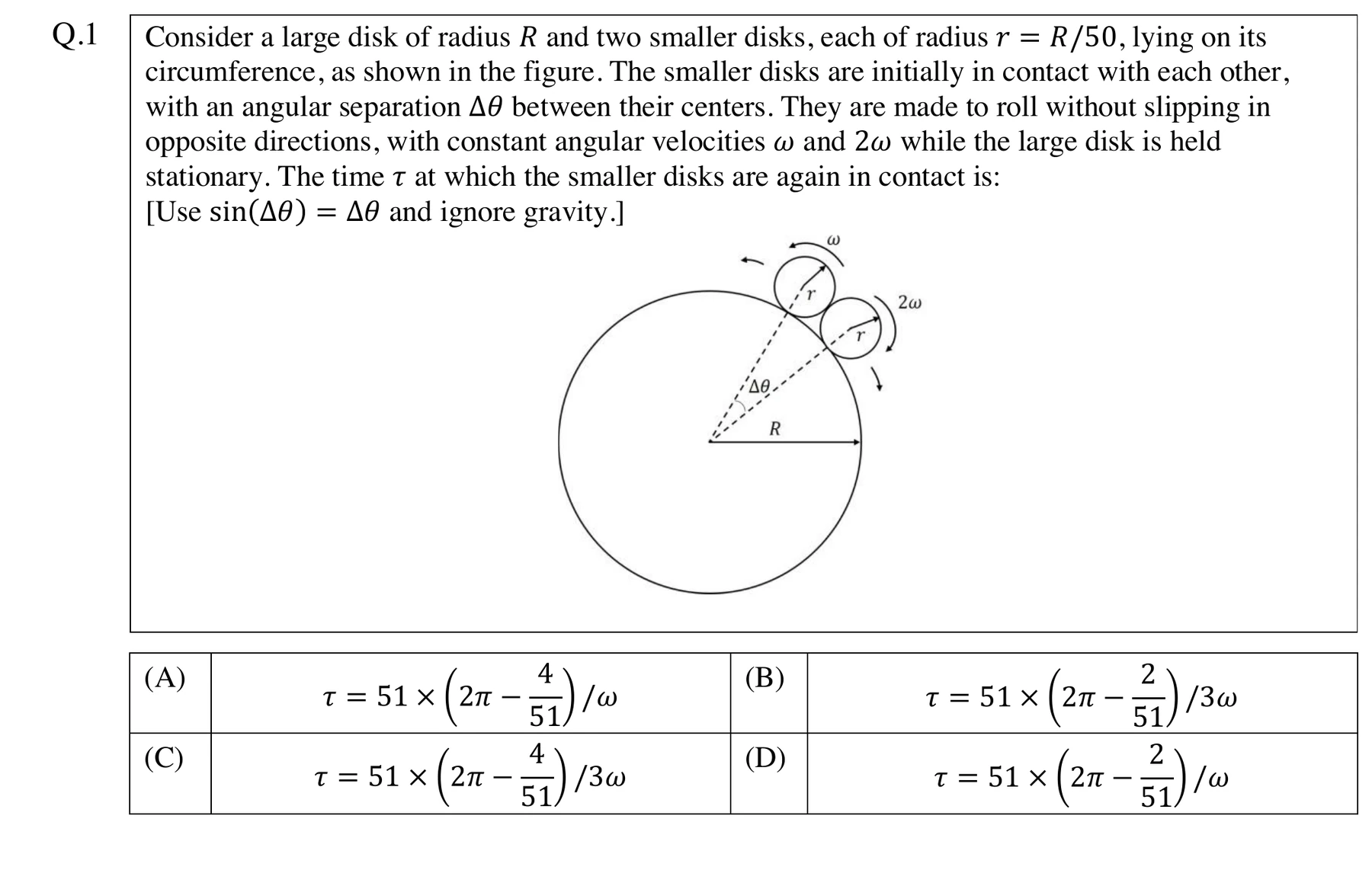
Consider a large disk of radius R and two smaller disks, each of radius r = R/50, lying on its circumference. The smaller disks are initially in contact, with angular separation Delta theta between their centers. They roll without slipping in opposite directions with constant angular velocities omega and 2 omega while the large disk is stationary. Find the time tau when they are again in contact. Use sin(Delta theta) = Delta theta and ignore gravity.
Answer choices
- A. tau = 51(2 pi - 4/51)/omega
- B. tau = 51(2 pi - 2/51)/(3 omega)
- C. tau = 51(2 pi - 4/51)/(3 omega)
- D. tau = 51(2 pi - 2/51)/omega
Watch the Question 1 video solution
Show the checked step-by-step solution
- Step 1: Initial contact: 2(R+r)sin(delta theta/2)=2r, so delta theta approximately 2r/(R+r)=2/51.
- Step 2: No slip gives center speeds r omega and 2r omega; dividing by R+r=51r gives opposite orbital rates omega/51 and 2omega/51.
- Step 3: Relative rate is 3omega/51. The next-contact relative sweep is (2pi-delta theta)-delta theta=2pi-4/51.
- Step 4: Dividing sweep by rate gives tau=51(2pi-4/51)/(3omega), choice C.
Correct answer: Choice C
Question 02 · Single correct
Coupled inductors and LC resonance
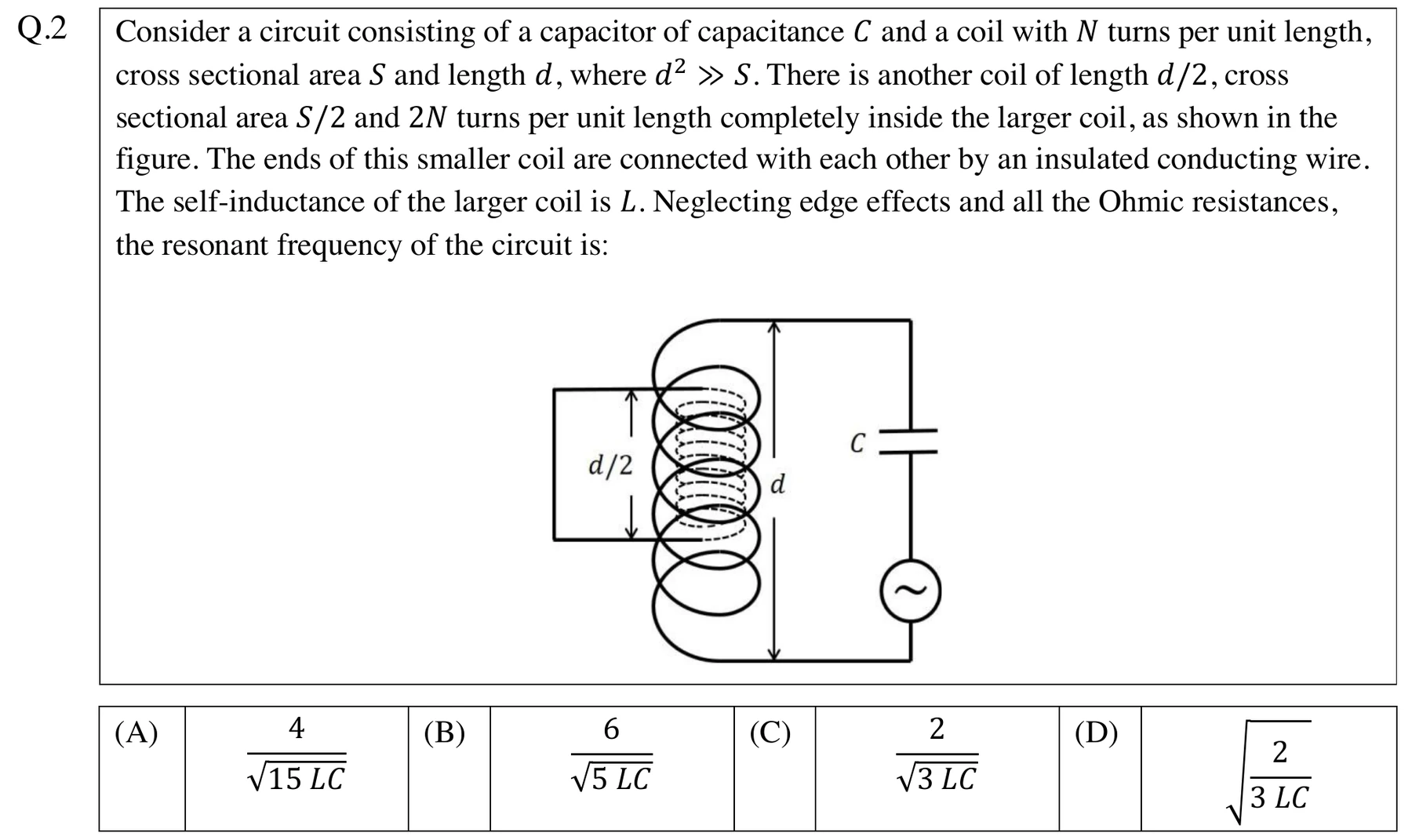
A capacitor of capacitance C is connected to a long coil with N turns per unit length, cross-sectional area S, and length d, where d squared is much greater than S. A second coil of length d/2, cross-sectional area S/2, and 2N turns per unit length lies completely inside the larger coil, with its ends shorted by an insulated conducting wire. The larger coil's self-inductance is L. Neglect edge effects and ohmic resistance. Find the resonant frequency.
Answer choices
- A. 4/sqrt(15LC)
- B. 6/sqrt(5LC)
- C. 2/sqrt(3LC)
- D. sqrt(2/(3LC))
Watch the Question 2 video solution
Show the checked step-by-step solution
- Step 1: L1=mu0 N^2 S d=L.
- Step 2: L2=mu0(2N)^2(S/2)(d/2)=L.
- Step 3: M=mu0 N(2N)(S/2)(d/2)=L/2, using only the common area and overlap length.
- Step 4: An ideal shorted secondary gives Leff=L1-M^2/L2=3L/4.
- Step 5: omega0=1/sqrt(Leff C)=2/sqrt(3LC), choice C.
Correct answer: Choice C
Question 03 · Single correct
Rigid-body dynamics: rolling cylinder crossing a sharp edge
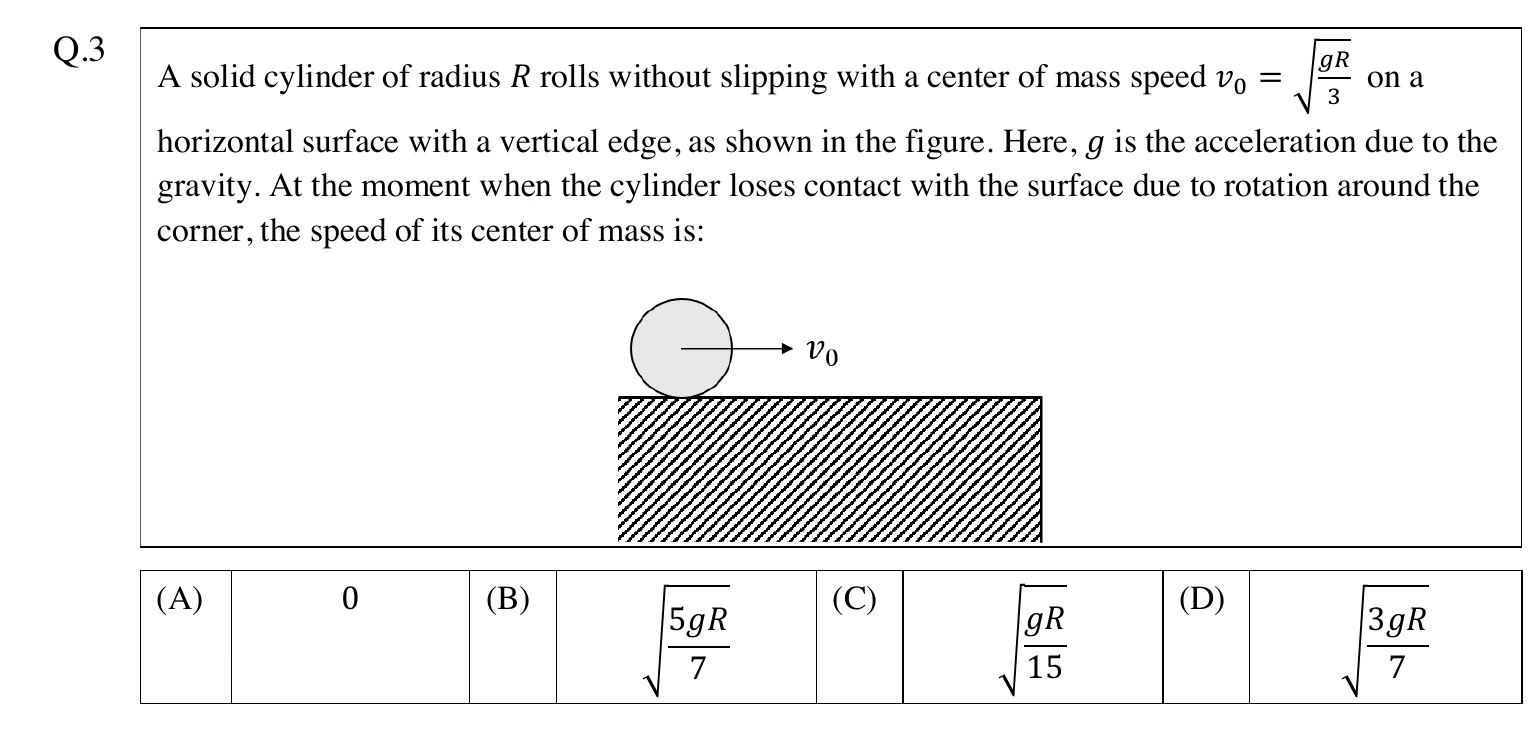
A solid cylinder of radius R rolls without slipping with center-of-mass speed v0 = sqrt(gR/3) on a horizontal surface toward a vertical edge. At the moment when it loses contact with the surface while rotating around the corner, what is its center-of-mass speed?
Answer choices
- A. 0
- B. sqrt(5gR/7)
- C. sqrt(gR/15)
- D. sqrt(3gR/7)
Watch the Question 3 video solution
Show the checked step-by-step solution
- Moment of inertia about the corner: I_O=I_CM+MR^2=(1/2)MR^2+MR^2=(3/2)MR^2. The cylinder instantaneously rotates about the fixed corner while rolling without slipping.
- Energy at angular displacement theta: (3/4)Mv^2=(3/4)Mv_0^2+MgR(1-cos(theta)). The center descends through R(1-cos theta), and v=R Omega.
- Insert the initial speed: v^2=gR/3+(4gR/3)(1-cos(theta)). Use v_0^2=gR/3.
- Loss-of-contact condition: Mg cos(theta)-N=Mv^2/R; N=0 => v^2=gR cos(theta). Gravity acts inward with component Mg cos theta; the corner force is radially outward.
- Solve: cos(theta)=5/7; v^2=5gR/7. Equating the energy result and separation condition gives choice B.
Correct answer: Choice B
Question 04 · Single correct
Lens power in an immersion medium
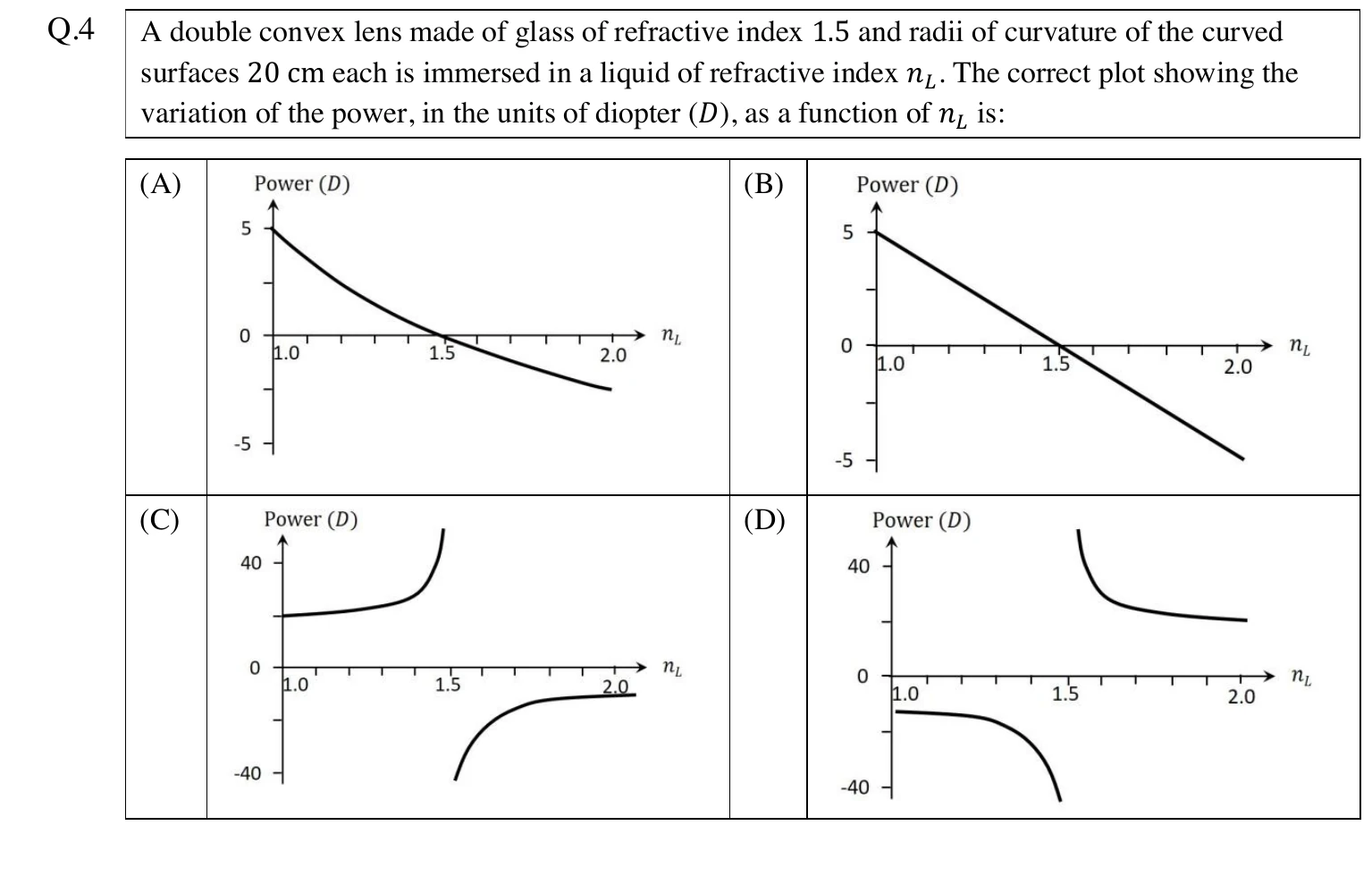
A double convex glass lens with refractive index 1.5 and radii of curvature 20 cm is immersed in a liquid of refractive index nL. Which plot correctly shows power in diopters as a function of nL? The exact four plots are preserved in the source image below.
Answer choices
- A. A decreasing concave-up curve through +5 at nL = 1 and 0 at nL = 1.5
- B. A decreasing straight line through +5 at nL = 1, 0 at nL = 1.5, and -5 at nL = 2
- C. Divergent branches at nL = 1.5, positive on the left and negative on the right
- D. Divergent branches at nL = 1.5 with the signs reversed
Watch the Question 4 video solution
Show the checked step-by-step solution
- Geometric focal-length convention: P_g=1/f=(n_g/n_L-1)(1/R1-1/R2)=15/n_L-10 D. This is +5 at n_L=1, zero at 1.5, -2.5 at 2, decreasing and concave upward: plot A.
- Reduced optical-power convention: Phi=n_L/f=(n_g-n_L)(1/R1-1/R2)=15-10n_L D. This is a straight line from +5 at n_L=1 through zero at 1.5 to -5 at 2: plot B.
- Reject pole plots: P_g(1.5)=0 and Phi(1.5)=0. Index matching removes refraction; there can be no divergence at n_L=1.5, so C and D are impossible.
Correct answer: Accepted: A or B, reflecting the two power conventions recognized by the supplied provisional key
Question 05 · Multiple correct
Bohr model, de Broglie wavelength, and Lyman-series transition
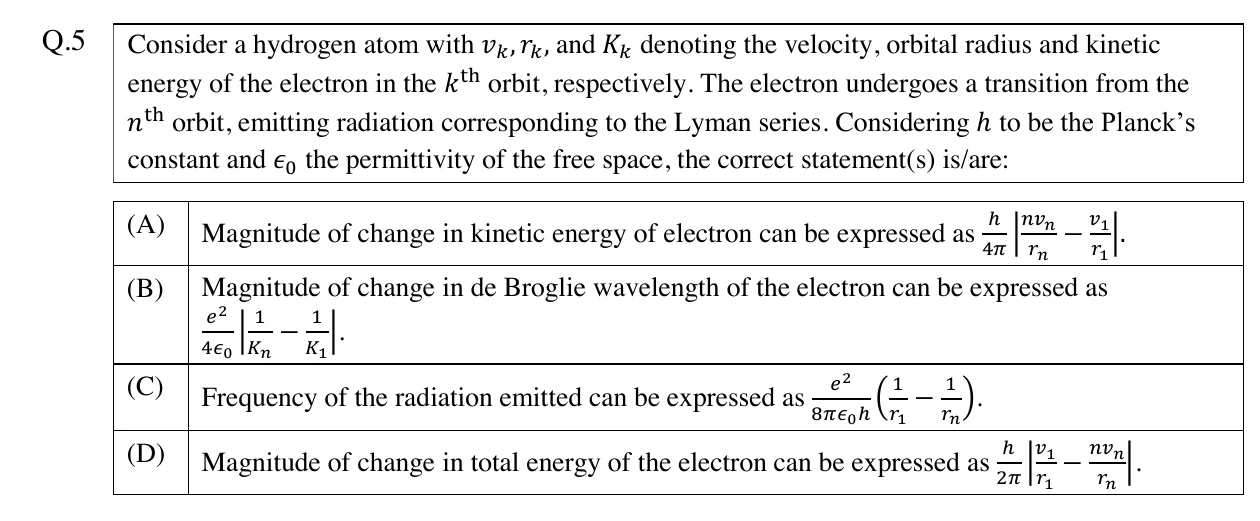
For a hydrogen atom, vk, rk, and Kk denote the electron velocity, orbital radius, and kinetic energy in the kth orbit. An electron transitions from the nth orbit and emits Lyman-series radiation. With h as Planck's constant and epsilon0 as the permittivity of free space, which statements are correct?
Answer choices
- A. |Delta K| = (h/4 pi)|n vn/rn - v1/r1|
- B. |Delta lambda| = (e squared/4 epsilon0)|1/Kn - 1/K1|
- C. nu = (e squared/8 pi epsilon0 h)(1/r1 - 1/rn)
- D. |Delta E| = (h/2 pi)|v1/r1 - n vn/rn|
Question 5 video update
The corrected video lesson is awaiting a completed, QA-approved horizontal render. The complete written solution is available now.
Show the checked step-by-step solution
- Write the Bohr relations: m vk rk = k h/(2 pi), Kk = k h vk/(4 pi rk), Kk = e squared/(8 pi epsilon0 rk), and Ek = -Kk.
- Check A: K1 - Kn gives the stated magnitude after using angular-momentum quantization, so A is correct.
- Check B: The de Broglie wavelength contains 1/(k Kk); the proposed expression omits the factor n, so B is incorrect.
- Check C: h nu = K1 - Kn = e squared/(8 pi epsilon0)(1/r1 - 1/rn), so C is correct.
- Check D: Because E = -K, the magnitude has coefficient h/(4 pi), not h/(2 pi); D is incorrect.
Correct answer: Choices A and C
Question 06 · Multiple correct
Projectile motion through a prescribed point
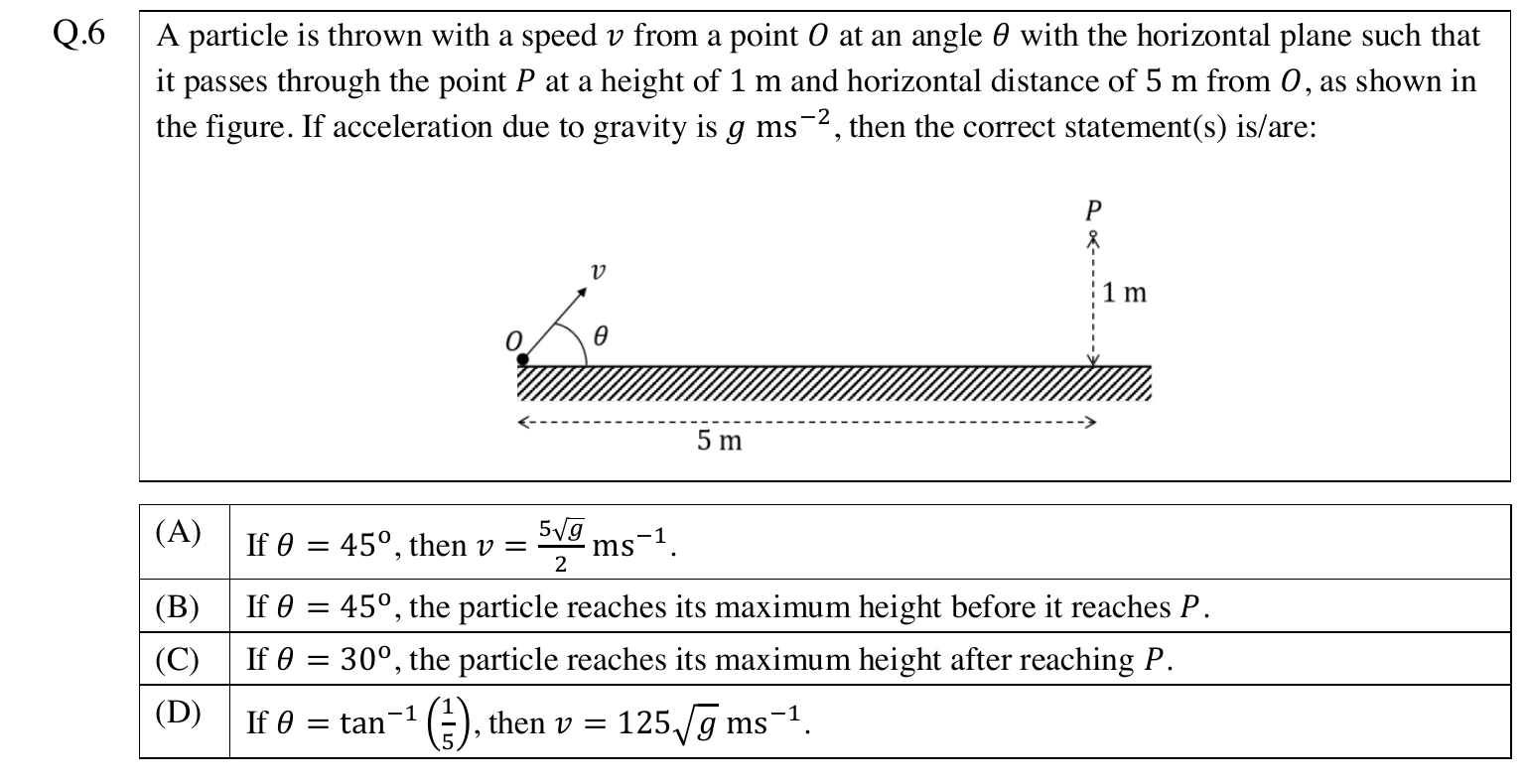
A particle is launched from O at speed v and angle theta. It passes through P, 5 m horizontally from O and 1 m above it. If gravitational acceleration is g, which statements are correct?
Answer choices
- A. If theta = 45 degrees, v = 5 sqrt(g)/2 m/s.
- B. If theta = 45 degrees, the particle reaches maximum height before P.
- C. If theta = 30 degrees, the particle reaches maximum height after P.
- D. If theta = tan inverse(1/5), v = 125 sqrt(g) m/s.
Watch the Question 6 video solution
Show the checked step-by-step solution
- Step 1: y=x tan(theta)-g x^2/(2v^2 cos^2(theta))
- Step 2: v^2=25g/[2 cos^2(theta)(5 tan(theta)-1)]
- Step 3: x_apex=v^2 sin(theta)cos(theta)/g=25 tan(theta)/[2(5 tan(theta)-1)]
Substitution check: at θ=45°, v²=25g/4 and x_apex=25/8 m<5 m, so A and B are true. At θ=30°, x_apex≈3.83 m<5 m, so C is false. At tanθ=1/5 the trajectory cannot reach the stated point at any finite speed, so D is false.
Correct answer: Choices A and B
Question 07 · Multiple correct
Efficiency of an isothermal-isochoric-adiabatic ideal-gas cycle
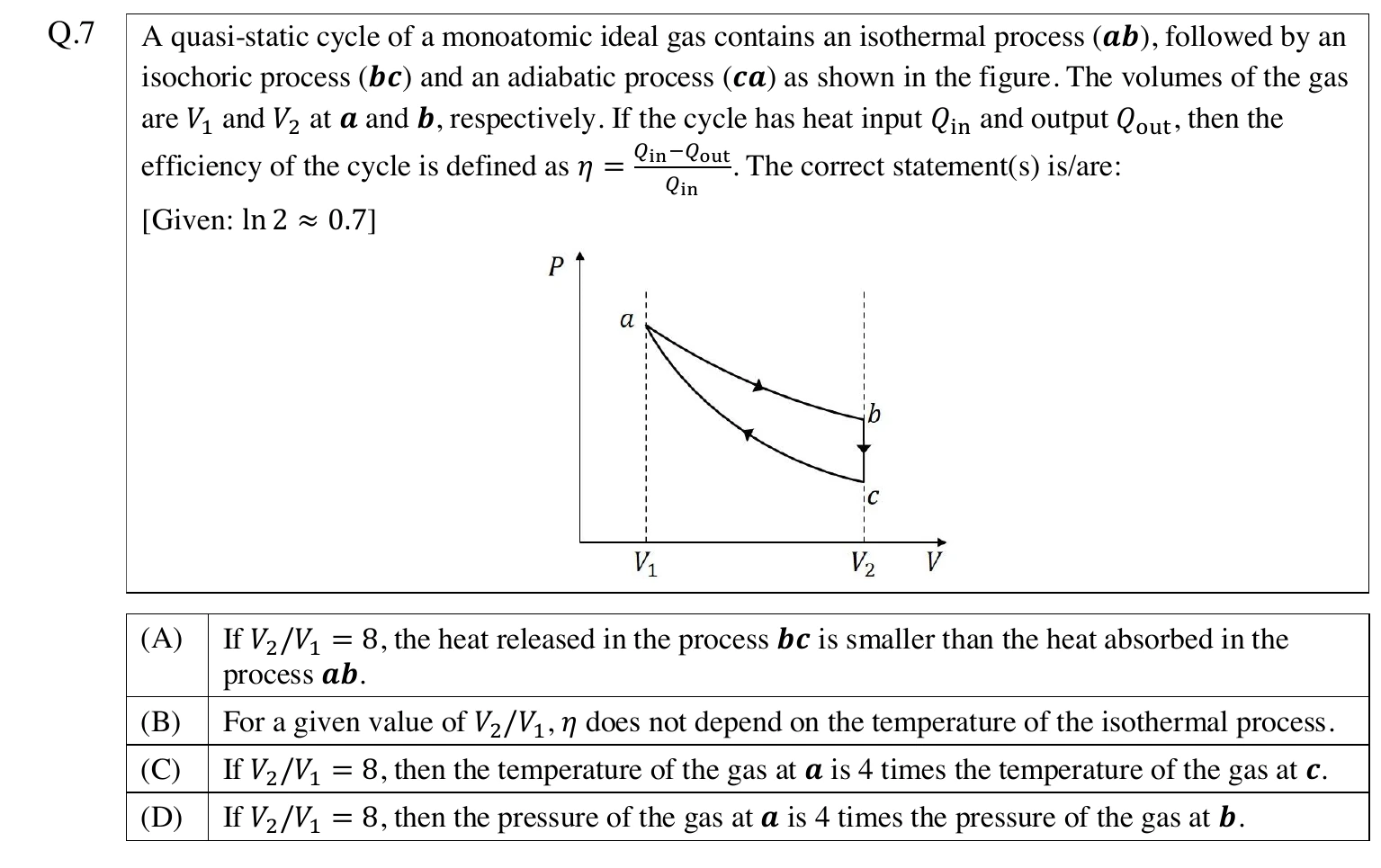
A quasi-static monoatomic ideal-gas cycle has isothermal process ab, isochoric process bc, and adiabatic process ca. The volumes at a and b are V1 and V2. With heat input Qin, heat output Qout, and efficiency eta = (Qin - Qout)/Qin, which statements are correct? Use ln 2 approximately 0.7.
Answer choices
- A. If V2/V1 = 8, the heat released in bc is smaller than the heat absorbed in ab.
- B. For fixed V2/V1, eta does not depend on the isothermal-process temperature.
- C. If V2/V1 = 8, the temperature at a is four times the temperature at c.
- D. If V2/V1 = 8, the pressure at a is four times the pressure at b.
Watch the Question 7 video solution
Show the checked step-by-step solution
- Step 1: T_c/T=r^(-2/3) from T V^(gamma-1)=constant on c to a.
- Step 2: Q_in=NRT ln r on a to b.
- Step 3: Q_out=(3/2)NR(T-T_c)=(3/2)NRT(1-r^(-2/3)) on b to c.
- Step 4: eta=1-[3/2(1-r^(-2/3))]/ln r.
- Step 5: P_a/P_b=V_2/V_1=r because a and b are isothermal.
For r=8, T_c/T=1/4, Q_out=(9/8)NRT, while Q_in=NRT ln8≈2.1NRT, so A is true. Temperature cancels from their ratio, so B is true; T_a/T_c=4 makes C true; and P_a/P_b=r=8, so D is false.
Correct answer: Choices A, B, and C
Question 08 · Multiple correct
Direction, wave vector, frequency, and magnetic field of a plane electromagnetic wave
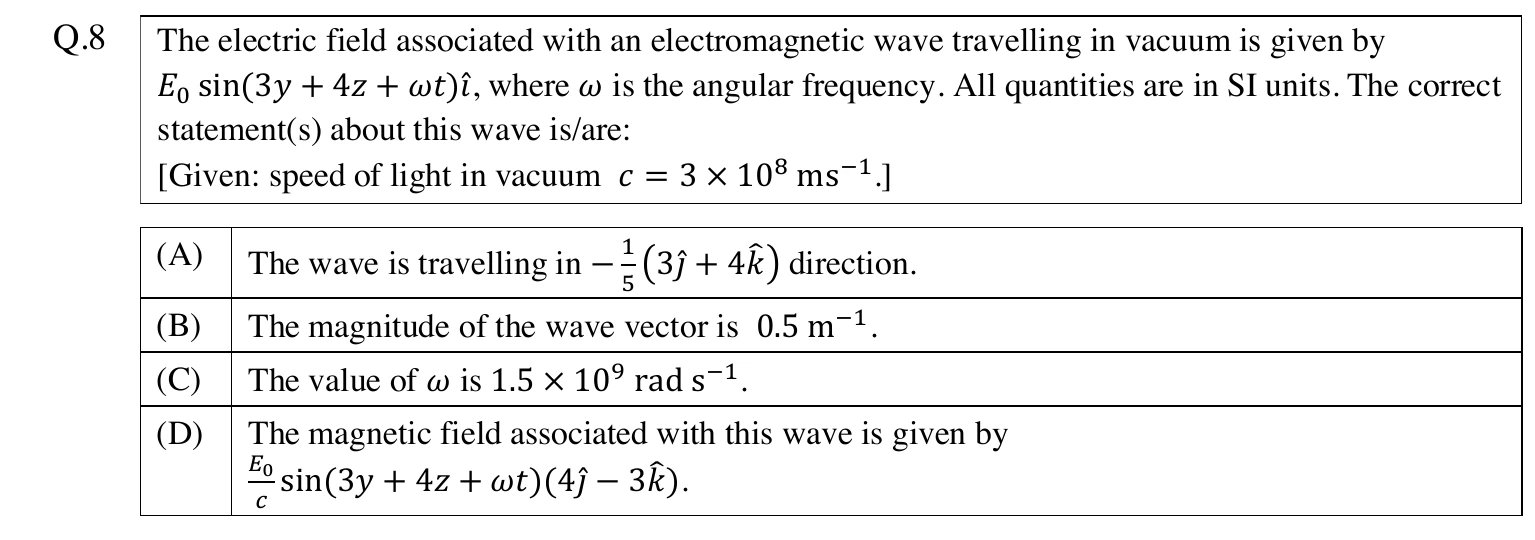
The electric field of an electromagnetic wave in vacuum is E0 sin(3y + 4z + omega t) i-hat, in SI units. Which statements are correct? Use c = 3 x 10^8 m/s.
Answer choices
- A. The wave travels in the direction -(3 j-hat + 4 k-hat)/5.
- B. The wave-vector magnitude is 0.5 per metre.
- C. omega = 1.5 x 10^9 rad/s.
- D. B = (E0/c) sin(3y + 4z + omega t)(4 j-hat - 3 k-hat).
Watch the Question 8 video solution
Show the checked step-by-step solution
- Step 1: spatial phase vector q=3 j-hat+4 k-hat
- Step 2: |q|=5 m^-1
- Step 3: plus omega t means propagation unit vector s-hat=-q/|q|=-(3j+4k)/5
- Step 4: omega=c|q|=1.5x10^9 rad s^-1
- Step 5: B=(1/c)s-hat cross E=E0/(5c) sin(phase)(-4j+3k)
Correct answer: Choices A and C
Question 09 · Numerical value
Small oscillations of a hinged rod in two immiscible liquids
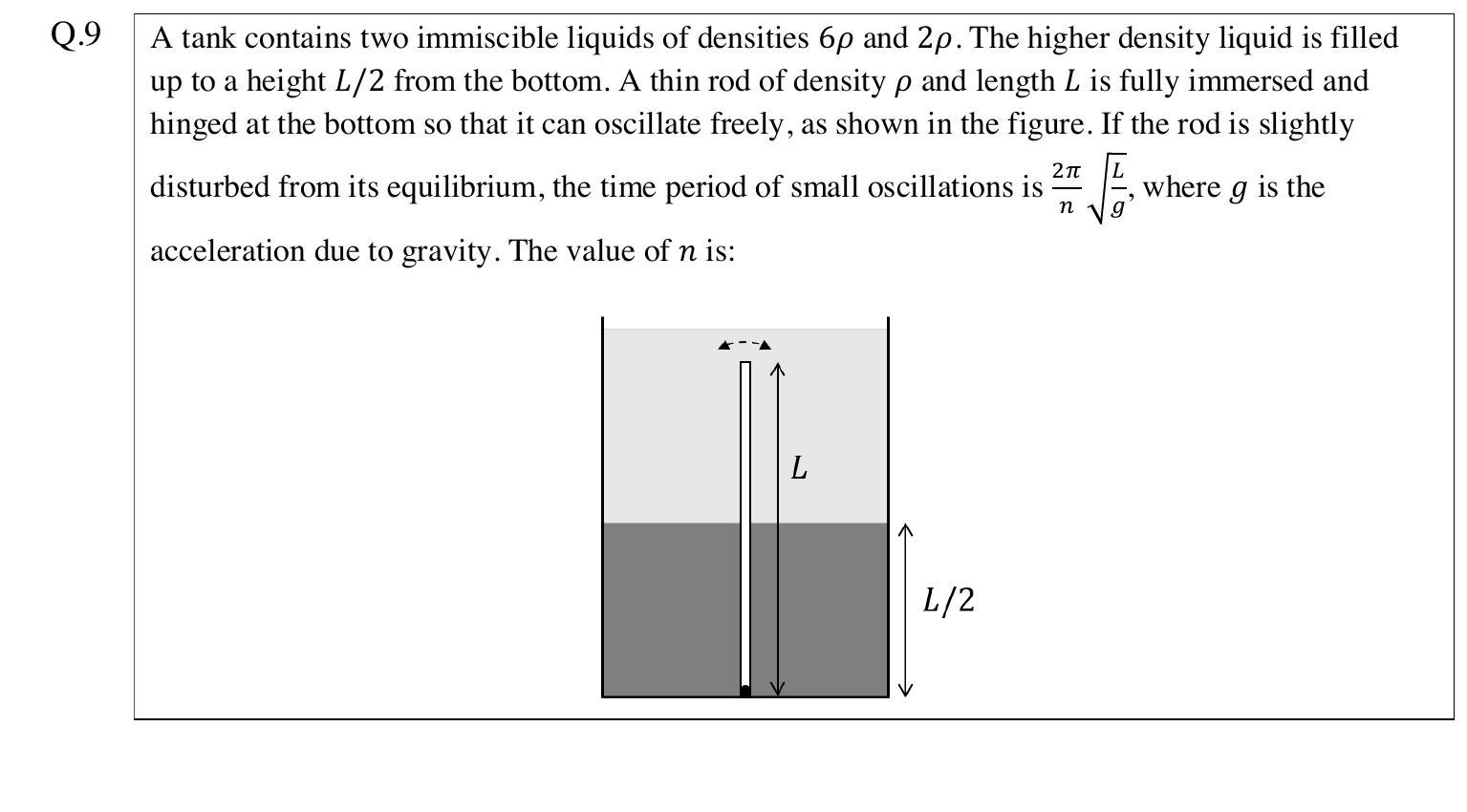
A tank contains immiscible liquids of densities 6 rho and 2 rho. The denser liquid fills the lower half of a fully immersed rod of density rho and length L, hinged at the bottom. If the small-oscillation period is (2 pi/n)sqrt(L/g), find n.
Response format: Numerical value.
Watch the Question 9 video solution
Show the checked step-by-step solution
- Step 1: lower-half excess upward force per unit length=(6rho-rho)Ag=5rho Ag
- Step 2: upper-half excess upward force per unit length=(2rho-rho)Ag=rho Ag
- Step 3: kappa=integral_0^(L/2)5rho Ag s ds + integral_(L/2)^L rho Ag s ds = rho AgL^2
- Step 4: I_hinge=(1/3)ML^2=(1/3)rho AL^3
- Step 5: omega_0^2=kappa/I=3g/L
- Step 6: T=2pi sqrt(L/(3g))=(2pi/sqrt(3))sqrt(L/g)
Correct answer: n = sqrt(3), accepted range 1.70 to 1.75
Question 10 · Numerical value
Five-stage Carnot-engine cascade
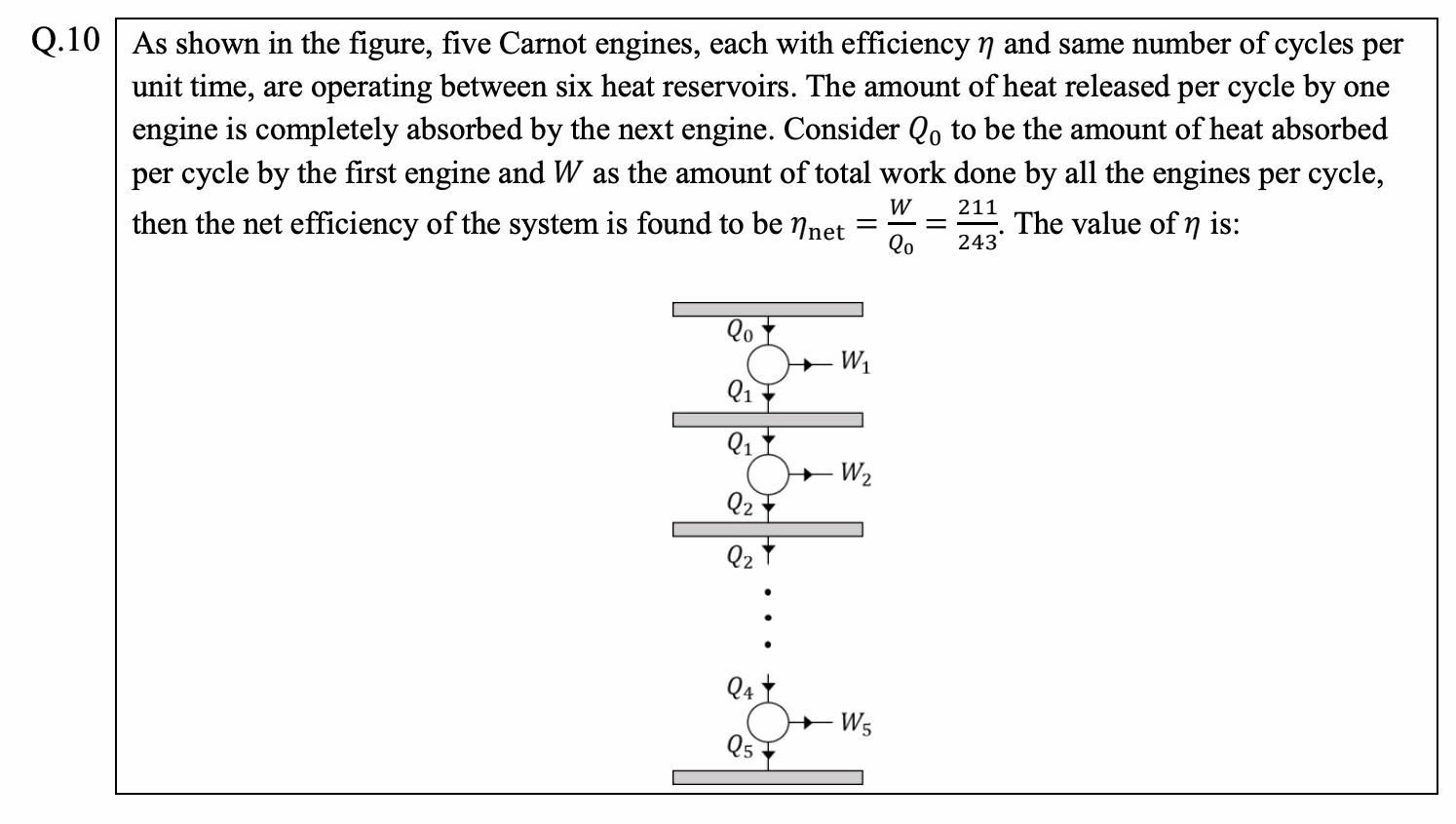
Five identical Carnot engines, each of efficiency eta and running the same number of cycles per unit time, operate in cascade between six reservoirs. The heat rejected by one engine is fully absorbed by the next. If the first absorbs Q0 per cycle and all five do total work W, the net efficiency W/Q0 is 211/243. Find eta.
Response format: Numerical value.
Watch the Question 10 video solution
Show the checked step-by-step solution
- Heat passed by each engine: Q_k=(1-eta)^k Q_0. Every identical engine rejects the fraction 1-eta of its input.
- Telescope the whole cascade: W=Q_0-Q_5. Intermediate heat transfers are internal to the five-engine system.
- Use net efficiency: 211/243=1-(1-eta)^5. The final rejected fraction is the fifth power of the single-stage rejected fraction.
- Take the physical fifth root: (1-eta)^5=32/243=(2/3)^5. Positive heat flow gives 1-eta=2/3, hence eta=1/3.
Correct answer: eta = 1/3, accepted range 0.32 to 0.34
Question 11 · Numerical value
Thermal relaxation between constant-volume and constant-pressure monoatomic gases
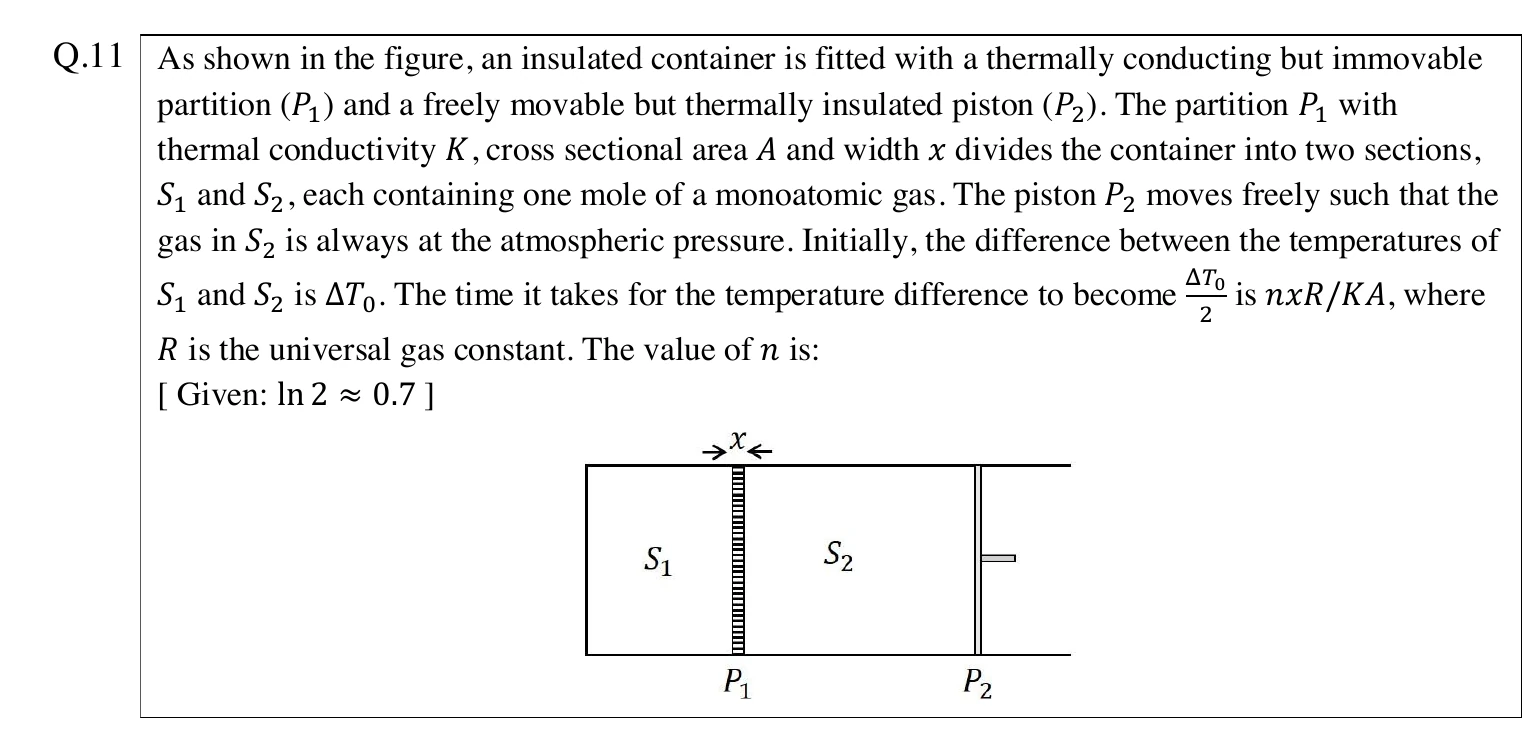
An insulated container has a thermally conducting fixed partition P1 and a freely moving insulated piston P2. Sections S1 and S2 each contain one mole of monoatomic gas; S2 stays at atmospheric pressure. P1 has conductivity K, area A, and width x. If the initial temperature difference is Delta T0, the time for it to become Delta T0/2 is n x R/(K A). Find n. Use ln 2 approximately 0.7.
Response format: Numerical value.
Watch the Question 11 video solution
Show the checked step-by-step solution
- Step 1: H=KA/x and heat current=H(T1-T2)
- Step 2: (3R/2)dT1/dt=-H Delta T
- Step 3: (5R/2)dT2/dt=+H Delta T
- Step 4: d(Delta T)/dt=-H[2/(3R)+2/(5R)]Delta T=-(16KA/(15Rx))Delta T
- Step 5: ln(Delta T0/Delta T)=16KAt/(15Rx)
- Step 6: t_half=(15Rx/(16KA))ln2
- Step 7: n=(15/16)ln2
Correct answer: n = (15/16) ln 2, approximately 0.65; accepted range 0.63 to 0.68
Question 12 · Numerical value
Magnetic dipole field of a uniformly charged rotating conical surface
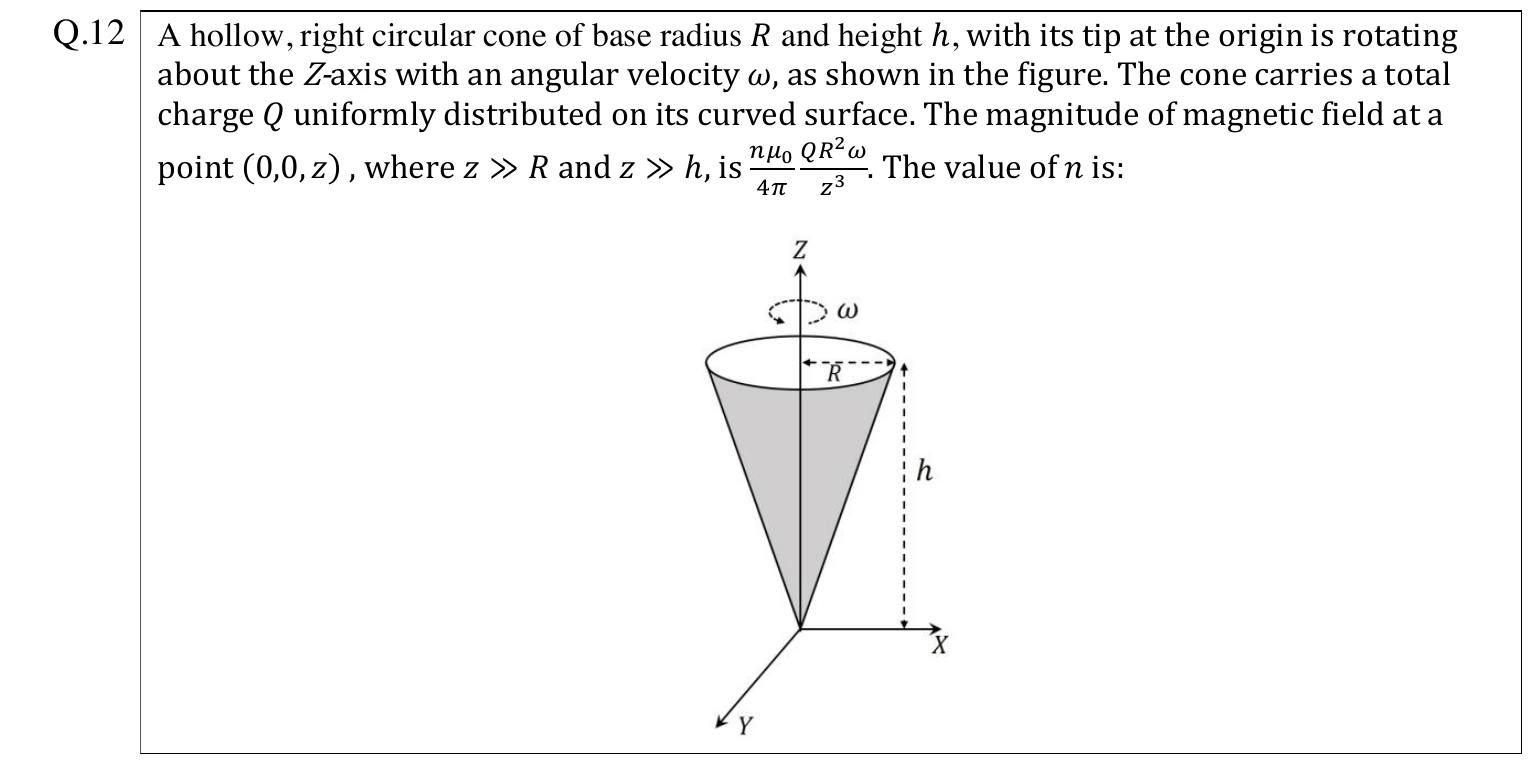
A hollow right circular cone of base radius R and height h, with its tip at the origin, rotates about the z-axis with angular speed omega. Charge Q is uniformly distributed on its curved surface. Far from the cone on its axis, the magnetic-field magnitude is n mu0 Q R squared omega/(4 pi z cubed). Find n.
Response format: Numerical value.
Watch the Question 12 video solution
Show the checked step-by-step solution
- Step 1: ell=sqrt(R^2+h^2), sigma=Q/(pi R ell)
- Step 2: r=Ru/h, ds=(ell/h)du, dA=2pi r ds
- Step 3: dq=sigma dA=(2Qu/h^2)du
- Step 4: dI=omega dq/(2pi)
- Step 5: dm=dI pi r^2=(omega/2)r^2dq=(Q omega R^2 u^3/h^4)du
- Step 6: m=integral_0^h dm=Q omega R^2/4
- Step 7: B_axis=mu0(2m)/(4pi z^3)=mu0 Q R^2 omega/(8pi z^3)
- Step 8: n/4=1/8, so n=1/2
Correct answer: n = 1/2 = 0.50
Question 13 · Matching lists
Sound interference from path differences in branched tubes
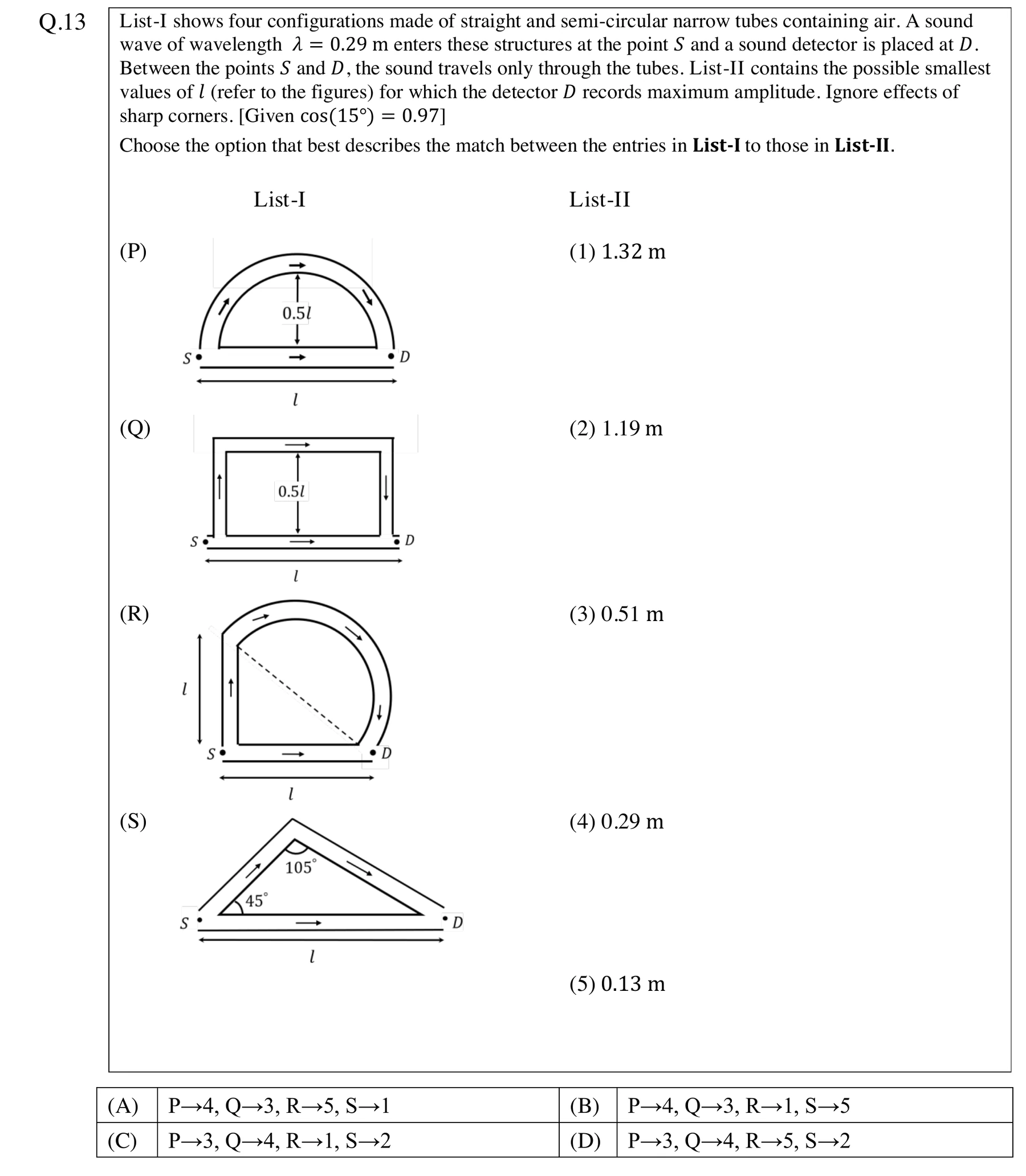
Four straight and semicircular narrow-tube configurations carry sound from S to D. The wavelength is 0.29 m. Match each configuration to the smallest scale l that gives maximum amplitude at D. Ignore sharp-corner effects and use cos(15 degrees) = 0.97. The exact P-Q-R-S diagrams are preserved in the source image.
Answer choices
- List II: (1) 1.32 m; (2) 1.19 m; (3) 0.51 m; (4) 0.29 m; (5) 0.13 m.
- A. P to 4, Q to 3, R to 5, S to 1
- B. P to 4, Q to 3, R to 1, S to 5
- C. P to 3, Q to 4, R to 1, S to 2
- D. P to 3, Q to 4, R to 5, S to 2
Watch the Question 13 video solution
Show the checked step-by-step solution
- Step 1: Constructive maximum: Delta L = m lambda; for the smallest positive l use m=1.
- Step 2: P: Delta L=(pi/2-1)l, hence l=0.508 m approximately 0.51 m, entry 3.
- Step 3: Q: Delta L=(2l-l)=l, hence l=0.29 m, entry 4.
- Step 4: R: diameter=sqrt(2)l and semicircle length=pi l/sqrt(2), hence l=lambda sqrt(2)/pi=0.131 m approximately 0.13 m, entry 5.
- Step 5: S: angles are 45, 105, and 30 degrees; using the supplied cos15=0.97, upper/base=(sin45+sin30)/sin105 approximately 1.244, so Delta L approximately 0.244l and l approximately 1.19 m, entry 2.
- Step 6: Therefore P->3, Q->4, R->5, S->2, which is option D.
In configuration R, the equal straight segments occur on both paths and cancel; only the semicircle-versus-diameter difference remains in ΔL.
Correct answer: Choice D: P to 3, Q to 4, R to 5, S to 2
Question 14 · Matching lists
Optical phenomena behind atmospheric and wave-optics effects
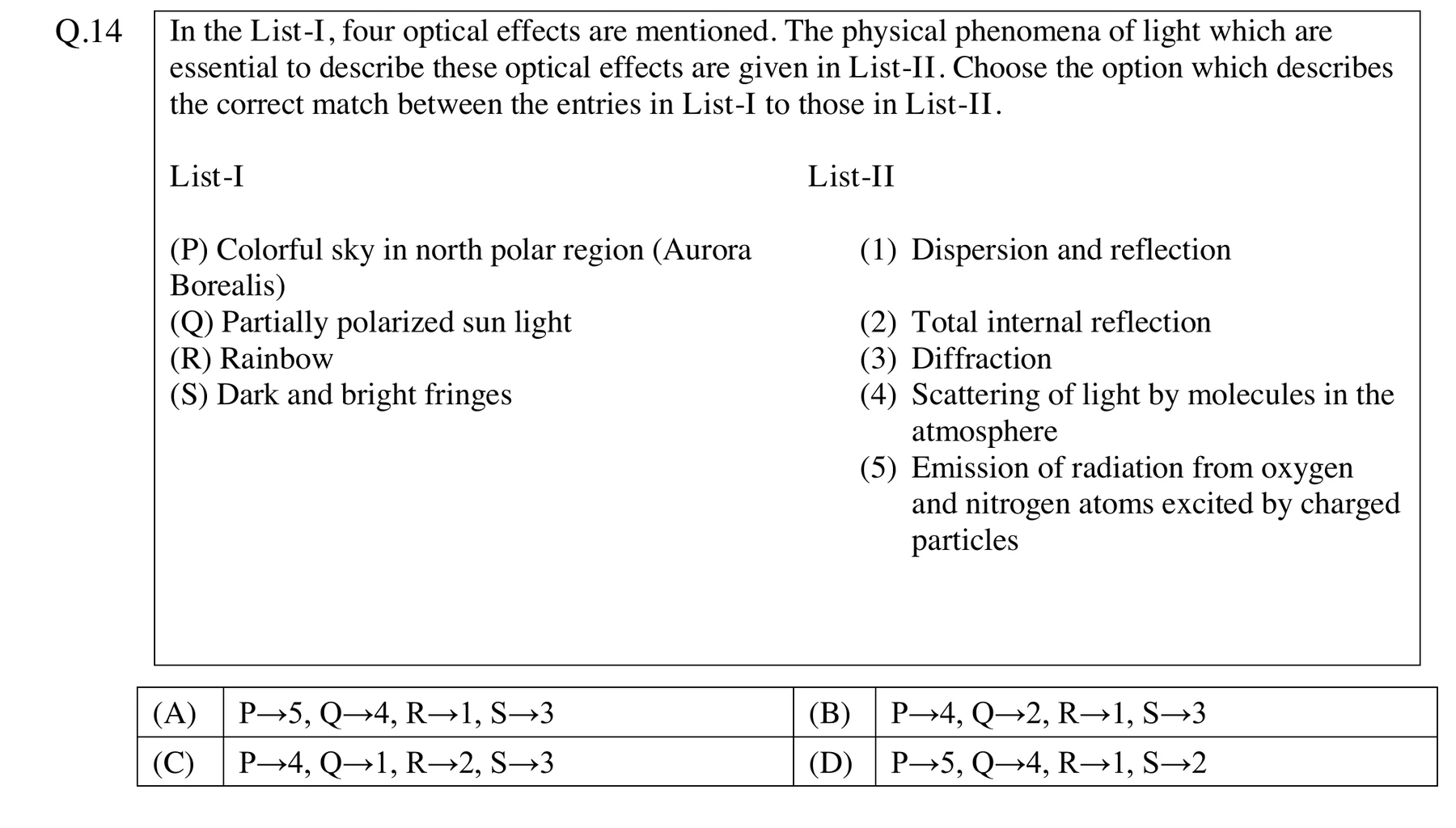
Match the optical effects in List I to the essential phenomena in List II.
Answer choices
- List I: P Aurora Borealis; Q partially polarized sunlight; R rainbow; S dark and bright fringes.
- List II: (1) dispersion and reflection; (2) total internal reflection; (3) diffraction; (4) atmospheric molecular scattering; (5) emission by oxygen and nitrogen excited by charged particles.
- A. P to 5, Q to 4, R to 1, S to 3
- B. P to 4, Q to 2, R to 1, S to 3
- C. P to 4, Q to 1, R to 2, S to 3
- D. P to 5, Q to 4, R to 1, S to 2
Watch the Question 14 video solution
Show the checked step-by-step solution
- Step 1: P: charged particles excite oxygen and nitrogen; their de-excitation emits auroral radiation, entry 5.
- Step 2: Q: molecular scattering in the atmosphere produces partially polarized sunlight, entry 4.
- Step 3: R: wavelength-dependent dispersion and internal reflection in water droplets produce a rainbow, entry 1.
- Step 4: S: diffraction redistributes light into alternating maxima and minima, producing bright and dark fringes, entry 3.
- Step 5: Therefore P->5, Q->4, R->1, S->3, which is option A.
Correct answer: Choice A: P to 5, Q to 4, R to 1, S to 3
Question 15 · Matching lists
Faraday induction in rotating loops crossing a half-plane magnetic field
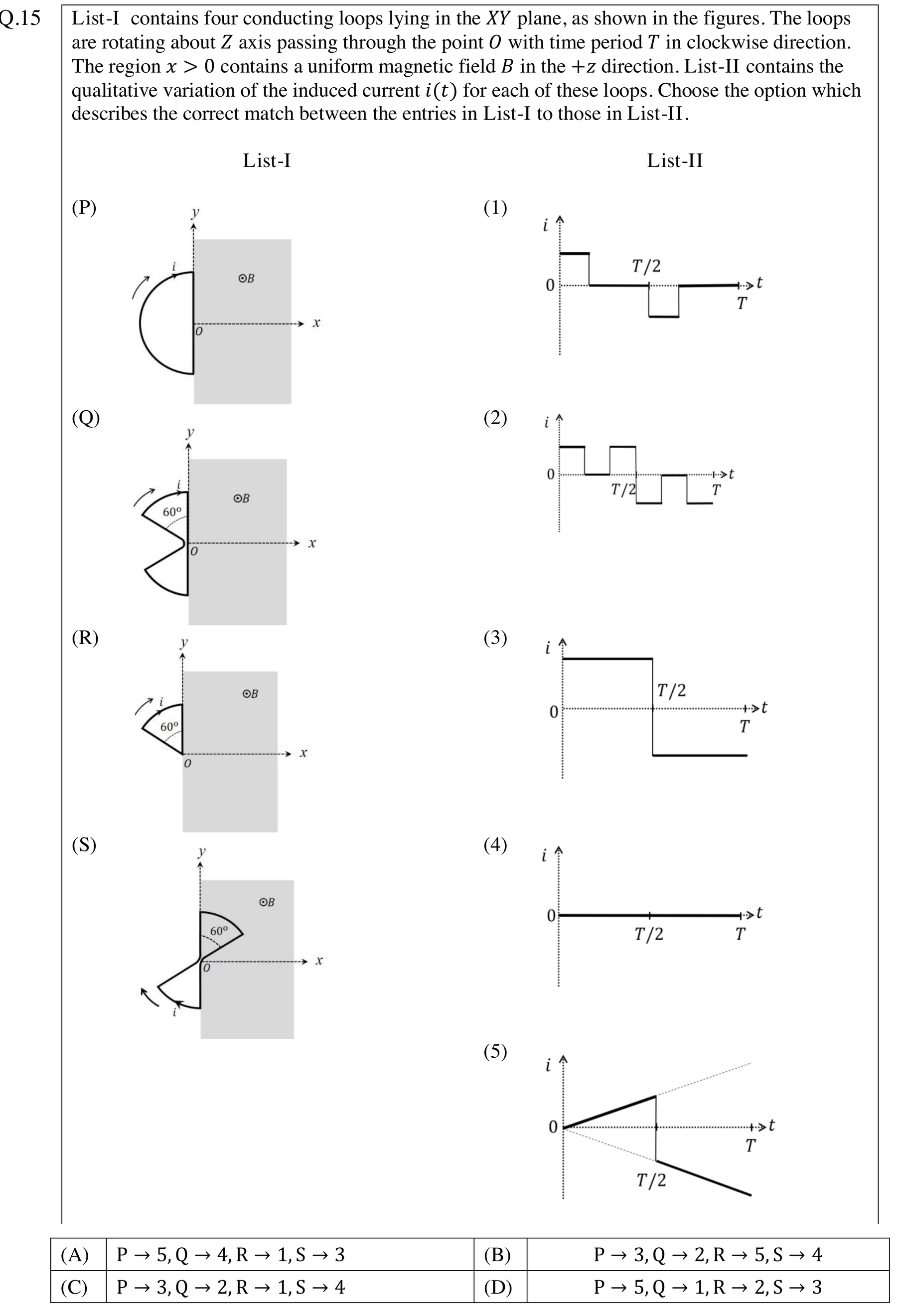
Four conducting loops in the xy-plane rotate clockwise about the z-axis through O with period T. A uniform magnetic field B in the +z direction occupies x > 0. Match loops P-Q-R-S to the five qualitative induced-current graphs. The exact loop shapes, current directions, angles, and graphs are preserved in the source image.
Answer choices
- A. P to 5, Q to 4, R to 1, S to 3
- B. P to 3, Q to 2, R to 5, S to 4
- C. P to 3, Q to 2, R to 1, S to 4
- D. P to 5, Q to 1, R to 2, S to 3
Watch the Question 15 video solution
Show the checked step-by-step solution
- Step 1: Magnetic flux is B times the signed loop area within x>0, because B is constant there and zero outside. Faraday law gives emf = -dPhi/dt; with fixed resistance, current follows the same derivative pattern with the arrow sign shown.
- Step 2: A circular sector of fixed radius sweeps area dA=(r^2/2)dtheta. With constant omega=2pi/T, current is constant while an arc crosses x=0 and zero during intervals of unchanged overlap.
- Step 3: P semicircle: over the first half-turn, overlap area grows linearly from zero to the semicircle area, then shrinks linearly over the second half. This gives equal positive and negative constant plateaus, graph 3.
- Step 4: Q two separated left-hand lobes: each lobe crosses the boundary in its own interval. The overlap grows in two separate intervals before the half-turn and falls in the corresponding two intervals afterward. This gives two positive and two negative rectangular pulses, graph 2.
- Step 5: R one 60-degree sector: overlap changes only while its curved wedge enters the field early in the rotation and exits during the corresponding interval after T/2; otherwise flux is constant. This gives graph 1.
- Step 6: S equal sectors on opposite sides of O: as one sector leaves x>0, the equal opposing sector enters; their flux changes cancel. Total occupied area and flux are constant, so i=0, graph 4.
- Step 7: Thus P->3, Q->2, R->1, S->4 is option C.
Correct answer: Choice C: P to 3, Q to 2, R to 1, S to 4
Question 16 · Matching lists
In-plane moment of inertia of rod frames
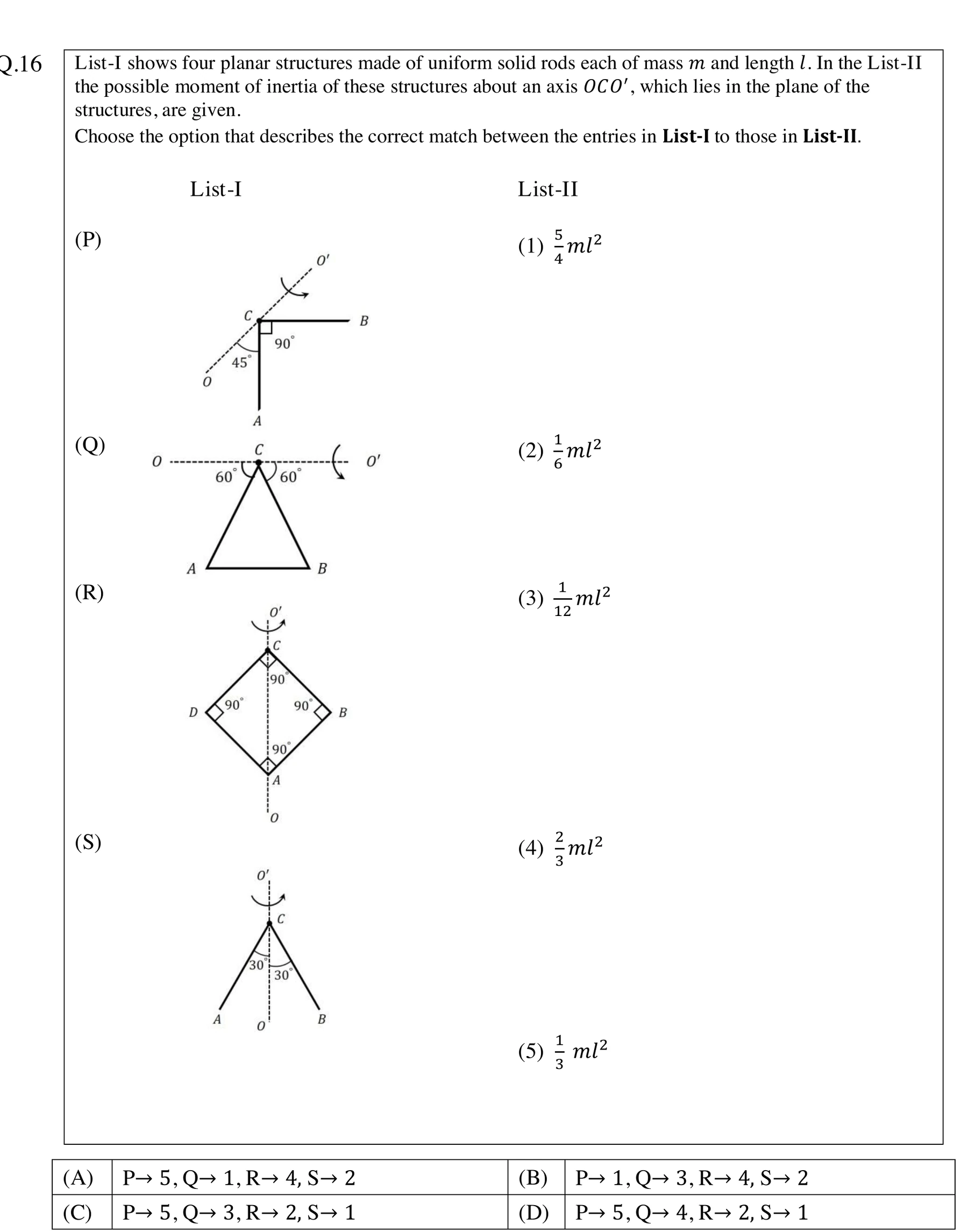
Four planar structures are made of uniform solid rods, each of mass m and length l. Match each structure's moment of inertia about the in-plane axis OCO-prime to List II. The exact rod arrangements and axes are preserved in the source image.
Answer choices
- List II: (1) 5ml squared/4; (2) ml squared/6; (3) ml squared/12; (4) 2ml squared/3; (5) ml squared/3.
- A. P to 5, Q to 1, R to 4, S to 2
- B. P to 1, Q to 3, R to 4, S to 2
- C. P to 5, Q to 3, R to 2, S to 1
- D. P to 5, Q to 4, R to 2, S to 1
Watch the Question 16 video solution
Show the checked step-by-step solution
- Step 1: For a rod of mass m and length l joined to an axis at one end and making angle theta with it, I = integral (s sin theta)^2 dm = (m l^2/3) sin^2 theta.
- Step 2: P: two rods at 45 degrees: 2(m l^2/3)(1/2) = (1/3)m l^2, entry 5.
- Step 3: Q: two sloping rods at 60 degrees give 2(m l^2/3)(3/4) = (1/2)m l^2. The horizontal base is a fixed distance (sqrt(3)/2)l from the axis, contributing m(3l^2/4). Total (5/4)m l^2, entry 1.
- Step 4: R: on the two sides leaving C, perpendicular distance from diagonal CA rises from 0 to l/sqrt(2); on the two sides approaching A, it falls from l/sqrt(2) to 0. Each side has the same integral and contributes (1/6)m l^2, total (2/3)m l^2, entry 4.
- Step 5: S: two rods at 30 degrees: 2(m l^2/3)(1/4) = (1/6)m l^2, entry 2.
- Step 6: The complete mapping P->5, Q->1, R->4, S->2 is option A.
Correct answer: Choice A: P to 5, Q to 1, R to 4, S to 2
Build a study library around worked examples
A question page works best when students can attempt the problem, inspect the checked derivation, and then watch a visual explanation. Start with the Golpo AI exam-question workflow, learn how to turn a PDF into a video, and compare Canvas Compact and Expanded styles. These related guides also show how to build on-demand lesson videos with practice and place video companions beside written lessons.
Frequently asked questions
How did Golpo AI turn each IIT JEE Advanced question into a video lesson?
Each lesson began with one clean screenshot containing the full question and answer choices. Golpo read it aloud, solved the problem, explained the reasoning step by step with progressive illustrations and equations, and revealed the verified answer at the end.
What was Codex’s role?
Codex served as Golpo’s QA collaborator. It prepared the answer-key-free question image, checked Golpo’s draft reasoning and final choice against the supplied provisional key, requested corrections when needed, and audited the finished video before publication.
Where can I watch the IIT JEE Advanced 2026 Physics playlist?
Open the IIT JEE Advanced 2026 Physics YouTube playlist ↗. The same approved videos also appear beside their questions below.
Does this guide cover every Physics question in IIT JEE Advanced 2026 Paper 1?
Yes. It includes all 16 Physics questions across the single-correct, multiple-correct, numerical-value, and matching-list sections.
Are these answers based only on the provisional key?
No. Each written solution was derived independently and then checked against the supplied provisional answer key. The guide identifies accepted ranges for numerical-value questions and preserves the source's A-or-B treatment for Question 4.
Why is Question 5's video still pending?
Fifteen playback-verified public Physics lessons are embedded below. Question 5 remains withheld while its corrected horizontal render is completed and independently checked.
How were the Golpo AI question videos produced?
Golpo solves each problem, returns the first step-by-step script for review, and creates the narrated progressive Canvas lesson. Codex collaborates by preparing the answer-key-free source image, checking and revising Golpo's returned script against the supplied answer choice, authorizing the render, and auditing the finished MP4.
Can I use this page instead of the official JEE Advanced materials?
Use this as a study companion. The source supplied for this project is a provisional question paper and key; candidates should rely on the official JEE Advanced website for final notices and official results.
Source note: This guide is a study companion based on the supplied provisional paper and key. Check the official JEE Advanced website for final notices, official keys, and results.
Tags


