How Physical Therapy Practices Can Create Rehabilitation Videos from Protocols
See four document-generated Golpo videos for a knee program, walker and stairs sequence, shoulder precautions, and the rehabilitation roadmap.

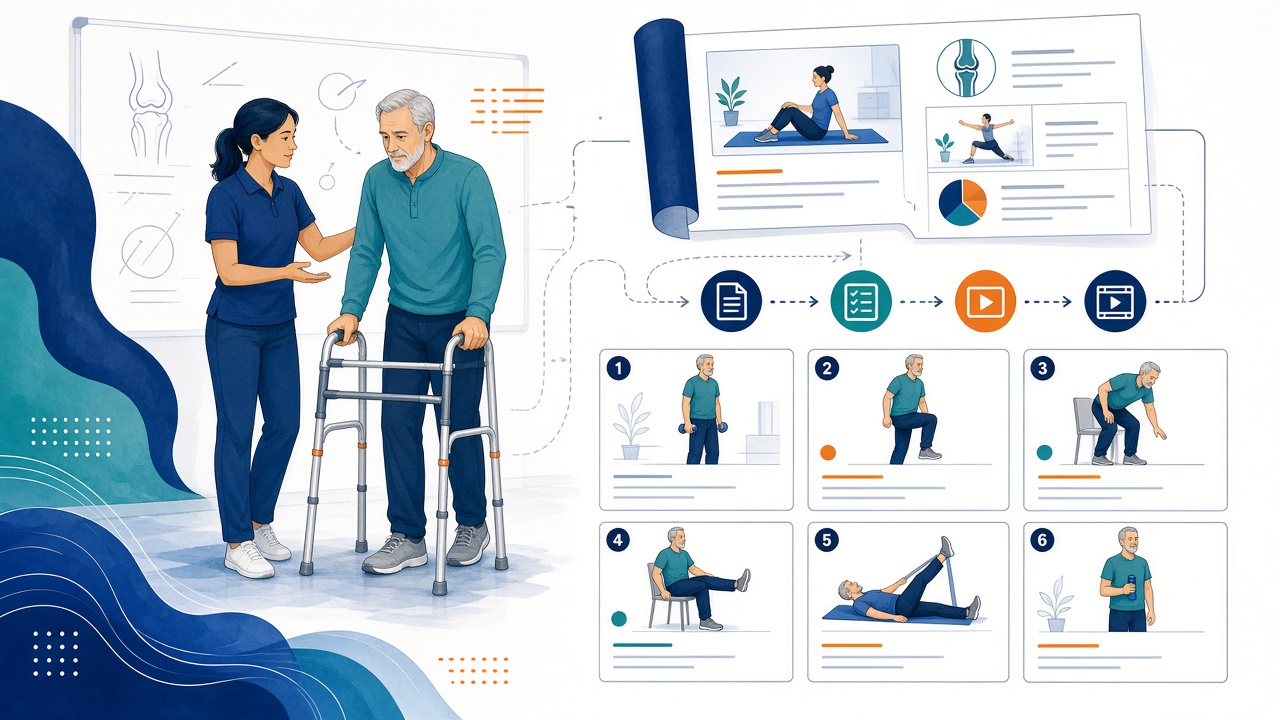
The direct answer: Build a versioned visual companion to the protocol the therapist selected, so the patient can replay the sequence without turning a generic video library into a treatment plan.
This guide is for physical therapy, occupational therapy, rehabilitation, orthopaedic, and home-exercise program teams. It contains four real Golpo videos. Each was generated from the source PDF or PowerPoint shown beside it. No narration script was supplied.
The business problem
- Paper handouts make sequencing and body position difficult to reconstruct at home.
- Generic exercise videos can conflict with procedure-specific phases, restrictions, and progression criteria.
- Protocols change, yet bookmarked videos and old portal links can remain accessible.
- A video cannot observe technique, symptoms, environment, or whether progression is appropriate.
The persuasive asset is not a generic AI video. It is a controlled pair: the exact operational document and a short visual explanation that can be checked against it. Buyers can inspect the source, the brief, the resulting narration, and the final scenes rather than trusting a claim about automation.
Four real document-to-video examples
| Example | Engine | Style | Length |
|---|---|---|---|
| Your First Two Weeks of Knee Rehabilitation | Golpo Canvas | Illustration (Expanded) | 2:11 |
| Walker Fit and Stair Sequence | Golpo Sketch | Classic with Words | 1:54 |
| Protecting a Shoulder After Repair | Golpo Canvas | Editorial (Compact) | 2:07 |
| The Rehabilitation Roadmap | Golpo Canvas | Editorial (Expanded) | 2:21 |
Example 1 · Document → video · Golpo Canvas · Illustration (Expanded) · 2:11
Your First Two Weeks of Knee Rehabilitation
Purpose: Explain the phase-one home program, exercise order, repetitions, walking plan, symptom rules, and progression gate.
Open the MP4 · 2:11
Source PDF: Rehab Knee Home Program
No script was supplied. Golpo wrote the narration from the uploaded document.
Exact production brief
Build this video entirely from the attached document. Title it: Your First Two Weeks of Knee Rehabilitation. Explain the phase-one home program, exercise order, repetitions, walking plan, symptom rules, and progression gate. Write the narration yourself from the attached document. No narration script has been supplied. Do not introduce any fact, figure, date, name, instruction, recommendation, legal conclusion, clinical interpretation, benefit, or outcome that is not in the document. Do not soften or strengthen its wording. The document is a clearly labelled fictional specimen, so describe its organizations, people, identifiers, and values as illustrative rather than real.
Exact visual direction
Use a day-by-day timeline and demonstrate only the positions pictured in the protocol. Do not invent an exercise or progression. FIGURE LOCK: every number, date, identifier, threshold, amount, dose, score, time, temperature, visit window, phone number, and code shown or spoken must be copied from the attached document. Never invent a placeholder or rounded value.
Boundary: The treating clinician selects the applicable plan and must assess technique, symptoms, environment, and progression.
Example 2 · Document → video · Golpo Sketch · Classic with Words · 1:54
Walker Fit and Stair Sequence
Purpose: Explain walker height checks, sit-to-stand sequence, level walking, curb sequence, and stair wording.
Open the MP4 · 1:54
Source PDF: Rehab Walker Stairs Guide
No script was supplied. Golpo wrote the narration from the uploaded document.
Exact production brief
Build this video entirely from the attached document. Title it: Walker Fit and Stair Sequence. Explain walker height checks, sit-to-stand sequence, level walking, curb sequence, and stair wording. Write the narration yourself from the attached document. No narration script has been supplied. Do not introduce any fact, figure, date, name, instruction, recommendation, legal conclusion, clinical interpretation, benefit, or outcome that is not in the document. Do not soften or strengthen its wording. The document is a clearly labelled fictional specimen, so describe its organizations, people, identifiers, and values as illustrative rather than real.
Exact visual direction
Use large words for UP and DOWN and preserve the guide's exact sequencing mnemonics. Never imply unsupervised practice is appropriate. FIGURE LOCK: every number, date, identifier, threshold, amount, dose, score, time, temperature, visit window, phone number, and code shown or spoken must be copied from the attached document. Never invent a placeholder or rounded value. Render a few large key words and short labels inside the drawing in every scene, the way the Classic with Words treatment does.
Boundary: The treating clinician selects the applicable plan and must assess technique, symptoms, environment, and progression.
Example 3 · Document → video · Golpo Canvas · Editorial (Compact) · 2:07
Protecting a Shoulder After Repair
Purpose: Explain sling setup, allowed daily activities, prohibited movements, home setup, and the red/yellow/green contact matrix.
Open the MP4 · 2:07
Source PDF: Rehab Shoulder Precautions
No script was supplied. Golpo wrote the narration from the uploaded document.
Exact production brief
Build this video entirely from the attached document. Title it: Protecting a Shoulder After Repair. Explain sling setup, allowed daily activities, prohibited movements, home setup, and the red/yellow/green contact matrix. Write the narration yourself from the attached document. No narration script has been supplied. Do not introduce any fact, figure, date, name, instruction, recommendation, legal conclusion, clinical interpretation, benefit, or outcome that is not in the document. Do not soften or strengthen its wording. The document is a clearly labelled fictional specimen, so describe its organizations, people, identifiers, and values as illustrative rather than real.
Exact visual direction
Contrast allowed and not-yet-allowed movements without showing a prohibited movement as a demonstration. FIGURE LOCK: every number, date, identifier, threshold, amount, dose, score, time, temperature, visit window, phone number, and code shown or spoken must be copied from the attached document. Never invent a placeholder or rounded value.
Boundary: The treating clinician selects the applicable plan and must assess technique, symptoms, environment, and progression.
Example 4 · Document → video · Golpo Canvas · Editorial (Expanded) · 2:21
The Rehabilitation Roadmap
Purpose: Turn the care-team deck into a patient roadmap covering evaluation, goals, visit cadence, home practice, reassessment, and discharge.
Open the MP4 · 2:21
Source PowerPoint deck: Rehab Plan Of Care Roadmap
No script was supplied. Golpo wrote the narration from the uploaded document.
Exact production brief
Build this video entirely from the attached document. Title it: The Rehabilitation Roadmap. Turn the care-team deck into a patient roadmap covering evaluation, goals, visit cadence, home practice, reassessment, and discharge. Write the narration yourself from the attached document. No narration script has been supplied. Do not introduce any fact, figure, date, name, instruction, recommendation, legal conclusion, clinical interpretation, benefit, or outcome that is not in the document. Do not soften or strengthen its wording. The document is a clearly labelled fictional specimen, so describe its organizations, people, identifiers, and values as illustrative rather than real.
Exact visual direction
Build a six-stage path and show where measurements and shared decisions happen. Do not promise a recovery date. FIGURE LOCK: every number, date, identifier, threshold, amount, dose, score, time, temperature, visit window, phone number, and code shown or spoken must be copied from the attached document. Never invent a placeholder or rounded value.
Boundary: The treating clinician selects the applicable plan and must assess technique, symptoms, environment, and progression.
A protocol library that remains in version sync
- Separate content by protocol, phase, procedure, and revision rather than by broad body part.
- Generate each video from its approved protocol or home-program document.
- Require a therapist to compare every depicted position, repetition, restriction, and progression gate with the source.
- Publish the protocol identifier and review date; retire superseded videos and links.
- Use analytics as a prompt for follow-up, never as proof that an exercise was performed safely.
Where API or MCP adds scale
Use API or MCP after the source templates and review gates are stable. A safe workflow identifies the approved document revision, uploads that artifact, generates a draft, compares scenes and narration with the source, routes exceptions to the named owner, publishes the approved MP4 and source together, and withdraws both when the source is superseded. Automation should accelerate a governed queue—not remove human review.
Publication boundaries
- The treating clinician's plan and current protocol control; the video is not an independent exercise prescription.
- Hands-on skills and assistive-device use require competency assessment where the care team specifies it.
- Never infer readiness to progress from watch history or elapsed time.
Review additions, meaning-changing omissions, sequence, numeric fidelity, visual implication, accessibility, source revision, and destination links. If the video and document disagree, the video does not publish.
Evidence and further reading
- APTA Guide to Physical Therapist Practice
- AHRQ PEMAT for audiovisual materials
- CDC STEADI patient and provider resources
Frequently asked questions
Can Golpo demonstrate exercises from a PDF?
It can turn the document into a visual draft, but a qualified therapist must verify every depicted position and instruction.
Can a video replace an in-person demonstration?
No. It is a replayable supplement and cannot assess technique, pain, balance, environment, or readiness.
How should protocols be versioned?
Give each source and video the same protocol ID, phase, effective date, and owner, then remove superseded links.
Can we make one video for every patient?
A library can cover approved protocols, while the treating clinician still selects what applies and documents any individual change.
What if the document and video disagree?
Stop publication. The source controls, and the video must be corrected or regenerated.
What should a rehabilitation pilot measure?
Track source-to-scene defects, patient questions, viewing completion, accessibility, and staff time; do not promise recovery or adherence.
Build the first controlled pilot
Choose one protocol phase with frequent sequencing questions and validate the first render against the therapist's source line by line.
Continue through the document-to-video healthcare cluster
- How Pharmacies Can Turn Medication Documents into Patient Videos
- Behavioral Health Intake and Consent Videos from Approved Documents
- Home Health and Hospice Caregiver Videos from Care Documents
- Medical Billing and RCM Explainer Videos from Patient Documents
- Clinical Trial Consent and Participant Videos from Approved Documents
- Insurance EOB, policy, claim, and renewal videos
- Doctor-clinic patient education videos
- Automate video generation with the Golpo API
- Create Golpo videos through MCP
Tags


