School District Family Communications That Explain the Decision
Two real document-to-video examples show how districts can explain weather operations and transportation changes accurately across schools.

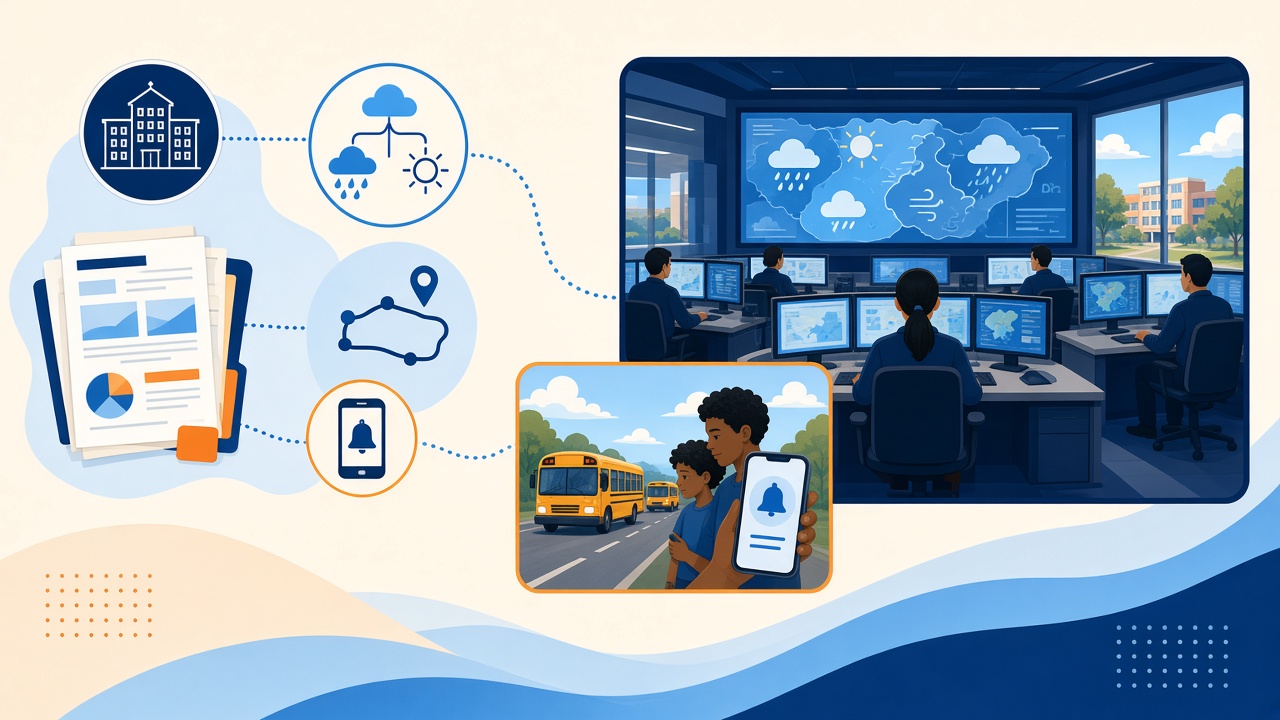
The direct answer: Turn an operations matrix or route-change brief into a family explanation that shows what changes, what does not, and where the next official update will appear.
This guide is for district communications, transportation, operations, emergency management, superintendent, and family-engagement teams. Both videos below are real Golpo renders generated from the source documents linked beside them. No narration script was supplied.
Why readers stay confused
The document exists. The explanation does not.
- A weather alert is an input to a district decision, not automatically a closure.
- Route changes involve stops, times, accessibility, school schedules, contractor dependencies, and multiple notification channels.
- A short social post cannot explain the operational sequence, while the full internal matrix is difficult for families to decode.
- District-wide scale magnifies one wrong time or stale route across every channel.
“At district scale, clarity is not more messaging. It is one reviewed explanation reused everywhere.”
Two documents. Two very different jobs.
The first video gets the larger stage because it explains the broad mental model. The companion is intentionally smaller and more task-specific—the way a useful institutional video library should work.
Companion example · smaller, sharper, task-specific
When a Bus Route Changes
Explain the temporary route change, affected stops, effective dates, family actions, accessibility requests, and help routes.
Open the source PDF · No narration script was supplied.
Production brief and visual controls
Build this video entirely from the attached document. Title it: When a Bus Route Changes. Explain the temporary route change, affected stops, effective dates, family actions, accessibility requests, and help routes. Write the narration yourself from the attached document; no narration script is supplied. Do not introduce any fact, figure, date, name, instruction, policy, right, deadline, recommendation, promise, or outcome not in the document. Treat the people, institution, identifiers, and values as the document's own facts. Never call the document a sample, demo, fictional, synthetic, illustrative, or an example.

VISUAL DIRECTION
Animate the old and temporary route side by side. Use only the stops, dates, and times in the brief. FIGURE LOCK: every number, date, time, code, fee, threshold, window, phone number, status, and identifier shown or spoken must come from the attached document. Do not invent placeholder values.
From approved document to governed video
- Convert the approved operations artifact into a family-facing source brief.
- Generate one master video and route it through operations and communications review.
- Use API variants only for fields that are controlled in the source: school, route, date, and language.
- Publish the video with the official alert and accessible text alternative.
- Expire temporary videos when the effective window ends.
Where API or MCP helps
Scale begins only after the source template and review gate are stable. API or MCP can upload the current artifact, request a draft, route it for source-to-scene review, publish the approved MP4 with the source, and withdraw the pair when that source is superseded. Automation should multiply reviewed institutional truth—not multiply prompts.
What the video must never decide
- Live emergency instructions and current district alerts always control.
- Do not present a forecast, watch, or warning as a district decision.
- Transportation videos must preserve accessibility and individual-routing contact paths.
Evidence and governing references
- Federal Guide for School Emergency Operations Plans
- National Weather Service winter weather guidance
- NHTSA school bus safety
Frequently asked questions
Can a district automate videos for every school?
Yes, after the template and source fields are controlled. Each variant still needs accurate school, route, date, and review data.
Should the video announce the closure?
The official alert does that. The video explains the approved decision and operational consequences.
Can a forecast be narrated as a closure trigger?
Only according to the district's own reviewed matrix; weather products are inputs, not school decisions.
How should temporary videos expire?
Publish with an effective window, remove them from evergreen libraries, and retain the approved record.
What should the district measure?
Measure defects, family comprehension questions, notification reach, accessibility, and staff time—not safety outcomes without evidence.
Start with one document people already ask about
Pilot a temporary route change where every stop, time, owner, and expiration date can be audited.
Continue through the Education operations series
- Turn the K–12 Family Handbook into Parent Orientation Videos
- College Student-Services Videos for Degree Audits and Registration Holds
- University Admissions Videos from Application and Enrollment Documents
- Financial Aid Videos That Explain the Offer Without Giving Advice
- Turn teacher lesson notes into whiteboard videos
- Build a classroom video library from lesson plans
- Automate document-to-video production with the Golpo API
Tags


