Campus Reporting and Student Conduct Videos from Current Policy
Two neutral document-grounded videos explain campus reporting options and the student-conduct process without choosing a route or predicting an outcome.

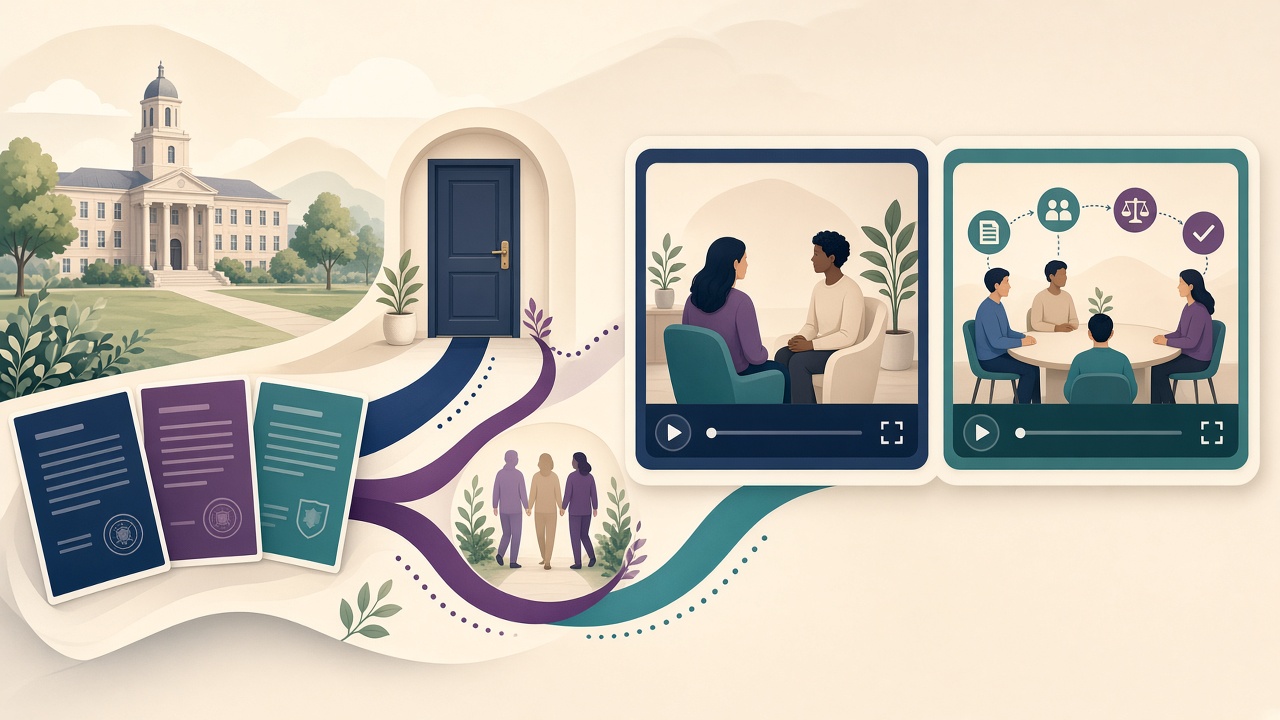
The direct answer: Make options and process visible without using a marketing narrator to tell someone what to report, where to go, whether a policy was violated, or how a case will end.
This guide is for student affairs, campus safety, Title IX, confidential-resource, conduct, legal, communications, and orientation teams. Both videos below are real Golpo renders generated from the source documents linked beside them. No narration script was supplied.
Why readers stay confused
The document exists. The explanation does not.
- Emergency, confidential, formal, anonymous, supportive-measure, and outside options have different purposes and limits.
- Students may not know which employees can maintain confidentiality.
- Conduct stages are hard to understand when notice, meeting, information review, resolution, outcome, and appeal live in separate policy sections.
- Regulations and institutional procedures change, making evergreen summaries risky.
“Neutrality is a design feature: show the options, preserve their limits, and let the person choose.”
Two documents. Two very different jobs.
The first video gets the larger stage because it explains the broad mental model. The companion is intentionally smaller and more task-specific—the way a useful institutional video library should work.
Companion example · smaller, sharper, task-specific
How the Student Conduct Process Works
Explain notice, meeting, information review, resolution paths, outcome notice, appeal, records, and support persons.
Open the source PDF · No narration script was supplied.
Production brief and visual controls
Build this video entirely from the attached document. Title it: How the Student Conduct Process Works. Explain notice, meeting, information review, resolution paths, outcome notice, appeal, records, and support persons. Write the narration yourself from the attached document; no narration script is supplied. Do not introduce any fact, figure, date, name, instruction, policy, right, deadline, recommendation, promise, or outcome not in the document. Treat the people, institution, identifiers, and values as the document's own facts. Never call the document a sample, demo, fictional, synthetic, illustrative, or an example.

VISUAL DIRECTION
Build a neutral process timeline. Never imply guilt, innocence, a fixed sanction, or a guaranteed outcome. FIGURE LOCK: every number, date, time, code, fee, threshold, window, phone number, status, and identifier shown or spoken must come from the attached document. Do not invent placeholder values.
From approved document to governed video
- Generate the options video from the current resource guide and conduct video from the current procedure.
- Keep emergency routing visually separate and first.
- Verify confidentiality limits, roles, stages, notices, timelines, and appeal grounds.
- Review with legal, Title IX, conduct, confidential resources, accessibility, and trauma-informed practice owners.
- Publish with current policy links and remove superseded videos immediately.
Where API or MCP helps
Scale begins only after the source template and review gate are stable. API or MCP can upload the current artifact, request a draft, route it for source-to-scene review, publish the approved MP4 with the source, and withdraw the pair when that source is superseded. Automation should multiply reviewed institutional truth—not multiply prompts.
What the video must never decide
- The video does not give legal advice, determine a violation, choose a reporting route, promise confidentiality, or predict an outcome.
- Emergency services and live campus directions control urgent situations.
- Current institutional policy and applicable law control; article language must avoid asserting superseded Title IX rules.
Evidence and governing references
Frequently asked questions
Can the video tell someone which reporting option to choose?
No. It explains the institution's documented options and limits while preserving individual choice.
Can it promise confidentiality?
No. It must state the current source's role-specific confidentiality and disclosure limits accurately.
Can the conduct video imply guilt?
No. It neutrally explains stages, roles, information review, notices, and appeal without predicting findings or sanctions.
Why must these videos be versioned closely?
Institutional policy and applicable law can change; stale procedural media can misdirect people.
Should emergency information be included?
Yes only as the current source states it, visually separate and subordinate to live emergency services and campus direction.
Start with one document people already ask about
Start with the reporting-options guide and have every office confirm how its role is depicted before publication.
Continue through the Education operations series
- Turn the K–12 Family Handbook into Parent Orientation Videos
- School District Family Communications That Explain the Decision
- College Student-Services Videos for Degree Audits and Registration Holds
- University Admissions Videos from Application and Enrollment Documents
- Turn teacher lesson notes into whiteboard videos
- Build a classroom video library from lesson plans
- Automate document-to-video production with the Golpo API
Tags


