Senior Living Family Communication Videos from Community Documents
See four document-generated videos for move-in week, family updates, service-plan conferences, and emergency preparedness.

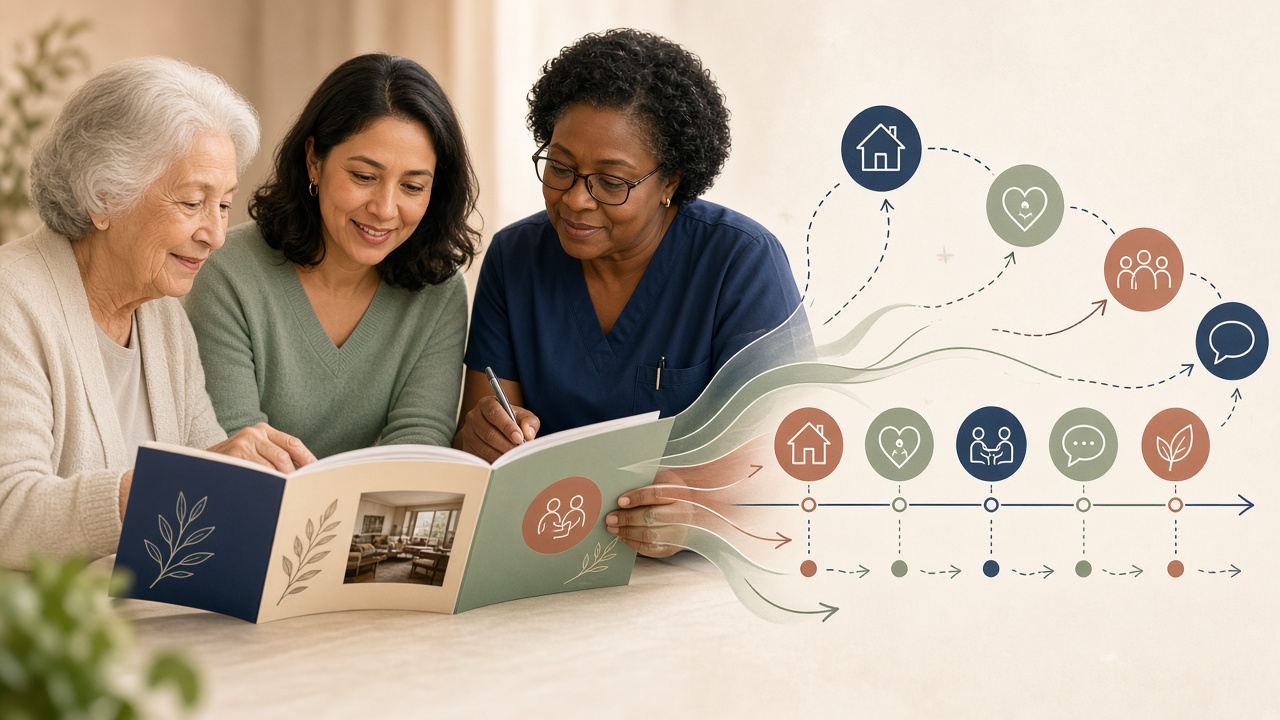
The direct answer: Explain operator-owned processes to the family member who may be remote from the resident—without drifting into insurance, clinical decisions, or promises about level of care.
This guide is for senior-living communities, assisted-living operators, long-term-care organizations, resident services, and family-engagement teams. It contains four real Golpo videos. Each was generated from the source PDF or PowerPoint shown beside it. No narration script was supplied.
The business problem
- The person reading the document is often a remote family member rather than the resident receiving services.
- Move-in, authorized contacts, belongings, medication handoff, service planning, and emergency communication involve different owners and deadlines.
- Incomplete or unclear transfer and discharge communication has a regulatory and trust surface.
- A generic family update can violate authorization boundaries or imply a care decision.
The persuasive asset is not a generic AI video. It is a controlled pair: the exact operational document and a short visual explanation that can be checked against it. Buyers can inspect the source, the brief, the resulting narration, and the final scenes rather than trusting a claim about automation.
Four real document-to-video examples
| Example | Engine | Style | Length |
|---|---|---|---|
| The Move-In Week Roadmap | Golpo Canvas | Illustration (Expanded) | 2:05 |
| How Families Receive Updates | Golpo Canvas | Editorial (Compact) | 2:07 |
| Preparing for a Service Plan Conference | Golpo Sketch | Classic with Words | 1:42 |
| How the Community Prepares for Emergencies | Golpo Canvas | Editorial (Expanded) | 2:24 |
Example 1 · Document → video · Golpo Canvas · Illustration (Expanded) · 2:05
The Move-In Week Roadmap
Purpose: Explain documents, room setup, medication handoff, belongings inventory, dining, orientation, and first care conference.
Open the MP4 · 2:05
Source PDF: Senior Living Move In Guide
No script was supplied. Golpo wrote the narration from the uploaded document.
Exact production brief
Build this video entirely from the attached document. Title it: The Move-In Week Roadmap. Explain documents, room setup, medication handoff, belongings inventory, dining, orientation, and first care conference. Write the narration yourself from the attached document. No narration script has been supplied. Do not introduce any fact, figure, date, name, instruction, recommendation, legal conclusion, clinical interpretation, benefit, or outcome that is not in the document. Do not soften or strengthen its wording. The document is a clearly labelled fictional specimen, so describe its organizations, people, identifiers, and values as illustrative rather than real.
Exact visual direction
Build a seven-day timeline using the guide's owners and deadlines. Do not imply a level of care. FIGURE LOCK: every number, date, identifier, threshold, amount, dose, score, time, temperature, visit window, phone number, and code shown or spoken must be copied from the attached document. Never invent a placeholder or rounded value.
Boundary: The video does not change a service plan, authorize disclosure, or replace a required notice.
Example 2 · Document → video · Golpo Canvas · Editorial (Compact) · 2:07
How Families Receive Updates
Purpose: Explain routine updates, portal messages, change-in-condition calls, consent, contacts, escalation, and response windows.
Open the MP4 · 2:07
Source PDF: Senior Living Family Communication
No script was supplied. Golpo wrote the narration from the uploaded document.
Exact production brief
Build this video entirely from the attached document. Title it: How Families Receive Updates. Explain routine updates, portal messages, change-in-condition calls, consent, contacts, escalation, and response windows. Write the narration yourself from the attached document. No narration script has been supplied. Do not introduce any fact, figure, date, name, instruction, recommendation, legal conclusion, clinical interpretation, benefit, or outcome that is not in the document. Do not soften or strengthen its wording. The document is a clearly labelled fictional specimen, so describe its organizations, people, identifiers, and values as illustrative rather than real.
Exact visual direction
Use a channel-routing map and preserve privacy/authorized-contact boundaries exactly. FIGURE LOCK: every number, date, identifier, threshold, amount, dose, score, time, temperature, visit window, phone number, and code shown or spoken must be copied from the attached document. Never invent a placeholder or rounded value.
Boundary: The video does not change a service plan, authorize disclosure, or replace a required notice.
Example 3 · Document → video · Golpo Sketch · Classic with Words · 1:42
Preparing for a Service Plan Conference
Purpose: Explain who attends, what data is reviewed, resident goals, decisions, unresolved questions, signatures, and follow-up.
Open the MP4 · 1:42
Source PDF: Senior Living Service Plan Conference
No script was supplied. Golpo wrote the narration from the uploaded document.
Exact production brief
Build this video entirely from the attached document. Title it: Preparing for a Service Plan Conference. Explain who attends, what data is reviewed, resident goals, decisions, unresolved questions, signatures, and follow-up. Write the narration yourself from the attached document. No narration script has been supplied. Do not introduce any fact, figure, date, name, instruction, recommendation, legal conclusion, clinical interpretation, benefit, or outcome that is not in the document. Do not soften or strengthen its wording. The document is a clearly labelled fictional specimen, so describe its organizations, people, identifiers, and values as illustrative rather than real.
Exact visual direction
Place the resident's goals in the center and use large labels for PREPARE, DISCUSS, DECIDE, and FOLLOW UP. FIGURE LOCK: every number, date, identifier, threshold, amount, dose, score, time, temperature, visit window, phone number, and code shown or spoken must be copied from the attached document. Never invent a placeholder or rounded value. Render a few large key words and short labels inside the drawing in every scene, the way the Classic with Words treatment does.
Boundary: The video does not change a service plan, authorize disclosure, or replace a required notice.
Example 4 · Document → video · Golpo Canvas · Editorial (Expanded) · 2:24
How the Community Prepares for Emergencies
Purpose: Turn the staff-and-family briefing into a resident-facing explanation of alerts, sheltering, evacuation, transport, medications, and reunification.
Open the MP4 · 2:24
Source PowerPoint deck: Senior Living Emergency Plan
No script was supplied. Golpo wrote the narration from the uploaded document.
Exact production brief
Build this video entirely from the attached document. Title it: How the Community Prepares for Emergencies. Turn the staff-and-family briefing into a resident-facing explanation of alerts, sheltering, evacuation, transport, medications, and reunification. Write the narration yourself from the attached document. No narration script has been supplied. Do not introduce any fact, figure, date, name, instruction, recommendation, legal conclusion, clinical interpretation, benefit, or outcome that is not in the document. Do not soften or strengthen its wording. The document is a clearly labelled fictional specimen, so describe its organizations, people, identifiers, and values as illustrative rather than real.
Exact visual direction
Use the deck's decision tree and role labels. Do not claim every emergency follows the same sequence. FIGURE LOCK: every number, date, identifier, threshold, amount, dose, score, time, temperature, visit window, phone number, and code shown or spoken must be copied from the attached document. Never invent a placeholder or rounded value.
Boundary: The video does not change a service plan, authorize disclosure, or replace a required notice.
A family-facing operational channel
- Choose operator-owned documents and define resident, family, and staff audiences separately.
- Generate move-in, communication, conference, or emergency orientation from the current document.
- Review roles, deadlines, contacts, privacy boundaries, and any implied care commitment.
- Publish to authorized audiences through the community's controlled channel.
- Keep insurance explanations on carrier-owned sources and clinical decisions in the care process.
Where API or MCP adds scale
Use API or MCP after the source templates and review gates are stable. A safe workflow identifies the approved document revision, uploads that artifact, generates a draft, compares scenes and narration with the source, routes exceptions to the named owner, publishes the approved MP4 and source together, and withdraws both when the source is superseded. Automation should accelerate a governed queue—not remove human review.
Publication boundaries
- The video does not assign a care level, change a service plan, authorize disclosure, or replace required notices.
- Consequential legal wording remains in the written agreement or notice.
- Emergency response varies by incident; the approved plan and live staff direction control.
Review additions, meaning-changing omissions, sequence, numeric fidelity, visual implication, accessibility, source revision, and destination links. If the video and document disagree, the video does not publish.
Evidence and further reading
Frequently asked questions
Is this another health-plan onboarding article?
No. This page covers care-operator documents and family operations; plan coverage remains with carrier-owned materials.
Can a family video replace a transfer or discharge notice?
No. Required notices and rights remain in the controlling documents and process.
How are privacy boundaries handled?
The source identifies authorized contacts and channels, and the final distribution workflow must enforce those boundaries.
Can the emergency video promise a fixed sequence?
No. It explains the approved framework while making clear that the incident and live direction determine action.
Can a service-plan conference video decide care?
No. It prepares participants for the documented process; decisions occur through the resident-centered conference and required approvals.
What is the first useful pilot?
Move-in week usually has clear tasks, owners, and deadlines that families repeatedly ask about.
Build the first controlled pilot
Start with move-in week, where a seven-day video timeline can remove uncertainty without making a clinical or contractual decision.
Continue through the document-to-video healthcare cluster
- How Pharmacies Can Turn Medication Documents into Patient Videos
- How Physical Therapy Practices Can Create Rehabilitation Videos from Protocols
- Behavioral Health Intake and Consent Videos from Approved Documents
- Home Health and Hospice Caregiver Videos from Care Documents
- Medical Billing and RCM Explainer Videos from Patient Documents
- Insurance EOB, policy, claim, and renewal videos
- Doctor-clinic patient education videos
- Automate video generation with the Golpo API
- Create Golpo videos through MCP
Tags


